
The silence came first.
Not the ordinary kind of silence that settles over a dinner table when people are busy chewing or waiting for someone else to speak, but the heavy, suffocating kind that drops into a room after someone says something so cruel that no one knows how to react.
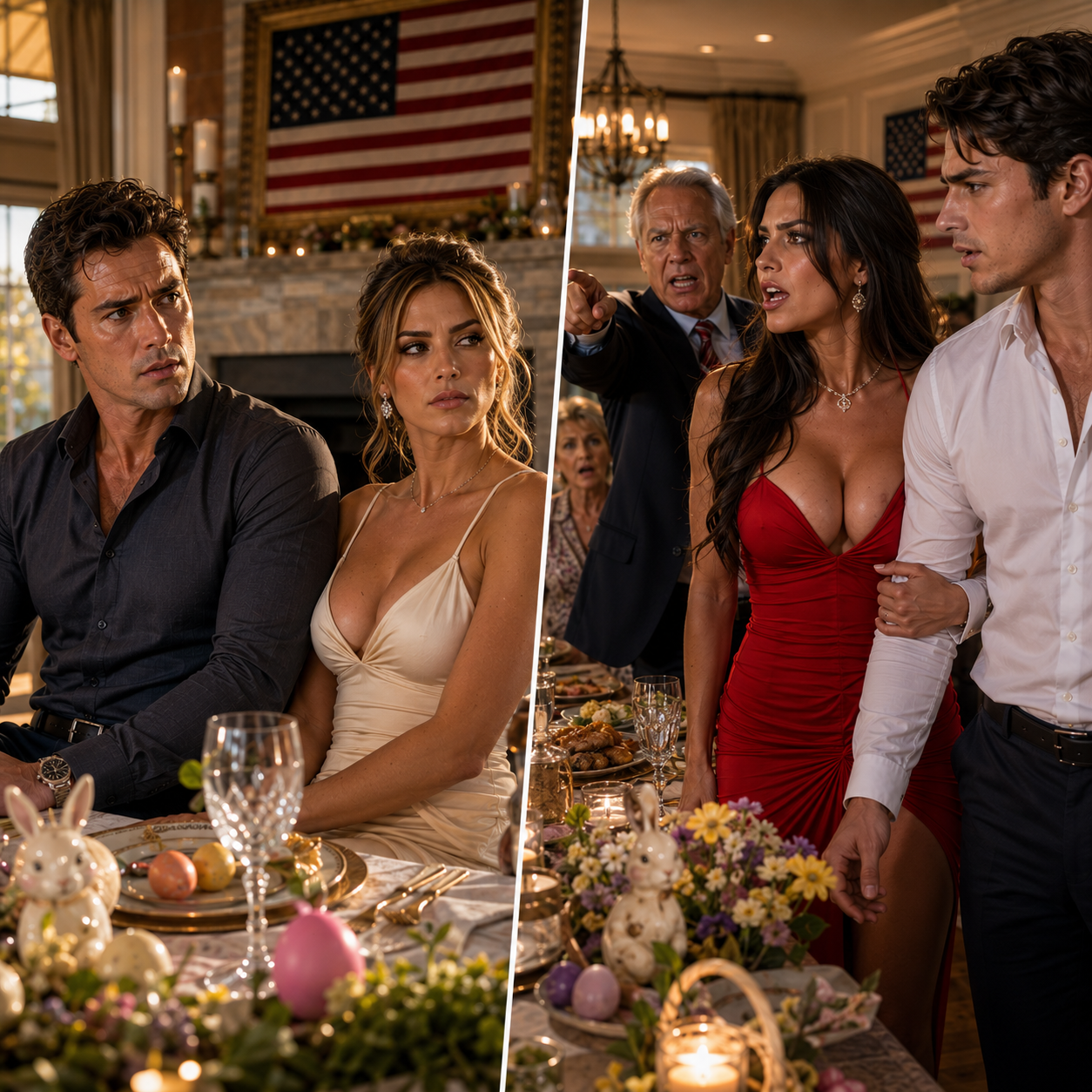
One second, Easter dinner was warm and alive. Plates were being passed, forks were scraping softly against china, my mother was smiling at the end of the table, and my wife Brooke was finally sitting down after spending two straight days cooking for everyone.
Then Vivien took one bite of Brooke’s food, lifted her chin like she was judging a competition no one had entered, and said loudly, “This is completely tasteless.”
The room froze.
My mother stopped with her fork halfway to her mouth. My cousin’s jaw went slack. My father, a man who had built his whole life around patience and quiet dignity, simply stared.
I felt heat rush up my neck. My hands clenched under the table. Brooke had cooked for two days. Two full days of planning, chopping, baking, seasoning, adjusting, tasting, cleaning, and trying to make Easter special for the family she loved as if it were her own blood.
And this woman, who had been dating my brother for barely five weeks, sat in my parents’ home and insulted her like she was nothing.
Before I could say a word, Brooke slowly placed her fork down.
She didn’t slam it. Didn’t raise her voice. Didn’t even blink.
She just looked Vivien directly in the eyes and said, calm as winter, “Honey, you can barely keep a man for three months. Don’t talk to me about taste.”
Nobody breathed.
I nearly choked trying not to laugh, even through my anger. My cousin looked like she wanted to stand up and applaud. Vivien’s face flushed a deep, furious red, and my brother Travis shot up from his chair so quickly the legs screeched against the floor.
“What did you just say to her?” he snapped.
Brooke leaned back with terrifying calm.
“You heard me.”
Vivien turned to him, eyes blazing, waiting for him to prove himself. And he did. In the worst possible way.
“We’re leaving,” Travis said.
I stared at him.
He was choosing her.
A woman he barely knew. A woman who had insulted our mother’s home, disrespected my wife, and poisoned the entire dinner table with one sentence.
Then my father stood.
My dad rarely raised his voice. He didn’t need to. He was the kind of man whose disappointment carried more weight than most people’s shouting. But when he spoke, his voice was low, cold, and filled with steel.
“If you walk out that door for her,” he said, “don’t bother coming back.”
That was the moment Easter dinner stopped being a family gathering and became a fracture none of us knew how to repair.
My name is Paul. I’m thirty-four years old, and to understand why that night destroyed us, you need to understand my brother.
Travis was the golden boy without officially being called the golden boy. My parents loved us both, but Travis had a way of making the world bend around him. Teachers liked him even when he skipped assignments. Girls adored him even when he broke their hearts. Friends forgave him after every stupid decision because Travis could smile, apologize, and somehow make people believe he had learned his lesson.
I was different.
I was the responsible son. The quiet one. The dependable one. The kid who helped Dad fix the sink on weekends while Travis was sneaking out. I got decent grades, took predictable jobs, paid bills on time, and never gave anyone a dramatic story to tell.
For years, I thought dependable meant boring.
Then I met Brooke.
I was twenty-two, half-asleep, and desperate for coffee when I walked into a small bakery near my college campus. Brooke stood behind the counter with flour dusted across one cheek and her hair twisted into a messy bun, arguing passionately with an older customer about why pumpkin pie was better than apple pie.
I pretended to study the muffin case just so I could keep listening to her.
Eventually, she caught me staring.
“You need help?” she asked, one eyebrow raised.
I panicked and said, “I’ll take whatever you recommend.”
Her smile turned wicked.
“That’s either very trusting or very stupid.”
I smiled back.
“Guess we’ll find out.”
That was the beginning of my real life.
Brooke wasn’t flashy. She didn’t need a room to revolve around her. She had a quiet strength, the kind that came from surviving hard things without becoming hard herself. She grew up poor, with a single mother who worked two jobs, and Brooke started helping with bills when she was sixteen. She fought her way through culinary school, restaurant apprenticeships, unpaid internships, brutal night shifts, and endless rejection without ever becoming bitter.
When we got married at twenty-seven, my parents loved her immediately.
My mother called her the daughter she never had.
My father respected her because she worked harder than almost anyone he knew and because she laughed at his terrible jokes even when they weren’t funny.
Brooke became family.
Not by marriage alone, but by showing up.
Every birthday cake. Every holiday dessert. Every time my mother needed help in the kitchen. Every time my father needed someone to taste-test a new barbecue experiment. Brooke was there.
Then there was Travis.
His relationship history was chaos disguised as romance. Every few months, he had a new soulmate, a new plan, a new woman he swore was different. Then came the breakup. Then came the dramatic calls. Then came another woman at another holiday.
At first, we laughed about it.
Then it became exhausting.
And then he brought Vivien to Easter.
He had only been dating her five weeks, which should have been warning enough. But my family tried to be kind. My mother hugged her. My father shook her hand. Brooke complimented her outfit.
Vivien responded by judging everything.
She looked around my parents’ warm, modest home and said, “This place is cute,” in a tone that made cute sound like poor.
My mother smiled awkwardly.
Then Vivien asked Brooke what she did.
“I’m a pastry chef,” Brooke said politely.
Vivien raised her eyebrows.
“Oh. That’s it?”
I felt Brooke stiffen beside me, but she stayed gracious.
“What do you do?” Brooke asked.
“Pharmaceutical sales,” Vivien replied, like she had just announced she was chairwoman of the Federal Reserve.
Then she laughed softly and said, “Well, at least baking is fun.”
Brooke’s smile tightened.
“It pays pretty well too.”
Vivien’s eyes narrowed.
That was the first spark.
Dinner itself started beautifully. My dad said grace. My mom passed the ham. Brooke’s homemade bread was still warm, the sweet potato casserole smelled incredible, and the coconut cake waiting in the kitchen looked like something from a magazine cover.
Then Vivien opened her mouth and set fire to everything.
After Travis left with her, nobody moved for a long time.
My mother cried silently. My father sat down with the exhausted weight of a man who had just watched his son become a stranger. Brooke tried to look composed, but I saw the hurt in her eyes. She had defended herself, yes, but the fact that she had needed to defend herself in the first place cut deeper than she wanted to admit.
That night, Travis texted me.
You should have defended me.
I stared at the screen, stunned by the audacity.
Defended him?
From what?
The consequences of his own cowardice?
I didn’t answer.
For the next week, everything in our family felt broken. My mother cried constantly. My father stopped mentioning Travis altogether. Brooke acted like she was fine, because that was Brooke’s instinct. When she was hurt, she worked harder, smiled softer, and tried not to burden anyone.
But I knew my wife.
I saw the way her face changed whenever Easter came up.
Then my mother called me crying.
“Vivien cheated on Travis,” she said.
I froze.
Apparently Travis had found messages. Explicit ones. Hotel reservations. Dates. Proof that Vivien had been seeing another man the entire time she was with him.
Even during Easter week.
While she sat at my parents’ table insulting my wife’s cooking, she had already been betraying my brother.
And Travis fell apart.
He called my parents. He called me. He even called Brooke.
None of us answered at first.
Not because we enjoyed his pain, but because heartbreak didn’t erase what he had done. Being betrayed didn’t automatically make him innocent. He had still chosen a woman who disrespected his family, and for the first time in his life, Travis had to sit alone with the consequences.
Around that same time, my own life changed.
My boss called me into his office and offered me a promotion. A real one. Higher salary, leadership role, new city, the kind of opportunity I had quietly worked toward for years without expecting applause.
When I told Brooke, she screamed and cried and jumped into my arms like I had just won the lottery.
“We’re getting our fresh start,” she said.
And we did.
We bought a house with a big kitchen and a yard. Brooke found a new position at an upscale restaurant. I started preparing for the move. For once, everything I had built quietly was finally becoming visible.
Then Travis called again.
This time, I answered.
“Paul,” he whispered, voice shattered, “I think I ruined my life.”
He didn’t sound like Travis.
The charm was gone. The performance was gone. All that remained was my younger brother, broken and ashamed.
I sat in my half-packed living room while Brooke wrapped dishes in newspaper beside me. When she saw my face, she knew immediately who it was.
I put him on speaker.
“I picked her over all of you,” Travis said.
Nobody spoke.
“I defended someone who embarrassed Mom,” he continued. “I let her disrespect Brooke. Dad looked at me like he didn’t even know me.”
His voice cracked.
“She cheated on me the whole time. And the worst part is, she wasn’t even trying that hard to hide it.”
Brooke stopped wrapping plates.
“She told someone I was temporary,” Travis whispered. “Temporary.”
That hurt to hear, even after everything.
I said quietly, “Nobody deserves betrayal.”
He started crying then.
Not sniffling. Not holding it together. Crying like a man who had finally reached the bottom of himself.
“I don’t know how to fix this,” he said.
I looked at Brooke.
She nodded.
“You start by fixing yourself,” I told him.
“What does that mean?”
“It means you stop chasing women who make you feel temporarily important.”
There was a long silence.
Then Travis said weakly, “That sounds like something Brooke would say.”
Brooke laughed softly.
“She probably would’ve said it nicer,” I said.
“No, she absolutely would not have,” Travis replied.
And for the first time in weeks, all three of us laughed.
It wasn’t forgiveness yet.
But it was a door opening.
Healing took time.
My father didn’t suddenly welcome Travis back. My mother wanted to, because mothers are built differently, but even she knew an apology had to come before reconciliation. Brooke was willing to move forward, but she had one condition.
“He needs to apologize for real,” she said. “Not because Vivien hurt him. Because he hurt us.”
She was right.
Thanksgiving became the test.
My mother wanted everyone together. Dad resisted. I resisted. Brooke was uncertain. But Mom finally said, “If families only gathered when things were perfect, nobody would ever eat together.”
So we went.
Walking into my parents’ house that Thanksgiving felt strange. The smells were familiar. The decorations were familiar. Football played softly in the living room like always.
But the air felt fragile.
Travis was already there.
Alone.
No girlfriend. No performance. No loud entrance.
Just Travis, standing in the living room looking nervous and older than before.
When he saw Brooke, he stood immediately.
The room quieted.
“Before we eat,” he said, “I need to say something.”
No one moved.
He looked directly at Brooke.
“I was wrong.”
Her face remained still.
“No excuses,” he continued. “Not Vivien. Not stress. Not anything. I failed you.”
His voice shook.
Then he looked at my mother.
“I failed you.”
Then Dad.
“I failed you.”
Then me.
“And I failed you too.”
Finally, he looked back at Brooke.
“You’ve done more for this family than I ever acknowledged. You made my birthday cakes every year. You helped Mom every holiday. You welcomed every terrible woman I dragged through that door.”
That got a few tearful laughs.
“And I repaid that by staying silent while someone disrespected you.”
His eyes filled.
“You deserved better from me.”
Brooke stared at him for a long moment.
Then she said, “Do you know what hurt most?”
He nodded, crying now.
“You made a stranger feel protected while making family feel disposable.”
Travis covered his face.
“That’s exactly what I did.”
Then Brooke walked over and hugged him.
My mother completely broke down. My father turned toward the TV like football had suddenly become the most fascinating thing on earth, but I saw his shoulders shaking.
That hug didn’t erase everything.
But it changed everything.
Dinner that night felt like family again. Messy, emotional, imperfect, but real.
Later, Travis and I sat on the porch swing like we used to when we were kids.
“You know,” he said, staring into the dark yard, “I always thought you were the boring brother.”
I laughed.
“Thanks.”
He smiled faintly.
“But you won.”
I frowned.
“This isn’t a competition.”
“It kind of is,” he said. “You built something real. I chased attention.”
That stayed with me.
Because for years, I had felt like the invisible son. The steady one. The predictable one. But maybe steady wasn’t boring. Maybe steady was the thing everyone eventually searched for after chaos burned them enough times.
“You didn’t lose,” I told him. “You just took a longer road.”
He smiled.
Then he surprised me.
“I enrolled in college.”
I turned to him.
“What?”
“Supply chain management,” he said, almost shyly. “I want stability.”
And for the first time in a long time, I believed him.
A year later, everything looked different.
Brooke became executive pastry chef at her restaurant. Her desserts were featured in a regional magazine. I bought ten copies, and my mother framed one.
My career took off.
Our house became a home.
We started talking seriously about having kids.
And Travis actually followed through. He finished his program near the top of his class, got a stable job, and eventually started dating a woman named Emily.
He waited eight months before bringing her home.
My father nearly fainted from shock.
Emily was warm, respectful, funny, and kind. Before dinner, she hugged my mother and thanked her for inviting her.
Then came dessert.
Brooke had made a new cake.
The room went quiet when Emily took her first bite, because everyone remembered Easter.
Even Travis looked traumatized.
Emily chewed slowly, then her eyes widened.
“Oh my God,” she said.
Everyone held their breath.
Then she smiled.
“This is the best thing I’ve ever eaten.”
The whole table burst into laughter.
My father laughed so hard he nearly choked on his water. Travis pointed dramatically at Emily and said, “Please marry her too.”
Brooke threw a napkin at him.
And in that moment, I realized something important.
Families don’t break because of one bad dinner.
They break when pride becomes more important than accountability.
They break when people refuse to apologize.
They break when love gets replaced by ego.
Ours almost broke that Easter.
But it survived because eventually, the people who needed to grow chose growth. The people who needed to apologize chose humility. And the people who were hurt chose forgiveness without pretending the hurt never happened.
That Easter dinner nearly destroyed us.
But it also forced the truth into the open.
It showed us who Travis had become.
It showed Travis who he didn’t want to be anymore.
And it reminded me that being dependable was never a weakness.
It was the foundation everything else stood on.
Now, every Thanksgiving, when Brooke places her sweet potato casserole on the table, someone always says, “Tastes perfect.”
And every single time, we laugh.
Because some wounds heal best when they become stories you can finally tell without pain.

![[FULL STORY] My Fiancée Laughed When Her Mother Called Me “Ordinary.” I Took Off the Ring and Said, “Good. Then You Won’t Miss My Very Ordinary Money.”](https://social-media.rabedo.com/thumbnails/1777881222_C7.jpg)
![[FULL STORY] “If You Love Me, You’ll Accept My Ex” — So I Let Her Plan It… Right Into Nothing](https://social-media.rabedo.com/thumbnails/1776864571_4543fe93-ef36-4d88-bc2c-be968d2fd342.png)