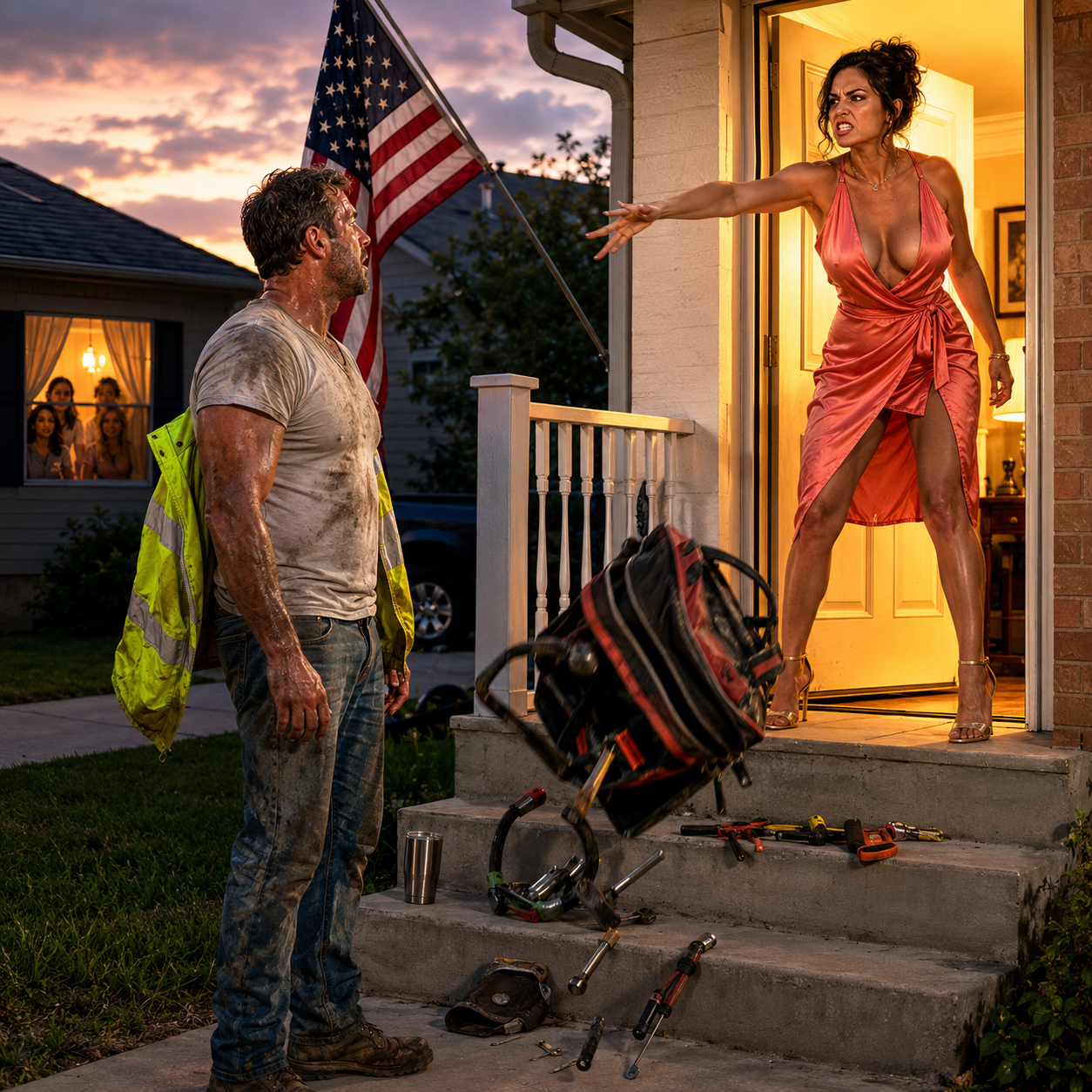
It started with the slam of the screen door and ended with my work bag tumbling down three concrete steps, tools clattering across the porch like they were trash. Seriously, Jackson? Again? Tina stood in the entryway of our house. Our house? With her arms crossed so tight you'd think she was holding herself together with sheer will.
Do you ever think before barging in like a dang bulldozer? I had just walked in sweaty boots caked with red Houston mud after a 12-hour shift laying foundation at a job site off 610. My back was killing me and my shirt was stuck to me like a second skin. But the second my boots hit the hardwood, Tina snapped like I dropped a live grenade in the living room.
I didn't even make it past the mat, I said, breathing heavy. It's just dirt. I'll mop it. Mop it. Her voice pitched high and sharp, echoing through the hallway. That's not the point, Jackson. It's the way you treat this place. Like a garage. Like I'm your mate. I bust my back out there every day to pay for this place.
I'm not trying to mess it up, then take your boots off like a grown man. She stormed forward, shoved my bag into my chest with a force that staggered me. You dragged filth in here like you were raised in a barn. The bag slipped. Hit the ground hard. She didn't flinch. I took a step back. Tina, you're making a scene.
You want a scene? Her eyes were wild now. Voice shrill. Next time I'm tossing everything. Your clothes, your toolbox, your stupid photo albums. All of it. Out. Right here. The street light above flickered once, then burned steady, just enough to cast us in a harsh white glow. Across the street, I saw movement behind the neighbors blinds. Curtains shifted.
A shadow paused. I come home after 16 hours, I said, keeping my voice low, even as heat pulsed behind my ears. And instead of hello or hey babe, I get this. You don't deserve hello, she spat. You deserve to sleep on the porch. Tina, stop. I'm tired of stopping. Tired of pretending you matter more than my peace.
Get that through your thick skull. You're not the only one sacrificing here. A lump rose in my throat, bitter and raw. I turned and picked up my bag. Not because I wanted to end the argument, but because I could feel something worse building in my chest. Keep your voice down, I muttered. People are watching.
Oh, let them watch, she said, stepping onto the porch. Maybe they'll finally see what I've been dealing with. And then she slammed the door hard. I stood there under the street lamp, wind brushing through the oak tree branches, bag in one hand, shame burning in my chest. Jackson Brooks, 39, construction foreman, pays bills early, never been in a fight in his life.
Grew up believing hard work earned you peace at home. I guess I never planned on marrying someone who could strip my dignity in front of the whole street just because my boots were dirty. And still, that wasn't the worst part because I hadn't even seen what was coming next. That same night, I found myself parked on a cracked leather bench in the back corner booth of Grady's.
Our local dive bar tucked between a pawn shop and an abandoned dry cleaner off Harrisburg Boulevard. My hands were still grimy, my knees stiff from work. And if the bartender noticed the dirt on my shirt collar, he didn't say a word, just slid a lone star my way and nodded once. "You sure you don't want something stronger?" Mark asked from across the table, swirling the last inch of bourbon in his glass. No, I said this will do.
Mark Hastings had been my friend for years. Framed houses with me back in '09 and now worked dispatch for the city's public works. Guy had a deep draw and the kind of mustache you only see on Texas sheriffs and country album covers. He waited until I took a long pull from the bottle before leaning forward. So, what did she do this time? I hesitated, stared at the condensation ring forming under my beer.
The jukebox behind us was playing some George Straight song about old flames and second chances. Fitting. She shoved my tool bag out the door. I said finally started yelling at me on the porch for tracking mud in like I was a stray dog. She forgot to chain up. Mark let out a low whistle. Dang. And the neighbors heard.
I added you know the Masons across from us. He nodded. Yeah. Their curtains were open, lights on. That little daughter of theirs was looking right out. Tina didn't care. Kept yelling like it was nothing. Mark sat back, rubbed his jaw. She's got some nerve. I let the silence hang there. The hum of conversation, clink of bottles, occasional laugh from the bar, all sounded too normal for how hollow I felt inside. Finally, Mark shook his head.
My wife never dare talk to me like that. I looked up. You serious? He nodded slowly. There's lines you don't cross, brother. You don't emasculate a man on his own porch. You don't throw his things out. You don't humiliate him in public. Just cause you're in a mood. It's been building. I admitted little stuff at first. Sarcasm, cold shoulders.
Then she started calling me a burden like I'm the reason she's stressed all the time. Mark leaned in. And what's she do all day? She works part-time at that yoga studio downtown. Says the commute drains her. Says being married to me is emotionally exhausting. He snorted. I bet you do more emotional heavy lifting by lunch than she does all week.
I took another swig, staring at the beer label like it had answers. I keep thinking it's just a rough patch, I muttered. That I'm tired and she's tired and maybe one good weekend could fix it. Mark tapped the table twice, firm, man. This ain't about tired. This is about respect. Either she lost it for you or she never had it in the first place.
His words hit like a thud in my chest. You love her? He asked. I hesitated. I did. That's not what I asked. I looked away. Couldn't say anything. The bartender came by, swapped our empties for fresh ones. I let the cold bottle sit in my hand without drinking it. The old neon light over the bar flickered, buzzing softly.
A country song about leaving played low. You know what I think? Mark said finally. What? She knows you won't leave. That's why she keeps pushing. She thinks she can burn your pride and you'll still come home with flowers. I let out a bitter breath. And maybe I would have. But not anymore. I didn't answer right away.
No, I said eventually quietly. Not anymore. He nodded like he'd been waiting for that. Good. About time. The jukebox clicked to another song. A slow one. The kind people cry to when nobody's watching. I stared into the amber glass in front of me. The sound of Tina's words still echoing from the porch. And for the first time, I realized what had really cracked inside me wasn't anger.
It was something deeper, something final. The next morning, I was up before the sun. The house was quiet, shadows still clinging to the corners of the kitchen. I moved slow, careful not to clatter the pans as I scrambled eggs and tossed toast into the old four slice toaster that always leaned to one side.
I wasn't trying to prove anything. I just wanted to bring the temperature down. Two plates, two cups. I even folded a napkin beneath the silverware like I was setting up some sort of peace offering. I didn't know if she'd come down, but I needed to try. Needed to know I'd done my part before the silence between us turned permanent.
When Tina finally came into the kitchen, she looked like she hadn't slept much. Hair still up from the night before, lips pursed, eyes scanning the room like she was preparing for battle. "You cooking?" she asked, tone flat. I gestured toward the counter. Thought we could eat together, maybe talk. She sighed and flopped into a chair, pulled her phone out without saying thank you.
I sat across from her, kept my voice low. Listen, about last night, Tina didn't look up. Here we go. I leaned forward, elbows on the table. I'm not here to argue. I just want us to talk like people without the yelling, without the doors slamming. She scoffed. You mean talk like you want? On your terms? No, I said calmly. on equal terms.
I want to feel like I can come home and not be attacked for stepping wrong. Tina finally looked up, but there was no softness in her gaze. You're always so dramatic, Jackson. You dragged in mud. It's not like I set the house on fire. It's not about the mod, I said, trying not to let her tone chip at me. It's about how you treated me.
That wasn't a disagreement. That was humiliation in front of neighbors. You can't take stuff that personal and make it public like that. She tossed her phone on the table. So what? You want an apology now? I want respect. That's all. Tina tilted her head. Oh, here we go with the respect talk again. You men are all the same.
You think anything short of praise is disrespect. I kept my breath steady. I'm not asking for praise. I'm asking not to be talked to like a dog. She rolled her eyes hard. So now I'm the abuser. You sound like one of those radio guys with podcasts on masculine boundaries. Spare me. I'm trying, I said slowly.
To save what's left of this, she stood abruptly, chair legs scraping across tile. No, you're trying to control me. Every time I express how I feel, you throw it back in my face. That's not what I'm doing. Yes, it is, she snapped. You want me calm, quiet, gentle, like some step forward wife. And when I speak with emotion, suddenly I'm the villain.
I stood up now too, not to yell, but because I couldn't sit still anymore. Tina, you don't listen. You react. You twist everything until you're the victim and I'm the bad guy. Her voice rose because you are. You think just cuz you work long hours, you get to come home and have the world revolve around you. Well, news flash, Jackson, my world doesn't.
I clenched my jaw, trying not to raise my voice. You know what? You win. You always do. I grabbed my keys from the hook, tossed them into my palm. I laid out breakfast, I said quietly. All I asked was a civil conversation. "You couldn't even meet me halfway," she crossed her arms. "Don't guilt me with eggs and toast.
That's not how you fix things. I'm not trying to fix anything with breakfast," I said, walking toward the door. I was just hoping we could act like two adults who live under the same roof. Then stop acting like my father. That one stopped me cold. I turned, stared at her. Excuse me. You heard me, she said, chin raised.
You get this look, this tone, like you're the one who knows better, like I'm a child misbehaving in your house. It's gross. A flush crept up my neck. I opened the door, held it a second longer than necessary. You know what's really gross? I said, getting screamed at by someone who says they love you every single day. Then I shut the door hard behind me.
Not slammed, just firm. Final. The cold morning air hit me like a slap. I stood there on the porch, staring at the empty street for a beat, then headed down the steps toward my truck. I didn't feel righteous. I didn't feel brave. I felt like a man trying not to break under the weight of a love that didn't feel like love anymore.
The sun was low by the time I turned onto my street. Headlights catching the edge of our mailbox like always. I slowed down, already rehearsing what I'd say if Tina was in another mood. Something calm, something short. But then I saw it. My flannel shirts, familiar reds and blues, were flapping like forgotten flags across the lawn.
My toolbox was cracked open, socket wrenches, and drill bits scattered like bones. Even my old photo frame, the one with my mom and dad on their anniversary, was lying face down in the grass. I slammed the truck into park and stepped out slow, heart beating low and heavy. "You got to be kidding me," I muttered, walking up the driveway.
My work boots crunched against gravel, kicked aside one of my old college hoodies. The front door creaked open, and then I heard her. "There you are." Tina's voice rang out sharp from the second story window. "Took your sweet time, didn't you?" I looked up. She was leaning out, hair in a messy bun, a wine glass in her hand like she was making a toast to herself.
"What is this?" I called back. "It's freedom," she shouted like she was putting on a show. "Yours and mine. I told you if you disrespected this house again, your stuff was gone. So, Tata, I looked around at the chaos. Denim, tools, framed memories, all of it tossed like trash. A couple of neighborhood blinds twitched. Tina, this is insane.
" No, she barked. What's insane is how long I let you walk around like you mattered more than me. I bent down slowly, picked up the framed photo. The glass was cracked. My dad's smiling face split clean down the middle. She kept talking, still behind that glass like a queen above her throne. Go ahead, take it. All of it.
And if you come back here tonight, I'll call the cops. You hear me? I didn't answer. I couldn't. I just kept collecting what I could carry. hoodie over one shoulder, bag slung across the other, my fingers wrapped tight around the handle of my toolbox like it was the only thing still solid in my life. And that's when I heard a different voice, quiet, steady, a little curious.
Hey, everything all right? I turned. She stood a few feet behind me, just outside the gate of the house next door, barefoot on the grass, sundress brushing her knees, a soft cardigan draped over one shoulder. Her eyes, warm and a little cautious, met mine. She gave me a small, polite smile. Sorry, I don't mean to pry.
I just uh noticed you could use a hand. I blinked, trying to place her. Natalie, she said, seeing the look on my face. I just moved in last weekend next door. Right. The gray bungalow. I'd seen the moving truck but hadn't gone over. Figured I'd welcome her once things settled down. Guess they never did. I'm Jackson, I said, adjusting the weight on my shoulder.
And this ain't normal, I promise. She tilted her head, then gently nodded toward the pile still in the grass. You got a place to go tonight? I hesitated. Honestly, no. She took a small step closer, voice still even. I've got a guest room. Clean sheets, door locks from the inside. No pressure. Just seemed wrong to let you sleep on a toolbox.
For the first time all day, something loosened in my chest. "You sure?" I asked. She smiled warm and easy. "Yeah, come on. Let's get this off the lawn before she throws the rest." I glanced up. Tina was no longer at the window. "Yeah," I muttered, finally exhaling. "That would be real nice." and together we started picking up what was left.
Natalie's place smelled like rosemary and fresh paint. A soft sort of welcome, like the house was trying to apologize for the one I'd just been thrown out of. "Sorry, it's a little bare," she said, setting her keys in a ceramic bowl by the door. "I'm still figuring out where everything goes. "It's nice," I said, stepping out of my boots by the entry.
Hardwood floors, cream walls, a navy blue couch with a sleeping cat curled on the corner like it paid rent. Real nice. She smiled. Guest rooms down the hall, bathrooms across. You're welcome to wash up first if you want. I shook my head. Nah, I'm good for now. We moved to the kitchen. It was a small space, cozy, with open shelves and a flickering candle already lit near the window.
Natalie opened the fridge and pulled out a covered glass dish. Lasagna? She said, balancing it with one hand. It's leftover, but still solid. You hungry? I hesitated. Yeah, honestly, yeah, I am. Grab a beer, she said, pointing to the fridge door with her elbow top shelf. I found two bottles and handed her one.
She popped the caps off with a magnet opener and we clinkedked them lightly before sitting down at her small round table. For a while, we didn't talk. The lasagna warmed in the oven. Outside, crickets stirred in the grass and the air from the open window carried in the faint scent of honeysuckle. Then she looked over at me.
So that fight, was it the first or just the loudest? I let out a dry laugh. Not even close to the first, just the one that came with gravity. She nodded like she understood more than she said. I figured you were calm. Too calm. That kind of calm usually comes from drowning in it a while. I looked down at the label on my beer.
been married almost 10 years. Not all bad, not all good. Lately, it's been I don't know, like living with a hurricane you're not allowed to evacuate from. That's a hell of a way to put it. I mean, she wasn't always like that, I added. Tina used to laugh. Used to dance in the kitchen. I don't know what changed, but I sure as hell know what stayed me.
Trying, showing up, being steady. She leaned her chin on her hand. Sounds exhausting. It is, I admitted. But tonight, something cracked. It didn't hurt like it usually does. It just felt done. Natalie didn't rush to fill the silence. She just let it settle soft and slow before saying, "That kind of done isn't failure.
Sometimes it's finally listening to yourself." I nodded, not trusting my voice for a second. The oven dinged. She stood, pulled out the lasagna, and began slicing clean, careful squares. plates are in that drawer if you want to grab them," she said, motioning behind me. I opened it and the whole drawer slid off the track, tilting sideways with a thunk.
"Whoa," I muttered, catching it with both hands. She laughed. "Yeah, that one's been driving me crazy. Mind if I fix it? Be my guest." I crouched beside the cabinet, inspecting the rail. Just a bent bracket and a misaligned screw. I tightened it, adjusted the drawer, and it slid back with a perfect whisper. Natalie clapped softly. You just earned yourself seconds. I grinned.
Deal. We sat down again, and this time the silence was easy. She told me about the little beach town she'd moved from. About the job she hadn't started yet, something with digital design. About the cat marbles who only liked women and sunbeams. I told her about job sites. About how Houston Clay turned your boots into bricks by noon.
I didn't talk about Tino again. Didn't need to. Somewhere in the middle of all that, the weight started to slip off my shoulders just a little. Maybe it was the lasagna. Maybe it was her voice. Or maybe it was just being somewhere I didn't have to defend my presence. When the plates were scraped clean and the cat had curled on my feet, Natalie looked at me again.
"You don't owe me details," she said. "But I'm glad you're here tonight." I swallowed hard. Me, too. And for the first time in a long time, I meant it. By the third day, the guest room didn't feel like a stranger's space anymore. It still had that faint smell of fresh paint and cedar drawers, but now my jeans were folded neatly in the dresser, and a pair of clean work socks sat waiting on the edge of the bed each morning.
Natalie had put a small lamp in the corner, said it was too dark in there for a man to think straight. She wasn't wrong. "Let me know if I'm overstaying," I said one evening as I tightened a bracket on the floating shelf in her hallway. My drill buzzed softly against the wall. She walked by holding a laundry basket and paused, giving me that amused sideways glance she'd started using more often.
"I will," she said. "But you're not even close." She moved on, and I caught myself smiling just for a second. The days took on a rhythm. I'd wake up to the smell of coffee and the sound of marbles batting at something across the floor. I'd eat toast with peach jam she made herself. She had jars lined up in the pantry, like tiny trophies of calm, and head out for work.
When I came back, there'd be something hot in the oven and a new fix it listing on the counter. "You don't have to do all this," I told her as I tested the wiring on a ceiling fan in the spare office. "I know," she said, handing me a Phillips head. "But neither do you, so I guess we're even." One night, she made fried catfish with collared greens and cornbread that tasted like something straight out of someone's grandmother's recipe box.
We ate barefoot on the back steps, passing a jar of sweet tea between us. You always cook like this? I asked. She shrugged. When I'm nervous, I looked at her. You nervous? Only when I let people stay in my house longer than 2 days. I laughed. Fair. But the truth was nothing between us felt forced.
She didn't ask questions I wasn't ready to answer. And I didn't try to act like I had it all together. We just moved in step like two people grateful not to be walking alone for once. She'd fold my shirts with this neat little half tuck the way my mom used to do. And I'd catch her watching me sometimes when I was hanging drywall anchors or adjusting a dimmer switch.
Not romantic, not expectant, just present. One afternoon, she caught me staring at a framed photo on her hallway table. A man with gray temples and a weatherworn smile stood next to a younger version of her. "My dad," she said gently, "taught me to fix a sink before I could parallel park. "He taught you right," I said. She smiled.
"He'd have liked you." The word sat with me long after she walked away because somehow, without trying, she was rebuilding something I didn't even know was broken. If you're still listening, please tap the like button on this video. It was a quiet Thursday evening, just warm enough to eat out on the screen porch. The table was set simply.
Two mismatched plates, a glass bottle of sparkling water between us, candles flickering in recycled jelly jars. Natalie had made skillet chicken with creamy grits, and there was a slice of peach cobbler waiting on the counter behind her, cooling beside the radio, humming soft blues. You've got a talent, I said between bites.
For food and making a man forget the rest of the world's burning. She smiled, but it didn't quite reach her eyes. I appreciate that, she said. Then she tucked her hair behind her ear, slow and deliberate, and glanced down at her plate. Something shifted. Natalie, she didn't answer right away. Instead, she ran her thumb along the rim of her water glass.
Can I ask you something? And you promise you won't take it the wrong way? I sat back a little, heart tightening. Sure. She drew a breath. It's not my business, and maybe I should have said something sooner, but before that fight with Tina, before the night she threw your stuff out, I used to see a car. Black BMW, real shiny.
It would pull up to your driveway late. Couple times a week, maybe more. I didn't move. Always after dark, she added, voice quieter now. Never stayed too long. I figured maybe a friend, but I also noticed Tina got real dressed up on those nights. And she never waved back when I was outside. My chest tightened slow and mean.
"And you're sure?" I asked, keeping my tone calm. "I wouldn't have brought it up if I wasn't," she said, her hands now resting still on the table. "I just didn't know how to say it, or if I should." I nodded slowly, pushing back my half empty plate. "No, I'm glad you did." Silence stretched between us. The crickets outside kept on chirping and the candles flickered, casting soft shadows across the woodpane walls.
But inside me, something cold had started to move. That creeping sharp suspicion that slips between your ribs and settles behind your heart. I'd ignored it too long. "I'm sorry, Jackson," Natalie said, voice gentle. "I didn't mean to ruin dinner." "You didn't," I said. "You just changed the temperature." She offered a small smile, but the ease between us had shifted just a fraction.
And though I thanked her for the honesty, something deep in me paused because truth, even gently delivered, doesn't always land clean. I trusted her mostly. But tonight reminded me I couldn't afford blind trust anymore. The next evening, I didn't come straight to Natalie's door. I parked my truck three blocks over by an old brick church.
Its lot mostly empty this time of night. The air had cooled, thick with humidity, cicas buzzing somewhere unseen. I walked back on foot, hoodie pulled low, and steps light. Natalie was waiting by the front door when I slipped in. She didn't ask questions, just nodded once and led me upstairs.
Her second floor office had a wide window overlooking both our houses. I pulled the chair close, eyes fixed on the driveway I used to call mine. "You sure you want to do this?" she asked, voice low. "I need to know," I said. I should have known already. She didn't push. Instead, she turned off the overhead light and left the room quiet, save for the occasional groan of old floorboards beneath our feet.
From up here, my old house looked cold, lifeless, like a shell. At 7:18, the porch light flicked on. Tina stepped out 5 minutes later, arms crossed, robe tied at her waist. Her hair was up, makeup subtle but deliberate, like she was expecting someone, but didn't want to look like she was expecting someone. She scanned the street once, twice.
Her head tilted in the direction where my truck would have been parked if I'd come home like usual. "See that?" I whispered. "She's looking for the truck." Natalie didn't say anything. Just stood beside me, still and steady. Then, at 7:31, a sleek black BMW rolled up slow and smooth. It idled for a second. Tina stepped back inside without waving or calling out.
10 seconds later, the porch light went dark and the car pulled into the driveway like it belonged there. The driver stepped out. A tall man, older business casual, slacks and a button-down. Confident gate. He didn't knock. She opened the door before he even reached it. And just like that, he disappeared inside. My chest didn't burn. It froze.
Natalie placed a gentle hand on the back of the chair, but didn't speak. She didn't need to. I knew something was off, I said quietly. Even before that fight, I could feel it, but I kept pushing it down. You didn't want to believe it. No, I said I didn't. Below us, the house stayed dark, curtains drawn, no porch light, just shadows moving behind the blinds.
I leaned forward, elbows on my knees, and let the silence settle around the truth. There it was, plain as day. She wasn't grieving what we had. She'd already replaced it. And that somehow hurt worse than anything she'd ever yelled at me. The next night, I didn't park down the street.
I pulled straight into my own driveway. Slow, deliberate, engine rumbling like thunder before a storm. My boots hit the pavement with purpose. I didn't hesitate, didn't breathe. Natalie had offered to come with me to wait outside just in case, but I told her this was mine to finish. As I stepped up to the front door, I could already hear the laughter inside.
Hers and his low and easy like this was just another pleasant evening in someone else's home. My home. I didn't knock. I opened the door with the keys she'd forgotten to ask for back. And there they were. Tina stood barefoot in the living room, wine glass in hand, midlife. Her robe this time was silk navy blue, just brushing her knees.
Her hair curled soft around her face, lips painted a color she never wore for me. Across from her, lounging on the couch with his legs crossed like he owned the place, sat the same man from the BMW. Button down open at the collar, white teeth, watch too expensive for his age. He held his wine like it was some symbol of class, not cowardice.
The second I walked in, their laughter stopped cold. Tina's smile shattered, her hand frozen midair. He sat up, confused, but not scared yet. I stepped in, shut the door behind me slowly. Then I looked right at him. "You've got 5 seconds to get out of my house." "Excuse me," he said, standing now. "Who?" I said. I took a step closer.
"You've got five." And I'd move fast. Tina came to life then, stepping in front of him like a shield. "Jackson, what are you doing? You can't just walk in here." I can, I said evenly, because it's still my name on that deed. And this, I motioned to the wine, the music, the little shakuderie board she never used to bother with when I was around.
This isn't happening under my roof. Look, man, the guy said, hands raised slightly. I didn't know there was an issue, Tina said. Don't say my name like we're equal. I snapped. You knew. You parked here knowing. He looked like he wanted to talk back, but something in my eyes made him think better of it. He grabbed his blazer off the back of the chair and made for the door.
I opened it for him. Outside, porch lights were flicking on. The masons across the street were peering through the blinds again. Old Mrs. Price was standing on her porch, phone in one hand, probably halfway through dialing someone. Good. Let them all see it. As the man passed me, I said quietly, "If I ever see you here again, I won't be this polite.
" He nodded once and left without another word. I turned back inside. Tina stood frozen, red rising in her cheeks, hands trembling now, not with guilt, but with rage. "How dare you?" she hissed. "You just humiliated me in front of the whole street." "Funny," I said. "You didn't mind an audience when you threw my things across this same lawn.
" Her mouth opened, but no words came. You made your choice, I continued. You invited him in. You let him sit where I used to sit. Laugh where I used to talk to you. You didn't even bother to hide it. You were never here, she shouted. You left. You moved in with that neighbor like a coward.
I left after you made it clear I didn't matter, I said. And Natalie? She gave me a clean pillow and quiet. That's more than you've given me in a year. She stepped forward, voice shaking now. So what? You're perfect. You get to judge me. No, I said I just finally see you for who you are. That silence between us hit different this time. No, wait.
No sorrow. Just a kind of closing door. She tried again, softer this time. Jackson, wait. Can we just Don't, I said, voice steady. Don't call me by name. Don't ask me to wait. Then I took one last look around the room. Our wedding photo still crooked on the wall, dust gathering on the frame.
You don't get to call me your husband anymore. And I walked out. Neighbors watched as I passed. No one said a word. I didn't care because for the first time in a long time, I didn't feel like I was leaving something behind. I felt like I was walking towards something better. The courtroom was colder than I expected. Gray walls, humming fluorescents, and the scent of old paper and nervous sweat.
I sat still, hands folded in front of me, the same way I used to sit at Sunday's service, patient, quiet, but ready to speak when called. Tina was already seated across the aisle. She looked different than she had the night I left, not angry now, polished, her hair styled, a muted blazer hugging her shoulders and her expression carefully arranged into something soft like she was here to win sympathy, not a settlement.
Her attorney stood, clearing his throat. Your honor, Mrs. Brooks deeply regrets the emotional tension that led to this point. She wishes to repair what's broken. I didn't flinch. She was under stress, he continued, and believes reconciliation is possible. At the very least, she seeks shared ownership of the home until matters settle.
Tina nodded slightly, eyes darting toward me. I didn't return the look. When it was our turn, my lawyer stood up without theatrics. Just facts. Your honor, my client has lived off premises since the separation by force, not choice. He was removed without consent, his belongings thrown into the yard. We've provided photos of this incident as well as testimony from a neighbor who witnessed the confrontation. He handed over a folder.
Neat, simple. And regarding reconciliation, Mr. Brooks has documented evidence of a third party consistently visiting the marital residence during work hours. Surveillance images timestamped. The pattern is clear. Tina shifted in her seat. Her attorney whispered something to her, but her eyes stayed forward now, still soft, but the edges of her mask had begun to slip.
The judge didn't ask many questions. She skimmed the files, adjusted her glasses, then looked directly at me. "Mr. Brooks, do you wish to pursue any form of shared property arrangement?" "No, ma'am," I said, my voice level. "I'm only asking for what I built." and peace. She nodded. Request granted.
Sole ownership of the property awarded to the petitioner. Divorce will proceed uncontested. The gavl struck once. Final clean. Tina stood slowly, gathering her papers. Her expression had changed now, less soft, more stunned. She approached me as I turned to leave. Jackson, wait. I stopped but didn't step closer. I made mistakes, she said.
But we had years together. That has to count for something. I met her eyes calm. It did. But what counts now is who stood by me when I had nothing. She blinked, unsure how to respond. She's in the hallway, I added quietly. The one who didn't need to tear me down to feel big. And with that, I walked out.
Natalie stood by the wall near the courtroom exit, wearing a pale yellow sundress and holding a folder of her own, just in case I needed support. When our eyes met, she gave me a quiet smile. You okay? She asked. I nodded once. More than okay. She smiled wider, brushing her hair behind one ear, her cheeks warming just enough to turn pink.
And for the first time in a long time, nothing in me needed fixing. A warm wind rolled across the backyard as the sun dipped low behind the trees, painting the fence line in gold. I sat back in the porch chair, coffee in hand, watching the sky bleed into soft orange and dusty pink. Natalie was next to me, legs tucked under her, one hand cradling her own mug, the other absently scratching marbles behind the ears where he lay stretched between us like he owned the place.
She didn't speak, neither did I. We didn't need to. The tools from our weekend shelf project still sat on the porch, half-packed in a plastic bin. We'd finish it tomorrow, maybe, or the next day. There wasn't a rush anymore. Think we'll finally try that gumbo recipe this week? she asked, voice low, teasing.
I smiled only if I get to stir this time. She laughed under her breath. Deal. I looked around at the fading sunlight, the sound of wind in the pines, the coffee cooling slowly in my hands. No tension, no second guessing, just steady breath, steady ground. This house wasn't just where I live now. It was the first place in a long time where I didn't feel like I was walking on eggshells.
We weren't in a rush to label what we were. We just trusted what we had and finally that was enough. That was the end of my story. I keep thinking about what Natalie did. That moment when she saw me gathering my things off the lawn and without knowing me offered help anyway. Would you have done the same for someone you barely knew or walked away? Tell me in the comments if you think she made the right call.
![[FULL STORY] The Man She Called a “Work Husband”](https://social-media.rabedo.com/thumbnails/1777065945_42ec3314-edb2-4d50-a40b-81cd230147b1.png)