
I found out I was pregnant on a Tuesday morning so quiet it almost felt holy.
The city had not fully awakened yet. Beyond the glass walls of my bedroom, the skyline was still washed in soft gray light, the kind that makes everything look suspended between yesterday and today. I stood barefoot in my bathroom, one hand braced against the marble counter, the other holding a pregnancy test so tightly that my fingers began to ache.
Two pink lines.
Not bold. Not dramatic. Just there.
I stared at them for so long my reflection in the mirror started to blur. For a moment, I looked like a stranger to myself. Not the woman the financial press occasionally described as disciplined and untouchable. Not the woman who could buy half the block beneath her penthouse if she wanted to. Not the woman men in tailored suits lowered their voices around in boardrooms because they never quite knew how much I already knew.
I looked like a woman on the edge of hope.
My hand drifted to my stomach before I could stop it. The gesture was instinctive, tender, almost shy.
“Hi,” I whispered, and then laughed softly at myself because the word came out trembling.
I was thirty-five years old. I owned more companies than most people could name. I could negotiate billion-dollar acquisitions without raising my voice. But standing there with those two pink lines in my hand, I felt suddenly young and painfully vulnerable.
And if I was honest, something worse than vulnerable.
I felt hopeful.
That was the most dangerous feeling of all.
I had been married to Edward Mensah for just under two years, and from the outside, our life looked enviable in the clean, polished way respectable lies often do. He was handsome, articulate, charming in public. He knew how to hold a room without seeming to force it. He knew how to laugh at the right moment, how to say a woman’s name as if he had been thinking about it all day, how to lower his voice just enough to make people lean in.
When I met him, I had mistaken polish for depth and attentiveness for character. It shamed me to admit that now, but it was the truth.
The first months of our marriage had been easy enough to believe in. Not perfect, but warm. He brought me tea when I worked late. He touched the small of my back as we walked into events. He remembered details I had mentioned in passing. He looked at me as if I were something rare, and because I had spent so many years being admired for my power and protected against opportunists, I let myself believe I had finally found a man who wanted me before he understood what my name could buy.
That had mattered to me more than I ever admitted.
I had not met Edward as Amara Akoye, the woman hidden behind holding companies, hospital consortiums, logistics firms, and real estate structures that quietly shaped half the city. I met him as Amara, a consultant in health sector strategy. That was the version of myself I offered him in the beginning. Elegant, intelligent, successful enough to be respected, but not so powerful that the truth would distort his eyes.
I wanted to be loved before I was valued.
That was my mistake.
Still, that Tuesday morning, holding a pregnancy test in my hand, I allowed myself to believe that whatever distance had grown between us in the past year could still be repaired. I told myself that maybe the child I had not expected would bring us back to each other. That maybe the strange silences, the late nights, the distracted responses, the subtle emotional absences were not what they had begun to feel like.
That maybe I was not losing my husband.
I should have known better. Women like me always know better. We simply choose the prettier lie until the uglier truth makes that impossible.
I decided I would tell him that night.
I left the bathroom with the test wrapped in tissue and tucked into the back of my drawer like a secret I wanted to unfold at exactly the right moment. I spent the morning in a state I had not felt in years, distracted in the most human way. In the board meeting at ten, I caught myself resting my palm over my stomach under the table while a regional acquisitions team discussed infrastructure exposure. At lunch, my assistant asked whether I was feeling alright because I had smiled to myself twice without explanation. By afternoon, I had already planned dinner in my head. I would come home early. I would cook myself, not because I needed to, but because I wanted the evening to feel intimate and ordinary. I would wait until we were seated. Then I would tell him.
Maybe he would smile the way he used to.
Maybe he would reach for my hand.
Maybe I would see the man I married look back at me from behind the polished distance that had begun to replace him.
By six-thirty, I was home. The house was quiet in that expensive, curated way quiet can be when walls are thick and everything inside them has been designed to signal peace. I changed clothes, tied my hair back, and moved through the kitchen with unusual lightness. I cooked Edward’s favorite meal, or rather, the meal he used to call his favorite before he stopped noticing the effort that went into small acts of love. I lit two candles at the dining table. I even placed a folded note beneath his napkin with a single line written inside.
We need to talk. It’s good news.
Then, because I still had time before he got home, I took his dry cleaning bag upstairs and began hanging his shirts in the dressing room.
That was when I found the perfume.
It was not dramatic. It did not announce itself with lipstick on a collar or an earring in a pocket or some cliché so obvious it would have insulted both of us. It was subtler than that, which made it worse. I lifted one of his white shirts from the hanger and caught the scent when I smoothed the collar with my hand.
I froze.
Then I brought the fabric closer to my face.
It was not mine.
I knew that immediately. I don’t wear perfume often, and when I do, it is never something sweet or overdesigned. This scent was expensive and calculated. Floral at first, but beneath it something deeper, more sensual. The kind of perfume a woman chooses when she wants to be remembered after she leaves the room. A woman who expects men to turn when she passes.
I inhaled again, hoping I had imagined it.
I had not.
My fingers tightened around the shirt. I stood there in the silence of my dressing room with Edward’s collar near my face and felt the evening tilt beneath me. Suddenly every small discomfort I had pushed aside in the past few months began stepping forward one by one, asking to be recognized. The late meetings he never used to have. The nights he came home distracted, smelling faintly of expensive hotel lobbies and something I could never quite identify. The way he had become more interested in who attended my industry dinners than in how I felt after them. The subtle questions. The too-casual curiosity about trusts, emergency signatory authority, asset structures, intergenerational inheritance. The way he watched certain men around me as if studying a code he wanted to crack.
I sat down hard on the bench by the wardrobe and stared at the shirt in my hands.
“No,” I whispered.
But it wasn’t denial. It was grief arriving before facts.
I wanted to confront him immediately. I wanted to place the shirt in front of him on the table and watch his face while I asked him whose scent he had carried into our home. But another part of me, the part that had built empires by never reacting before understanding, held me still.
I needed certainty.
I needed to know whether this was betrayal or only the prelude to it.
I needed to know if my child would be born into a marriage that still had something worth saving.
When Edward came home that night, he was forty minutes late.
He entered with his usual smooth apology already on his lips. “I’m sorry, traffic was impossible,” he said, loosening his tie as he stepped into the dining room.
The apology would have worked once. That night, I watched him too carefully for it to land.
He looked handsome, composed, mildly tired. A man returning from a demanding day. But his smile faltered when he saw the candles and dinner waiting.
“What’s all this?”
“I wanted us to have dinner together,” I said.
“On a Wednesday?”
“It’s Tuesday.”
He laughed softly. “That tired, huh?”
I studied him over the candles. He reached for his wine glass. His cuff links flashed in the warm light.
I almost told him then. I almost reached beneath the napkin, handed him the note, and changed my life.
But the smell of another woman still sat in the back of my throat.
So I waited.
That was the last quiet decision I made before everything became violence.
Two days later, I was in the back seat of my car on the way home from a late meeting at one of the teaching hospitals linked indirectly to my private holdings. Rain lashed the windshield hard enough to blur the city into streaks of white and gold. My driver, Kofi, steady and trustworthy, kept both hands on the wheel and his eyes ahead. I was tired, but in a softer way than usual. I had spent the day turning over possibilities in my mind. Confrontation. Proof. Private investigation. Conversation. None of them felt complete yet. I had told no one about the pregnancy. Not my doctor. Not my assistant. Not even my closest attorney, who knew almost everything else about my life. I wanted one more day to think. One more night to decide what kind of truth I was standing inside.
I remember touching my stomach and thinking, Tomorrow.
Then headlights cut across the rain.
A truck lurched suddenly from the next lane, too fast, too close. Kofi swore under his breath and yanked the wheel. I heard the scream of tires losing their grip on slick asphalt. The car spun. There was a burst of light, a sound like metal tearing itself apart, then the world became impact.
Glass exploded inward. My shoulder slammed against the door. Something struck my side with blinding force. The seat belt dug into me so hard I thought my ribs had cracked. Then came another hit from somewhere impossible to name, and for one suspended second I felt the violent certainty that my body was no longer inside a machine. It was inside a weapon.
The last thing I remember before darkness took me was Kofi shouting my name.
When consciousness returned, it did not come with vision.
It came with sound.
A monitor. Slow, indifferent, steady.
A ventilator. Air hissing in, air exhaling out.
Rubber soles on a polished floor.
Muted voices speaking in professional tones.
I tried to open my eyes.
Nothing happened.
I tried to move my hand.
Nothing.
I tried to speak.
Nothing.
Panic surged through me with such force I thought it would shatter whatever prison I had woken into. I screamed inside myself. I fought for one finger, one blink, one breath on my own. There was nothing. No response. No tremor. No escape.
I was there.
Completely there.
And trapped.
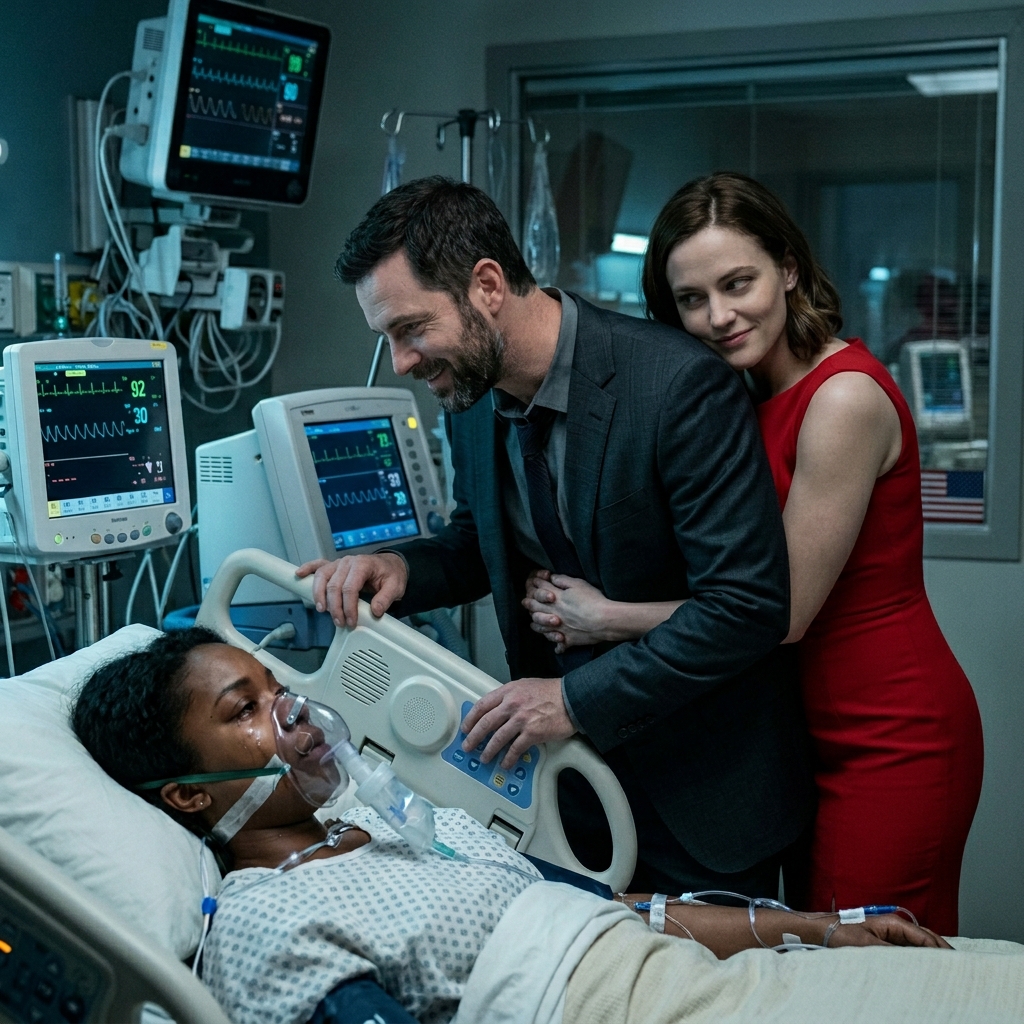
The realization came in fragments over what might have been hours or days. I could hear every word spoken around me. I could process it. I could feel the sheets against my skin, the weight of air against my face, the pressure points in my body where nurses turned me. But I could not command any part of myself to answer. Later I would hear the words locked-in syndrome spoken by a neurologist to someone in the hallway, accompanied by caution, rarity, uncertainty. In those first days, I knew only one thing clearly.
I was alive inside silence.
Edward arrived the second day.
Or perhaps the first. Time had no edges in that room. I knew him by his footsteps before his voice confirmed it. He stood in the doorway for several seconds before entering. Even without seeing him, I could feel something in his stillness that made my skin crawl.
Then he moved closer.
“How is she?” he asked.
The doctor sighed. “Critical, but stable. Severe neurological trauma. There’s significant concern about responsiveness.”
“Can she hear us?”
“We don’t know.”
A lie. Or perhaps caution. Either way, it left me alone in my terror.
The doctor left. Edward stayed. For a long time, he said nothing. I expected grief. A prayer. My name spoken with love. Instead there was only silence and the sound of his sleeve brushing against the bed rail as he adjusted his position.
Then he exhaled.
Not shakily. Not like a devastated husband. More like a man calculating the next move after an unexpected delay.
“Forgive me,” he whispered.
The words should have sounded broken. They did not.
Before I could understand why, I heard a small plastic sound near the machinery at my bedside. A line being handled. Something light touched, then moved.
Terror detonated inside me.
No.
No.
No.
I screamed inside my own mind with everything I had. My chest remained still. My mouth did not move. My fingers lay useless against the sheet. The world narrowed into that tiny sound and the certainty of what it meant.
Then footsteps approached outside. Edward pulled back quickly. A nurse entered carrying medication. His voice changed instantly.
“Has there been any improvement?” he asked softly.
The performance was flawless. To anyone else, he was a worried husband trying not to fall apart. To me, he was death in an expensive suit.
That should have been the moment my love for him died.
It wasn’t.
The truth is uglier. Love does not die cleanly, even under betrayal. For a while, it lived on as disbelief. Surely I had misunderstood. Surely fear had distorted what I heard. Surely no man could move from a wife’s bedside to her life support with that much calm. But then the evidence kept arriving.
His phone conversations.
The financial questions.
The treatment decisions.
And then her.
The first time I heard Vanessa’s voice, I did not know her name. Only the perfume announced her before she spoke. The same scent from Edward’s collar unfurled into the hospital room like a confession.
“She looks peaceful,” the woman said.
Peaceful.
If I had been able to laugh, I would have.
Edward lowered his voice. “Keep it down.”
“She can’t hear us.”
I went cold.
She came closer. I could feel the shift in air near the bed.
“You’re still dragging this out,” she murmured. “She’s not coming back, Edward. Stop pretending this is temporary.”
He was silent.
Her heels clicked once as she shifted her weight.
“You deserve more than a half-lived future tied to a woman who never really let you into her world.”
The sentence sliced deeper than she could have known. Because suddenly, layered beneath the affair and the cruelty, another truth emerged. Edward had discovered enough to understand that I had hidden my real financial reach from him. Maybe not the full architecture. Maybe not the quiet extent of my control. But enough to know there was far more behind me than the version of myself I married him as.
Enough to become dangerous.
That same evening, after Vanessa left, Edward took a call in the corner of my room.
“Yes,” he said quietly. “I’ve started asking the right questions.”
A pause.
“No, not directly. Through intermediaries.”
Another pause.
“Emergency authority, if it comes to that.”
My entire body felt like a coffin and my mind the last living thing inside it.
Then came the worst blow of all.
The doctor’s voice the next day. Soft. Careful. Clinical.
“We were unable to save the pregnancy.”
I did not understand at first. My mind had spent so much effort surviving terror that the words seemed to float above me without meaning.
Then they landed.
Pregnancy.
Unable to save.
My baby.
Gone.
I had no tears. My body would not allow even that mercy. But something in me split open with such force that for a while I thought I would lose my mind entirely. My child had existed in secret hope for less than a week, and now the only people who knew were the doctors and the man who had helped put me here. Edward came to the bedside later that day. He said nothing about it. Not a word. Either he had not asked or he had and did not care. I will never know which possibility disgusts me more.
That was the day I stopped wishing for an explanation.
The woman who wanted answers died with that child.
In her place, something colder began to form.
Not immediately. Vengeance is not born in fire. It is born in stillness, when grief has exhausted itself and left only clarity behind. I understood then that if I ever regained even the smallest piece of control, I would not spend it asking why. I would spend it making sure Edward and the woman beside him lost everything they had gambled my life to gain.
Dr. Daniel Adebayo was the first person to understand that I was still inside my body.
He had been my private physician for years, one of the few people in my personal orbit whose loyalty I trusted without reservation. He knew the version of me the public never saw. The overworked woman who forgot meals during acquisitions. The insomniac who masked exhaustion with perfect posture. The daughter who still asked once a year for the same flowers her mother used to grow. He also knew how I moved, how I thought, how I resisted helplessness.
On the sixth or seventh day after the accident, he entered my room alone. His chair scraped softly against the floor as he sat beside me.
“If you can hear me,” he whispered, “give me something.”
I pushed with everything I had.
At first, nothing.
Then a twitch.
My ring finger.
So small it might have been dismissed by anyone not searching for it. Dr. Adebayo inhaled sharply.
“If that was you,” he said more quietly, “do it again.”
I did.
That was the beginning of my return.
He did not announce it. He did not tell Edward. He did not deliver hopeful news into a room where hope could become a threat. Instead he moved with the precision of a man who knew danger when he saw it. Over the next two days he ran discreet assessments. Eye movement. stimulus tracking. motor intent. He reviewed treatment orders and found enough irregularities to disturb even his careful professionalism. A specialist consultation had been canceled. Medication changes had been requested in language designed to sound compassionate while reducing intervention. Spousal authority had been probed in ways that did not belong to grief.
When he was certain enough, he arranged a transfer.
Officially, I was moved to a private neurological recovery extension center. Unofficially, the facility operated under the umbrella of one of my own hidden medical holdings, accessible only through channels Edward did not understand existed. He accepted the transfer because it fit the story he preferred to believe. A wife moved somewhere quieter to decline out of sight. He thought distance worked in his favor.
He had no idea it had just saved his life from becoming a murder charge before I was ready to use him.
Recovery was war.
There is no dignified version of learning to reclaim a body that still feels like enemy territory. The first breakthroughs were humiliatingly small. A blink on command. A finger under immense strain. The ability to track yes and no through eye movements. A communication grid. A machine. My thoughts dragged themselves toward language through the narrowest openings.
The first complete sentence I managed to form took nearly ten minutes.
Do not let him know I am recovering.
Dr. Adebayo looked at the screen, then at me. His face became very still.
“I understand,” he said.
Within twenty-four hours, he had brought in my chief legal counsel, Miriam Sarpong, under strict confidentiality. Then came Isaac, the financial officer who oversaw the most sensitive layers of my private structure, and Tunde, a forensic cyber investigator who had once untangled a hostile acquisition attempt for me by tracing deleted communications through six different jurisdictions. Kofi, still recovering himself, sent word through a secure channel that there was something he needed to tell us when he was stronger.
From a rehabilitation bed, unable to stand without assistance, I began building my husband’s collapse.
First we documented everything. Edward’s inquiries into signatory authority. His attempts to access account layers he did not understand. The boutique advisory contacts linked to Vanessa’s social world. The hotel reservations disguised as strategy sessions. Deleted messages recovered from cloud backups Edward did not know existed. In them, his ambition was laid bare with all the elegance stripped off.
She kept me outside her real life, one message read.
Then we take what should have been ours anyway, Vanessa replied.
Another exchange, later and uglier.
When this is done, you won’t need to ask anyone for a seat at the table.
He had always wanted entry more than love. Vanessa gave him the illusion of belonging to a class of people he had spent his life studying from the outside. Together, they had built not an affair but an alliance. Desire was only the polish. The real engine beneath it was greed.
Kofi’s information deepened everything. When our investigators visited him privately during his recovery, he told them something that chilled even Miriam. In the week before the crash, he had noticed the same dark SUV behind us twice on routes that should not have overlapped. The night of the accident, just before the truck swerved, he had seen headlights in the side mirror positioned too close for coincidence. He could not prove orchestration. But coupled with Edward’s unusual interest in my movements that week and Vanessa’s messages about timing, suspicion became structure.
Not enough for a murder charge.
Enough for fear.
Enough for me to know the accident was not fate.
That knowledge did something terrible and useful to me. It burned away the last softness I still carried toward Edward. Betrayal was one thing. Opportunism another. But planning to profit from my death while my child died with me was a different category of evil. It simplified every decision that followed.
Miriam laid out my options one afternoon while a physiotherapist adjusted the brace on my recovering leg. Quiet divorce. Total financial severance. Private asset shielding. Civil destruction with minimal noise. I listened, then shook my head.
“No.”
She studied me. “Why?”
“Because if I end this quietly,” I said, my voice still rough from disuse, “he will survive it quietly.”
“That may not matter if he loses everything.”
“It matters.” I swallowed against the dryness in my throat. “He lives on appearance. He survives on perception. If the truth stays private, he will become a tragic widower with legal complications. He will recover. He will rebrand. He will find another woman. Another ladder.”
Miriam did not interrupt.
“I want revelation,” I said. “Complete revelation. In front of the people he has always performed for.”
That was when the trap changed from defensive to theatrical.
We built a bait account.
Not a fake account exactly. Something more sophisticated. A real emergency reserve structure linked to a decoy holding company seeded with enough apparent authority language to tempt a man already circling wealth he believed he almost touched. Access could be triggered through spousal incapacity provisions, but only through a set of provisional documents that, if executed improperly, would automatically alert compliance teams, freeze associated accounts, and preserve forensic trails.
In simpler terms, it was a financial tripwire disguised as opportunity.
We leaked its existence carefully.
Not to Edward directly. Men like him trust what they overhear more than what they’re told. An administrator at the long-term care facility, who was in fact working with us, made an offhand remark within his hearing about “significant emergency liquidity under spouse review.” Dr. Adebayo, with remarkable restraint, discussed long-term decision burdens in a tone meant to sound clinical rather than strategic. A private legal intermediary Edward had already contacted received exactly enough incomplete information to point him toward the wrong door.
He walked through it eagerly.
The first unauthorized inquiry hit three days later.
Then document requests.
Then exploratory signatures.
Then a forged authorization packet routed through an external consultant connected to Vanessa’s network.
Every move recorded.
Every move preserved.
He thought he was taking money.
He was building evidence.
While this unfolded, Vanessa grew bolder. Perhaps because proximity to imagined wealth had made her careless. Perhaps because she believed my silence was permanent. She and Edward began appearing in more visible ways at events once considered too soon for a grieving husband. Not enough to trigger scandal among people determined to excuse men like him, but enough to plant rumors. Engagement rumors emerged first as whispers. We let them spread. Then came the public announcement: Edward Mensah and Vanessa Cole would marry in a private chapel ceremony followed by a reception attended by the city’s most selective families.
Vanessa came from old money. Edward had wanted entry all his life. Their wedding was not romance. It was accession.
That made it the perfect stage.
In the final week before the ceremony, I pushed my body harder than Dr. Adebayo liked. Walking still cost me. Standing too long sent knives of fatigue through my back and legs. My left hand trembled when I wrote for more than a few minutes. But I could stand. I could speak. I could walk slowly without assistance if I rested beforehand. It was enough.
The night before the wedding, I stood before a mirror in the recovery suite while a tailor adjusted the ivory suit Miriam had insisted on commissioning for the occasion. Not white, not bridal, nothing soft enough to be mistaken for sentiment. The fabric was structured, clean, ruthless in its simplicity. My face had thinned since the accident. Grief had left its quiet traces in the bones beneath my eyes. But the woman in the mirror did not look broken.
She looked exact.
“You don’t have to do this in person,” Dr. Adebayo said from the doorway.
“Yes,” I said, looking at my reflection. “I do.”
He was silent for a moment. “Then promise me that if you feel your body giving out, you leave.”
A small smile touched my mouth. “I can promise to remain standing long enough.”
He didn’t smile back, but I saw the approval in his eyes.
The chapel was breathtaking.
That is what everyone said later, before they spoke about anything else. Sunlight poured through stained glass windows and scattered jewel-toned light over the stone aisle. White flowers lined each pew in arrangements so tasteful they looked effortless. A string quartet played near the altar. The guest list was a catalogue of people who mattered, or at least believed they did. Old money, new money, political heirs, cultural patrons, executives who treated charity as social currency. The room smelled of lilies, polished wood, and expensive restraint.
Edward stood at the altar in an ivory tuxedo that fit him too well. Vanessa moved toward him in a gown that shimmered without vulgarity. She looked triumphant. He looked fulfilled. They looked like two people mistaking appetite for destiny.
The priest began.
I waited outside with Miriam, Dr. Adebayo, Isaac, Tunde, two investigators, and a court officer whose expression suggested he had done enough public interventions to enjoy none of them.
Inside the chapel, Edward’s phone was already vibrating. Asset freezes had begun twelve minutes earlier. The first compliance alerts. The first denial notices. The first sealed legal triggers. He ignored them. Of course he did. He thought nothing in his life could be larger than the ceremony in front of him.
Then the priest reached the familiar line.
“If anyone objects to this union,” he said, “speak now or forever hold your peace.”
I opened the chapel doors myself.
“I do,” I said.
Everything stopped.
Truly stopped. The quartet froze mid-breath. A woman in the second row gasped hard enough to be heard at the altar. Vanessa’s face lost color so quickly it was almost theatrical. Edward did not pale. He emptied. Every trace of confidence drained from him at once, leaving behind something naked and animal.
I walked down the aisle slowly.
Not because I wanted to make an entrance, though I understood the power of it. I walked slowly because that was the pace my healing body could hold without trembling. But from the way the room watched, no one knew the difference. To them, I looked controlled. Intentional. Unshaken.
Beside me walked Dr. Adebayo. Behind us, Miriam, the investigators, and the court officer.
When I reached the center aisle, I stopped and looked directly at Edward.
“Hello, husband,” I said.
No one breathed.
His mouth opened, then closed. “Amara…”
“You seem surprised.”
Vanessa took one step backward before catching herself. I turned my head slightly and looked at her. “You too.”
The priest lowered his book. “I… perhaps this should be discussed privately.”
“No,” I said, not taking my eyes off Edward. “It has been private long enough.”
Miriam stepped forward and handed a file to the court officer, who remained still for the moment.
Edward found his voice first. “Amara, this is not what it looks like.”
I almost laughed. Men say that so often, as if appearance is the problem and not the rot beneath it.
“You’re right,” I said softly. “It’s worse.”
I took one more step toward him. “You were told I might never speak again. That I might never move. That I might never remember.” My voice remained calm, and I could see that calm unsettling him more than rage ever could. “But I heard everything, Edward.”
A shudder moved through the room.
His eyes flickered. “You were confused. You were injured.”
“I heard your calls.”
He went still.
“I heard you ask about authority over my accounts while I was on life support.”
Vanessa’s fingers tightened around her bouquet.
“I heard you cancel specialist care.”
Edward shook his head quickly. “That’s not true.”
“And I heard you,” I said, turning to Vanessa, “tell him at my bedside that I wasn’t coming back.”
The bouquet slipped lower in her hands.
“That never happened,” she said, but the confidence was already gone.
“Would you like me to repeat the date?” I asked. “Or the perfume you wore when you stood next to my bed and talked about my death as if I were already gone?”
A ripple of whispers moved through the pews.
Vanessa looked at Edward then, not me. It was a small, revealing thing. She was already searching for someone else to steady her.
Edward tried one last pivot toward dignity. “Amara, whatever you think you heard, this is a misunderstanding. We can talk about this at home.”
At home.
The phrase hit the room with accidental obscenity.
I took another step, close enough now to see sweat beginning at his temples. “My home is not the place where a man waits for his wife to die.”
No one moved.
I let the silence harden.
Then I said the sentence I had carried inside me for weeks. “I was pregnant.”
Edward stared at me.
For one second, real shock replaced performance.
“I was going to tell you,” I continued. “The night I found another woman’s perfume on your collar.”
Vanessa’s breath caught. Edward said nothing.
“We never had that conversation,” I said, my voice lower now, rougher with memory. “Because two days later, I nearly died in a crash you spent the next week trying to profit from.”
“That’s insane,” Vanessa whispered.
I looked at her. “Is it?”
Then back to Edward. “I lost our child while I lay trapped in my body listening to you plan a future without me.”
The room broke into gasps. Someone sat down too quickly and knocked against a pew. Somewhere near the back, an older woman said, “Oh my God,” with all the conviction of someone watching morality become visible.
Edward’s eyes had gone wild. “I didn’t know,” he said. “I didn’t know about the baby.”
For the first time all morning, anger moved plainly through me.
“I called your name,” I said. “On that hospital bed, inside my own mind, while your hand was on the line keeping me alive. I called your name when they told me our child was gone. I called your name while you stood there pretending to grieve.”
He took a step down from the altar. “Amara, please.”
“Don’t.” The word landed like a blade. “Do not beg now because the audience changed.”
Miriam nodded to the court officer. He stepped forward.
“Edward Mensah,” he said in a clear, official voice, “you are hereby served notice regarding fraudulent financial access, forgery, and unlawful attempts to exploit incapacitated marital authority.”
The words rolled through the chapel with devastating precision.
Miriam continued, each phrase sharpened into a verdict. “Over the past several weeks, Mr. Mensah attempted to access restricted emergency reserve structures through forged authorization packets, unauthorized signatory representations, and external intermediaries. Every inquiry, every transfer attempt, every signature was recorded.”
Edward’s phone began vibrating again. This time he looked down. Then Vanessa’s. Then, from the pockets and handbags of several guests connected to the financial world, came the small, unmistakable chorus of people receiving news simultaneously.
Isaac stepped forward holding a slim tablet. “All accounts associated with those attempts have been frozen. Compliance investigations have been triggered. Associated advisory entities are under review.”
Vanessa’s face changed then, finally, from shock to fear.
“What do you mean associated entities?” she demanded.
Tunde spoke without emotion. “Transfers routed through Cole Advisory social proxies have been flagged. Deleted communications between you and Mr. Mensah have been preserved.”
She stared at him. “You can’t do that.”
“We already did.”
Her bouquet slipped from her hand and hit the chapel floor.
That sound, small and ridiculous in the middle of catastrophe, seemed to wake the room. Whispers swelled. Heads turned. Respectable people who had spent years perfecting public composure leaned toward each other in barely disguised fascination. This was the collapse Edward had always feared: not ruin alone, but witnessed ruin.
I looked at him and saw, with a strange calm, that he was finally understanding the shape of the trap.
“You thought you were taking my money,” I said quietly.
His breathing had turned shallow.
“You were building the evidence against yourself.”
Miriam held up one of the forged packets. “This account was a monitored reserve structure. Any unauthorized access attempt automatically triggered a forensic compliance review.” She looked directly at Edward. “You were never stealing from her successfully. You were documenting your own fraud.”
His knees seemed to loosen beneath him.
Vanessa found her voice through panic. “Edward, what did you do?”
He turned toward her, and for one revealing instant I saw exactly what their relationship had always been. No loyalty. No love. Just two ambitious people discovering that greed had a cost neither wanted to pay alone.
“I didn’t know,” he said again, but now he was saying it to her.
That almost amused me.
Then I delivered the final blade.
“Oh, and one more thing,” I said. “Kofi survived.”
Edward’s head snapped toward me.
“We still don’t know exactly how that truck entered our path that night,” I continued. “But we know enough to keep asking. We know about the car following us earlier that week. We know about the messages discussing timing. We know enough that every version of your innocence now comes with questions you may never fully escape.”
He looked physically sick.
Vanessa stepped away from him as though proximity itself could contaminate her.
“Tell me that’s not true,” she said.
He did not answer.
Because some silences confess more honestly than words ever can.
The priest stood at the altar clutching his book like a man who had suddenly discovered he was officiating not a wedding but a public exorcism. Several guests had already taken out their phones. Others tried to appear above it all while failing badly. A woman near the front, one of Vanessa’s mother’s oldest friends, quietly removed herself from the pew and walked out without looking at the bride.
Vanessa noticed.
It broke something in her expression.
High society does not have to shout when it rejects you. It simply withdraws oxygen.
She looked at me with something halfway between rage and pleading. “You could have handled this privately.”
I met her gaze. “So could you.”
That ended her.
Not dramatically. She did not scream or collapse. Her ruin was subtler and, for a woman like her, more painful. Her face went still. Empty. She understood in that instant that she would never recover socially from being the woman exposed at the altar as a hospital-room opportunist tied to fraud and possible conspiracy. In her world, there are many sins men forgive. Desperation is not one of them.
Edward made one final attempt.
“Amara,” he said, voice cracking now, polish stripped away entirely. “Please. I made mistakes. I was angry. I thought you didn’t trust me. I thought you’d hidden me from your life, from your real world.”
The gall of it almost stole my breath.
“I did hide my wealth from you,” I said. “Do you know why?”
He stared at me.
“Because I wanted to know who you were when there was nothing obvious to gain.”
The room went silent again.
“And now I do.”
I moved closer until I was standing only a few feet away from him. He smelled of expensive cologne, panic, and the faint metallic edge of a man whose future had just burst open beneath him.
“You didn’t lose me,” I said, each word precise. “You lost everything you tried to steal.”
Then I turned and walked out.
No one stopped me.
Outside, the afternoon light felt strangely clean. The air was warm. Somewhere beyond the chapel grounds traffic moved, indifferent to the end of worlds. I stood at the top of the steps for a second longer than necessary because my body reminded me, sharply, that healing does not care about timing or revenge. My leg ached. My spine felt fragile. My heart felt old.
Dr. Adebayo came to my side without comment. “Can you make it to the car?” he asked quietly.
“Yes.”
That was not entirely true, but I made it anyway.
The fallout began before we reached the gate.
By evening, Edward’s accounts were frozen across multiple institutions. The provisional authority inquiries he had routed through intermediaries were now sealed evidence. The consultant he had used to prepare forged documents was already cooperating under pressure. The advisory boutique linked to Vanessa’s social network issued a statement distancing itself from unauthorized activities within forty-eight hours. By the third day, journalists with reputations for accuracy rather than spectacle had enough verified detail to publish what polite society could no longer smother with euphemism.
The widower narrative died before it had even fully formed.
In its place came the truth. Or enough of it.
Fraud. Financial exploitation. Improper medical interference. Questionable conduct during spousal incapacitation. Affair. Wedding confrontation. Possible links to pre-accident surveillance still under review.
Edward did not go to prison immediately. Reality is rarely that satisfying that quickly. But he entered a legal and social hell from which there was no clean escape. Charges in one form. Investigations in another. Civil exposure layered over criminal risk. Professional blacklisting. Social exile. The kind of men who once clapped his shoulder at dinners stopped returning his calls. Clubs revised their guest policies. Boards postponed decisions indefinitely. Investors withdrew from meetings already scheduled.
He had built himself around access.
Now every door recognized him and stayed closed.
Vanessa’s collapse was swifter and quieter. Her family issued no public defense. Her mother left the city for three weeks. Invitations disappeared. Her engagement photos were never published. A museum committee she expected to join chose someone else without explanation. A charity gala seating list quietly placed her at a table no one important wanted. In some circles, ruin arrives not as scandal but as downgraded proximity. For Vanessa, that was a living death.
She called me once.
I did not answer.
Edward tried twice.
The first time, he sent a message through counsel requesting a private conversation “to clarify misunderstandings.” Miriam laughed out loud when she read it to me. The second time, he came to my office reception and asked for five minutes. My receptionist, who had seen enough headlines by then to understand exactly who stood in front of her, said politely, “You do not have an appointment.”
“I’m her husband,” he told her.
She looked up and said, with admirable calm, “Not in any way that matters here.”
I watched from behind glass and let him wait half an hour before security escorted him out.
The investigation into the crash remained open.
No final charge ever arrived tying him neatly to an attempted murder plot. The world is messier than stories want it to be. Men like Edward are often more careful in their darkest intentions than in their greed. But the questions remained, sharpened by evidence that refused to disappear. Why had he been so interested in my travel that week? Why had Kofi noticed the same vehicle twice before the crash? Why had Vanessa written, in one recovered message, You said after Thursday everything changes?
He could not answer those questions cleanly.
That was enough.
Months later, when my body was stronger and the scars more private, I stood once again in front of a mirror. Not in a hospital. Not in a recovery suite. In my own bedroom. Morning light spread across the floor in almost the same shape it had the day I discovered I was pregnant. I was dressed for work. My hair was pinned back. A simple cream blouse. Dark trousers. No performance. No softness I did not choose.
I placed my hand over my stomach.
There was no child there. Only memory.
For a long time that memory had felt like a wound I could not look at directly. But grief changes texture with time. It does not disappear. It settles differently. That child had lived in my body for only days after I knew of them, yet the loss had reordered my soul. Not because motherhood would have completed me. I have never believed women require children to become whole. But because that small, secret life had arrived in the final hour before illusion died. It became, in my mind, the last pure thing Edward could not reach without destroying himself.
I touched the spot once, gently.
“I know,” I whispered.
The words were for the child. For the woman I had been. For the body that had survived being made into a grave and refused to stay one.
Then I turned from the mirror and walked toward the life waiting beyond the glass.
No one had chosen me in the end.
Not the way I once begged love to choose me.
But I had chosen myself.
And that, I had learned at catastrophic cost, was the only choice no betrayal could survive.
![[FULL STORY] My Fiancée Called Cheating an Accident, So I Accidentally Canceled the Wedding](https://social-media.rabedo.com/thumbnails/1777909728_acdaab47-d194-494c-8c07-a7690bff8ffa.jpg)


![[FULL STORY] My Fiancée Said: "I'm In Survival Mode. You Either Help Me Or Get Out Of The Way." I Replied: "Then](https://social-media.rabedo.com/thumbnails/1777351484_B13.png)
![[FULL STORY] My fiancée texted me at 2 a.m. saying she was at her ex's house and told me to come pick her up](https://social-media.rabedo.com/thumbnails/1776958431_34.png)