
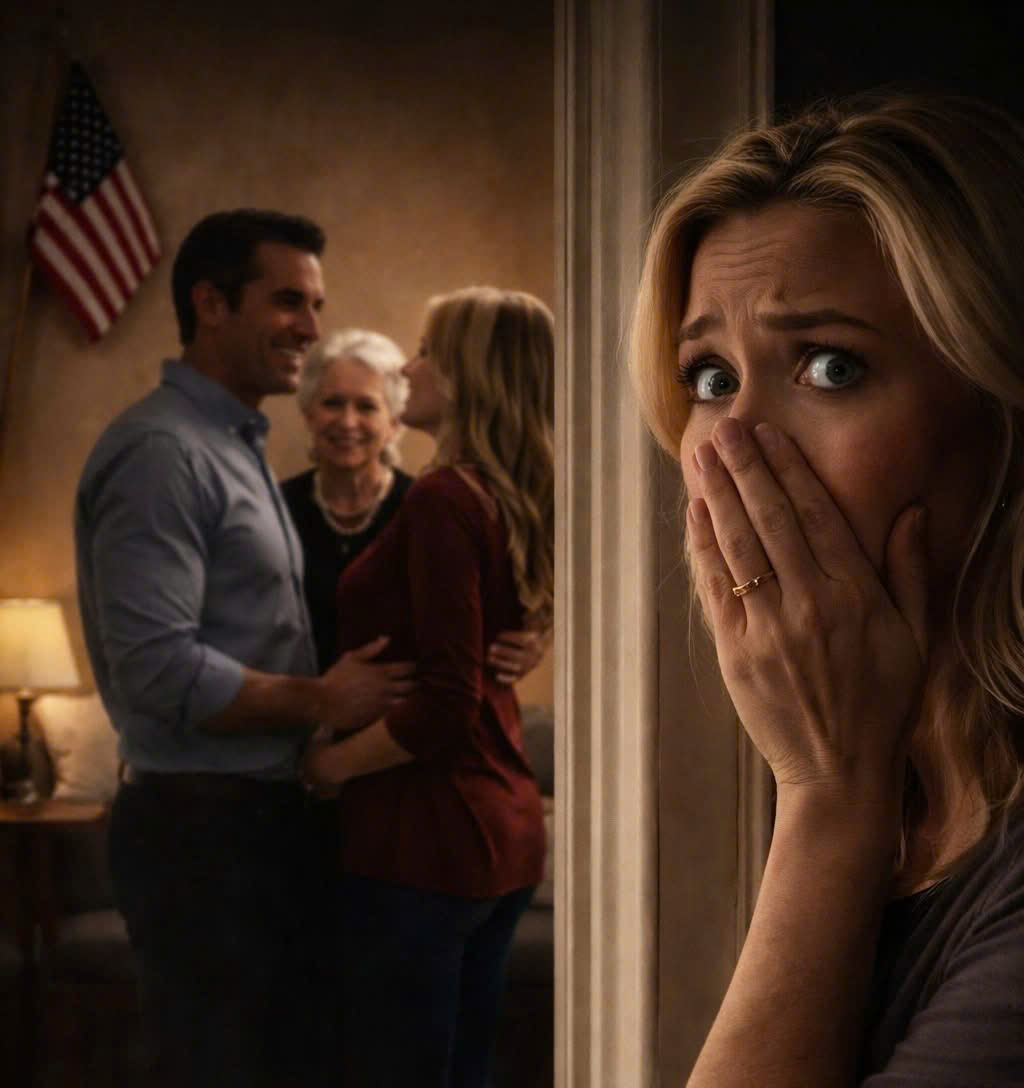
The last thing my husband ever said to me as my husband was, “This is probably for the best.”
Not I’m sorry.
Not I never meant for this to happen.
Not even take care of yourself.
Just that.
“This is probably for the best.”
He said it while adjusting the cuff of his navy suit, standing in the hallway outside courtroom 4B like we had just finished an unpleasant board meeting instead of dissolving fifteen years of marriage. The fluorescent lights above us made everyone look slightly unreal. My attorney stood beside me holding a leather folder against his side. Adrian’s attorney was already checking his phone. My former mother-in-law, Evelyn Mercer, sat at the far end of the bench with her purse in her lap and that thin composed expression women like her wear when they think dignity can hide satisfaction.
My ex-husband’s name was Adrian Mercer.
He was forty-two years old, founder of Mercer Strategic Logistics, a man who liked to say he had “built everything from the ground up,” which was true only if you ignored the quiet lies, the borrowed money he never disclosed, the taxes he treated like flexible suggestions, and the people he used as stepping stones and then forgot the moment they sank.
I didn’t cry in the courthouse.
People imagine you cry at the end of a marriage. They imagine trembling hands, a dramatic exit, grief arriving neatly on cue because that’s where movies put it. Real grief almost never has that kind of timing.
I had cried months earlier in the laundry room with the dryer running so my children wouldn’t hear me. I had cried sitting in my car in a grocery store parking lot after finding the first message on Adrian’s phone. I had cried while rinsing rice at the sink, while folding towels, while helping my youngest son tie his shoes, because betrayal does not politely wait for privacy.
By the day the divorce papers were signed, the crying was done.
In its place was something steadier.
The judge asked if I agreed to the terms as presented.
“Yes, Your Honor,” I said.
My voice did not shake.
Across the aisle, Adrian shifted in his chair with visible impatience. He had always hated delays. Waiting, paperwork, process, accountability—anything that slowed him down irritated him.
The settlement looked simple on paper. He kept the Beacon Hill townhouse. Most of the liquid assets remained untouched pending standard disclosures. The business accounts stayed with him. I took the children and a modest settlement, plus temporary relocation rights under a provision he had skimmed but not fully understood.
To anyone watching, it looked like I had walked away with less.
That was part of the design.
My attorney, Graham Keller, had spent three months preparing the part Adrian never imagined I was capable of preparing.
Three months earlier, I still thought I was dealing with infidelity.
I did not yet understand I was dealing with a murder plan.
It started with a message.
Adrian had fallen asleep on the couch with his phone face-up on his chest. I was coming downstairs to turn off a lamp when the screen lit up. I didn’t touch it at first. I just looked.
The sender’s name was saved as Camille Arden.
The message preview read:
Once the policy pays, we can stop pretending.
My stomach turned.
At first I told myself there had to be another meaning. Business. Insurance. A client. Something administrative.
Then another message appeared.
You said her route never changes.
I stood there in the quiet living room while the screen went dark again in his hand.
The affair itself was not difficult to confirm after that. Late-night calls. Hotel receipts hidden under expense categories. Calendar blocks labeled as investor dinners that never existed. He had become sloppy in the way people do when they mistake being believed for being clever.
What I was not prepared for was what sat underneath the affair.
Three weeks after that first message, I came downstairs for water just after midnight and heard Adrian’s voice through the cracked patio door.
He was outside. Speaking low.
“She leaves at 8:10 every morning,” he said. “Same road, same turn near the rotary. If something happens before year-end, the coverage pays in full.”
A woman’s voice answered through speakerphone. Warm. Amused.
“And no one will question it?”
Adrian laughed softly.
“It’ll look like a brake failure.”
I stopped breathing.
That’s the thing about moments like that. People think there is some cinematic clarity to them. That your mind sharpens immediately, that your body reacts in a single clean line.
Mine didn’t.
For a few seconds, my brain rejected what I was hearing so completely that my body kept trying to place it into some other category. Business jargon. Dark humor. A conversation taken out of context.
Then Adrian said, “After that, the policy goes into trust. We’ll be fine.”
And the last defense I had left inside me collapsed.
They were talking about me.
My husband and his mistress were calmly discussing how to make my death look accidental and how much money it would bring them after I was gone.
I stayed in the hallway until he came back in. Then I walked upstairs on numb legs, got into bed beside him, and stared at the ceiling until dawn.
I did not confront him.
I did not scream.
I did what women do when they realize that survival depends on not being underestimated for one minute longer.
I made a plan.
The next day I created an encrypted email account from the public library two towns over. That same afternoon I contacted Graham Keller, a financial litigation attorney a former client had once recommended to me after a zoning dispute. He had a dry voice, excellent posture, and the particular stillness of men who know panic helps no one.
“I need advice,” I told him in our first meeting.
He asked if my husband was physically abusive.
“No,” I said. “He’s more efficient than that.”
Graham looked at me over his glasses.
“What does that mean?”
I slid my phone across the table and played the recording I had made from the hallway the night before.
He listened without interrupting.
When it ended, he leaned back in his chair and was silent for a long moment.
Then he said, “You cannot let him know you know.”
That became rule number one.
For the next three months, I lived inside two parallel lives.
In one life, I was still Adrian Mercer’s wife. I made dinner. Signed school forms. Sat across from him at the breakfast table while he scrolled market reports and complained about labor costs and fuel prices. I watched him kiss our daughter on the forehead before school and wondered how a man could sound so ordinary in the morning after discussing my death at midnight.
In the other life, I copied everything.
Insurance documents.
Undeclared accounts.
Transfers through shell entities.
Offshore holdings routed through Harbor Crest Advisory, a company name that appeared nowhere in our official disclosures.
Expense reports used to hide hotel stays with Camille.
And one especially useful series of internal emails proving that Adrian had deliberately omitted income streams from Mercer Strategic Logistics when restructuring his tax position after a government contract.
The affair mattered emotionally.
The finances mattered legally.
The murder plan mattered most of all.
Graham and I built the case carefully. Not for criminal charges—not yet. For leverage. For timing. For survival. He told me, very early on, that men like Adrian rarely collapse because of the first bad thing they do. They collapse because they do too many bad things at once and eventually trip over the pile.
I filed for divorce when everything was ready.
Adrian didn’t fight much. That should have scared me more than it did.
He seemed relieved, if anything. Camille—who I still believed at the time was really named Camille—had clearly convinced him I would be easier to replace than manage. He wanted efficiency, not spectacle. His family wanted the same.
Evelyn Mercer attended every hearing.
She never spoke to me directly, not once. She didn’t need to. Her expression did all the talking. She believed her son was moving upward into a brighter future with a younger woman and a new baby. She believed I was a complication being professionally removed.
Her husband, Leonard Mercer, came only once. He looked uncomfortable the entire time and kept clearing his throat like a man who had wandered into the wrong room but lacked the courage to leave it. Adrian’s younger sister, Brianna, came to the final hearing and smiled when she thought I wasn’t looking.
By then, I was far past being wounded by any of it.
Wounds were for the months before.
By the day the judge signed the decree, I was working from checklists.
The minute we stepped out into the courthouse corridor, Adrian said, “I’ll have someone coordinate with you about visitation once we know where you’re settling.”
“You’ll go through my attorney,” I said.
That made him pause.
“There’s no reason to be difficult.”
“I’m not being difficult,” I said. “I’m being clear.”
He gave me the look he used to reserve for waiters who got his order wrong. Mild contempt. Mild surprise that anyone beneath his current emotional needs might have a position of their own.
Then he turned away.
Ten minutes later, my children and I were in a black town car headed to Logan Airport.
I had packed the night before. Three suitcases. Three passports. School records. Birth certificates. Two stuffed animals, because my youngest son Mason slept badly without his bear and my daughter Ava was old enough to pretend she didn’t need comfort but still young enough to notice when I remembered the things she didn’t ask for.
Lucas, my middle child, sat in the back seat staring out the window.
“Mom,” Ava asked quietly, “where are we going?”
“We’re taking a trip,” I said.
“For how long?”
“For as long as we need.”
“Is Dad coming?”
“No.”
She absorbed that in silence. Ava had my habit of understanding more than was said aloud.
At the airport, everything moved quickly. Security. Boarding. Carry-on in the overhead compartment, folder still inside with copies of everything Graham and I had prepared.
By the time we were in the air over Boston Harbor, Adrian was on his way to Rosehill Women’s Center in Back Bay with Camille on his arm and his family orbiting around them like they had already been invited into some better version of the future.
I did not see that part happen, of course.
But later I reconstructed it from enough sources that I know exactly how it must have looked.
Evelyn arrived first, carrying flowers. Brianna took photos in the lobby. Leonard stood off to one side, hands in his coat pockets. Adrian checked his phone twice and frowned when my name didn’t answer.
Camille wore cream cashmere and a smile that photographed beautifully. That much I know because Brianna posted a now-deleted story with the caption:
New beginnings for our family.
The ultrasound room was dim. Clean. Soft jazz playing too quietly through ceiling speakers. One of those spaces designed to make women feel safe and men feel important.
The technician began the scan.
Then paused.
“I’m going to ask the doctor to come in,” she said.
Camille’s smile faltered.
“Is something wrong?” Evelyn asked immediately.
The doctor entered a minute later with a tablet in hand and the professionally neutral expression of someone about to say something nobody in the room wants said.
He asked a few questions first. Date of last cycle. Prior tests. Estimated conception timeline.
Camille answered quickly, but not quite cleanly enough.
Adrian interrupted. “What exactly is the issue?”
The doctor turned the monitor slightly.
“The measurements do not support the gestational timeline you’ve described.”
Silence.
“What does that mean?” Adrian asked.
“It means,” the doctor said calmly, “that this does not align with the dates you’ve given. At minimum, the pregnancy would have predated your stated relationship.”
That was the line that blew the first hole in the room.
Before anyone could fully react, Adrian’s phone rang.
Graham Keller.
He answered because his father told him he should. Leonard, to his credit, at least had enough instincts left to recognize that the third call from a lawyer on a morning like that might matter.
Adrian stepped into the hall.
“Mr. Mercer,” Graham said in his level voice, “I’m calling regarding your financial disclosures in the matter of Mercer v. Mercer.”
Adrian already sounded irritated. “The divorce is final.”
“Yes,” Graham said. “Based on the disclosures you submitted. We have now verified that those disclosures were materially incomplete.”
No answer.
“We have identified undeclared accounts, offshore transfers, and income streams routed through Harbor Crest Advisory that were not included in your sworn statement.”
“That’s a misunderstanding.”
“You are welcome to present that position to federal investigators,” Graham said. “Several of your accounts have been temporarily frozen pending review. The IRS has initiated formal inquiries. In addition, the non-disclosure clause in your settlement has now been triggered. Asset division will be reassessed.”
There are moments in a person’s life when reality arrives so fast it physically changes their posture.
This was one of those moments for Adrian.
By the time he walked back into the ultrasound room, he had gone from smugly restored husband-to-be to a man trying and failing to keep his face arranged.
His mother saw it first.
“What happened?”
Adrian looked at Camille.
Then at the screen.
Then at his family.
“Everything,” he said.
While they were standing in that room watching the future split open under their feet, my children and I landed in Vancouver.
From there, a driver took us to Richmond, British Columbia, where I had rented a modest two-bedroom house in a quiet neighborhood near a good elementary school and a public park with a faded basketball hoop. It was not glamorous. It was not meant to be. It was safe, anonymous, and far enough away to buy time.
The house smelled faintly of lemon cleaner and old wood.
Lucas looked around and said, “This is where we’re staying?”
“This is where we start,” I said.
Ava walked through the kitchen slowly, taking in the small table, the narrow fridge, the groceries already inside because I had arranged that too.
Mason set his stuffed bear on the couch and asked if there was internet.
It was such a little question.
It nearly broke me.
Because little questions mean children still believe in tomorrow.
That first night, after they slept, I stepped onto the back patio and finally returned Graham’s call.
“We’re here,” I said.
“Good,” he replied. “Then we proceed.”
“What happened?”
He gave me the summary without drama.
Accounts frozen.
IRS inquiry opened.
Counsel for Mercer Strategic Logistics alerted.
Settlement reopened.
Emergency protective actions in motion.
I leaned against the railing and let it all settle into me.
Not triumph.
Something quieter.
Like weight shifting back toward where it belonged.
The first calls from Adrian started that evening.
I did not answer.
The first call from Evelyn Mercer came the next morning.
I ignored that too.
By the third day, they found me anyway.
I had been in Richmond less than seventy-two hours when Evelyn and Leonard Mercer appeared on my doorstep.
He looked tired. She looked shattered and furious at once, which is a difficult expression to wear but one she managed.
“Natalie,” she said as soon as I opened the door. “Please. We need to talk.”
I did not invite them in.
My children were inside eating toast.
“There’s nothing to discuss.”
Her composure cracked immediately.
“You have to help Adrian.”
“Do I?”
“This has gone too far.”
I almost laughed.
“He’s being investigated,” she said. “His accounts are frozen. Partners are panicking. The press is asking questions. He could lose everything.”
I met her eyes.
“He planned to kill me.”
Leonard flinched like he had been struck.
Evelyn went still.
“Natalie…”
“No,” I said. “You don’t get to act shocked now. Not from this distance. Not after sitting in that courtroom with a smile on your face. Not after celebrating your son’s affair in a clinic while I left the country with his children.”
Her mouth opened. Closed.
“You don’t understand—”
“I understand perfectly.”
She lowered her voice then, choosing a different strategy.
“Please. Whatever happened between you and Adrian, the children need stability.”
That one almost impressed me.
Using the children when I was the one who had removed them from a man planning my death.
I said it again, more quietly.
“He planned to kill me.”
This time Leonard looked at his wife, not me.
“Evelyn,” he said softly.
She ignored him.
“If there has been some misunderstanding—”
“A misunderstanding?” I repeated. “He discussed my brake lines on the patio. He discussed my life insurance. He discussed making my death look accidental.”
The last of the color left her face.
I will say this for her: in that moment, she believed me.
I could see it.
And because she believed me, she understood what kind of son she had raised far more clearly than she ever intended to.
Still, she straightened.
“You could still help him.”
“No,” I said.
I closed the door gently.
Two days later, Camille disappeared.
At first Adrian thought she was panicking under pressure. He called. Texted. Sent flowers to an apartment she no longer occupied. Her phone went dead. The fake prenatal appointments stopped. The boutique concierge doctor stopped returning calls because, as it turned out, the receipts Brianna had been showing people so proudly had not all come from the same clinic.
Then Adrian got his answer.
Camille called from a blocked number.
Her real name, he learned in that conversation, was Vivian Shaw.
And she had never loved him at all.
“My brother trusted you,” she said.
Adrian was in his office when the call came, though “office” is a generous word for what remained of that part of his life by then. Three senior managers had resigned. Two banks had suspended credit review. One government contract had gone into compliance audit.
“What are you talking about?” he asked.
“Marcus Shaw,” she said. “Does that name mean anything to you?”
It did.
Of course it did.
Marcus Shaw had been a mid-level development partner Adrian brought into an energy logistics expansion three years earlier. Adrian had assured him the numbers were solid. Assured him the shell structure was temporary. Assured him the risk was manageable.
Then Adrian moved money.
Marcus took the fall.
He lost his capital, then his house, then his mind.
Six months later, he killed himself.
Vivian said all of that in a voice so calm it must have terrified Adrian more than rage would have.
“I changed my name,” she told him. “I waited. I got close to you. I let you think I was easy to fool.”
His silence told her she had him.
“You destroyed your own family for me,” she said. “That was almost too easy.”
“And the baby?” he asked, because even at the end men like Adrian still reach first for the part that humiliates them most visibly.
“There is no baby,” she said.
He did not speak.
“I was never pregnant. The positive tests were staged. The appointments were arranged. The timing confusion was on purpose. I wanted your mother in that room. I wanted all of you there.”
He whispered, “You reported me.”
“Yes.”
“Why?”
There was a pause.
“Because Marcus is dead,” she said. “And you were still having catered lunches and quarterly growth meetings.”
Then the line went dead.
That was the moment Adrian lost the last illusion still holding him upright.
The mistress gone.
The baby fake.
The revenge deliberate.
The authorities real.
The wife beyond reach.
After that, the collapse accelerated.
Mercer Strategic Logistics did not disappear overnight, but it started to fold inward the way damaged buildings do before they finally give. Quietly first. A paused merger. Withdrawn investors. Board review. A story in the business press about discrepancies in executive disclosures. Then a second one naming Harbor Crest Advisory. Then a third connecting Adrian to prior partnership complaints, including Marcus Shaw’s estate.
Brianna deleted her social media for a week. Then for good.
Evelyn stopped calling me after the second refusal.
Leonard sent one email with no subject line that read only: I am sorry for what I did not stop.
I did not answer.
Adrian called for the first time six weeks after the divorce.
By then, Ava had started at her new school and already found the quiet corner of the library she preferred. Lucas had joined a neighborhood basketball program and was beginning, slowly, to laugh like himself again. Mason had stopped asking every night whether his father knew our new address.
I almost didn’t answer.
But I did.
“Natalie,” he said.
His voice sounded hollowed out. Not theatrically remorseful. Just worn down by the friction of consequence.
“What do you need?”
He let out a breath.
“I wanted to say I’m sorry.”
There are words that arrive too late and still matter, though not in the way the speaker hopes.
I looked out the kitchen window at my son shooting baskets alone in the driveway.
“I believe that you regret this,” I said.
Silence.
“That isn’t the same as being sorry for who you were while you were doing it.”
He swallowed hard enough that I heard it through the line.
“I want to do better with the kids.”
That, at least, was a real sentence.
“Then do better,” I said. “Consistently. Through the structure that’s already in place. On time. No manipulation. No surprises.”
“I will.”
There was a pause.
Then, quietly: “Is there any chance for us?”
I had known that question was coming.
Men like Adrian almost always imagine their remorse is more powerful than the memory of the danger they created. They confuse being devastated with being transformed.
“No,” I said.
He didn’t argue.
Maybe because he finally understood. Or maybe because he no longer had the strength.
Either way, the answer stayed where I put it.
Months passed.
Not dramatically. Just steadily.
That is one of the things no one tells you about surviving something awful: the healing rarely announces itself. It arrives disguised as ordinary life. School lunches. Grocery lists. New routines. The first morning you realize you slept through the night. The first time your daughter asks if you’re happy and you don’t have to think long before answering.
I found part-time work with a landscape design firm outside Vancouver. Nothing glamorous. Honest work. Work that ended at a reasonable hour and let me come home before dark. The children settled. The legal reassessment concluded. I received what was fair, not extravagant. Enough to build from. Enough to correct what had been hidden.
I did not press for punishment beyond the truth.
Truth was punishment enough.
Adrian remained in the children’s lives carefully, formally, under supervision for a time and then under stricter but stable boundaries. He showed up more often than I expected. Less perfectly than he promised. But more often than before. I let the children have whatever version of a father he could still manage to become.
What I did not do was confuse that with redemption.
One Sunday morning nearly a year after we left Boston, I stood in the kitchen while sunlight moved across the floorboards and watched my three children exist without tension.
Ava reading.
Lucas arguing with a toaster.
Mason coloring with his tongue pressed lightly to his lip.
No fear in the room.
No waiting for a phone to light up.
No second life under the first one.
Just peace.
That was when I understood fully what I had actually won.
Not the legal process.
Not the reassessed assets.
Not the moral victory people like to imagine in stories like this.
What I won was the ability to stop waiting for someone else’s choices to determine whether my life was safe.
That was the real ending.
Not the day the judge signed the papers.
Not the day the fake pregnancy collapsed.
Not even the day Adrian said he was sorry.
The real ending was quieter than that.
It was the day I looked around a small kitchen in a house I had chosen, in a life I had rebuilt, and realized there was no part of me that wanted to go back.
And there still isn’t.

![[FULL STORY] She Said She “Settled” for Me — Then Came Back When I Finally Found Someone Better](https://social-media.rabedo.com/thumbnails/1777551374_f790307d-1054-4967-b513-8b2d12c75fc3.png)


![[FULL STORY] My girlfriend asked me to play a stranger because her "successful" ex was visiting, so I decided to expose his dark criminal past.](https://social-media.rabedo.com/thumbnails/1776999851_C13.png)