The first time I saw the wedding invitation, I thought it was a joke.
The envelope was thick, cream colored, expensive enough to tell me the sender wanted to be admired before the card was even opened. My name was written across the front in gold calligraphy, the kind that tried too hard to look elegant. I stood in my kitchen in East Point, Georgia, one hand still dusted with flour from the biscuits I had been making for my sons, and stared at it for a full minute before I broke the seal.
Inside was a formal invitation to the wedding of Vincent Hale and Cassandra Whitmore.
Saturday, November 18th.
The Brookhaven Manor Club.
Black tie.
Reception to follow.
I almost laughed.
Vincent never did anything halfway. Not when he was charming strangers. Not when he was humiliating me. Not when he was destroying a life and calling it ambition.
Then I saw the handwritten note at the bottom, in blue ink I recognized immediately.
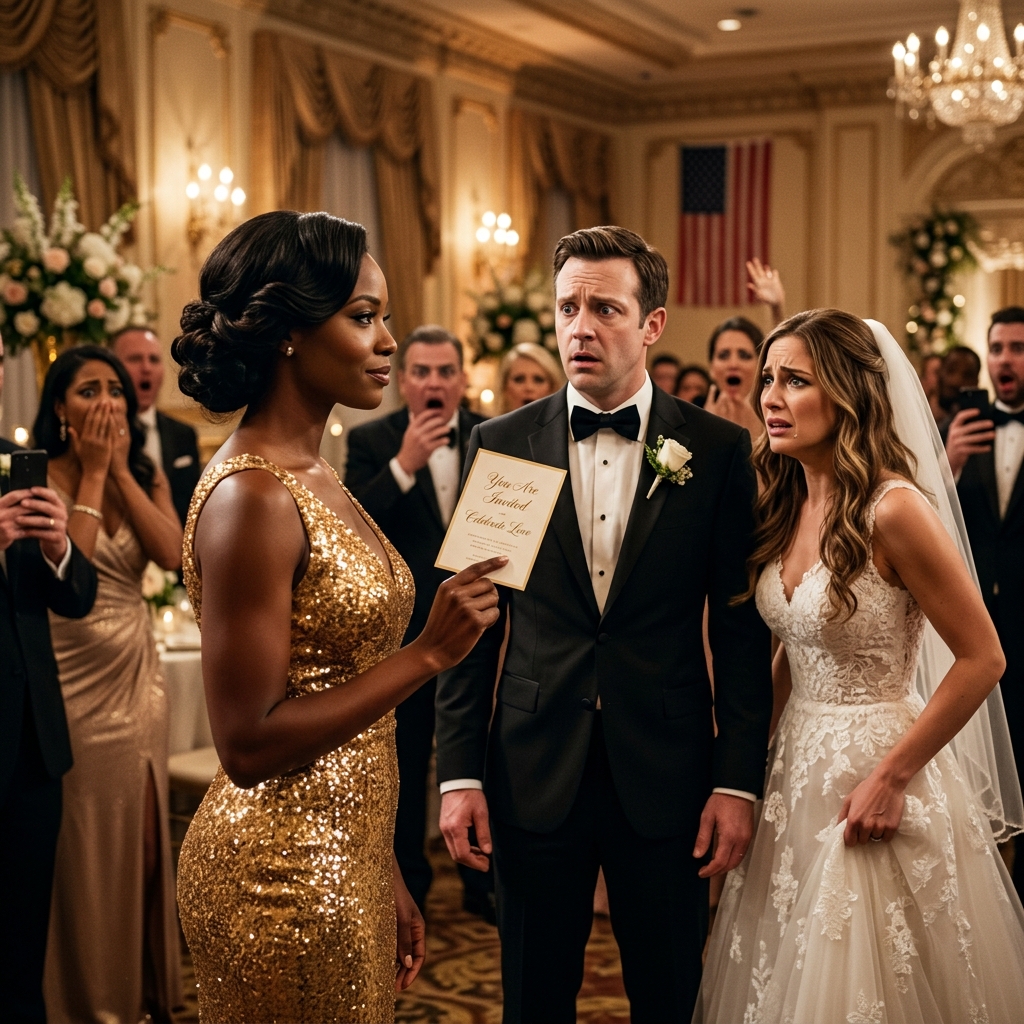
Bring your sewing machine. Maybe you can fix the bride’s hem.
That’s all those little hands were ever good for.
For a second, the kitchen around me vanished.
I was no longer thirty six years old with two boys doing homework at my table.
I was twenty four again, standing in a courthouse hallway with mascara I had forgotten to wipe off from the night before, listening to my husband tell his lawyer I had never contributed anything meaningful to the marriage because sewing wasn’t a real profession.
I was twenty eight, nursing a feverish child at two in the morning while Vincent stumbled through the front door smelling like another woman’s perfume and expensive whiskey.
I was thirty one, watching him carry my grandmother’s Singer machine out of the house after the divorce because technically it had been purchased during the marriage and technically the law allowed him to steal the last sacred thing I had left.
That note in the invitation did not just insult me.
It reached backward through years and pressed every bruise he had ever left where nobody could see.
“Mama?”
I looked up. My younger son, Mason, was sitting at the table with his pencil between his teeth and his math worksheet untouched in front of him.
“You okay?”
I folded the card closed.
“I’m fine, baby.”
My older son, Elijah, who had inherited my habit of noticing what people wished he would miss, looked up from his science packet.
“That from Dad?”
The room fell quiet in the way only a room with children of divorce can. They knew how to read tension before they knew long division.
“Yes,” I said.
“What does he want now?” Elijah asked.
I should have lied. I should have told them it was nothing. But I was tired of teaching my sons that cruelty had to be hidden to remain polite.
“He’s getting married,” I said. “He sent an invitation.”
Mason frowned. “Why would he invite you?”
Before I could answer, the front door opened and James stepped inside carrying two grocery bags and a pumpkin pie from the bakery on Glenwood. He used his shoulder to close the door and looked between my face and the card in my hand. He knew instantly something was wrong.
James had a way of reading a room that made people either feel safe or exposed. With me, it had always made me feel safe.
He set the bags down.
“What happened?”
I handed him the invitation.
He read it once.
Then he read the note again, slower.
His face did not change much, but I had learned the meaning of his silences. The air around him turned still. Controlled. Dangerous.
“Mason,” he said gently, without taking his eyes off the card. “Can you and your brother put the groceries away for me?”
The boys slid from their chairs. They liked James. Trusted him. Followed his voice without question. When they disappeared into the pantry area, James looked at me.
“He sent this on purpose.”
“Yes.”
“He wants you there.”
“Yes.”
“He wants an audience.”
I let out a breath I had been holding since I opened the envelope.
“He wants me to show up looking small.”
James placed the invitation on the counter with a carefulness that frightened me more than anger would have.
“Then that’s the one thing you will not look.”
I leaned against the sink.
“I wasn’t going to go.”
His eyes held mine.
“That’s not true.”
No, it wasn’t. I hated that he knew me that well.
Part of me wanted to stay home, protect my peace, keep my dignity far away from Vincent and his polished little circus.
But another part of me, the deeper part, the one my grandmother had stitched into existence, knew that if I didn’t go, some small corner of me would always feel as though I had let him write the ending.
James stepped closer.
“Do you want to go?”
I looked toward the pantry where my sons were arguing softly about where the canned yams belonged.
I thought about every year Vincent had made me feel replaceable.
Every time he laughed when I talked about opening my own shop.
Every time he called my work domestic, cute, small, feminine, unserious.
Every time he stood on my labor and then mocked the hands that held him up.
“Yes,” I said quietly. “I think I do.”
“Then you’re going.”
I laughed once, bitter and short.
“In what? My church coat?”
“In victory.”
He said it so simply that I almost smiled.
Then he picked up the card again.
“There’s something else we need to talk about.”
I looked at him.
James set the invitation down and rubbed a hand over his jaw like a man reorganizing the truth before he placed it in someone else’s hands.
“When we met, I told you I worked in construction.”
“You do.”
“I left out some details.”
I stared at him.
“What details?”
He held my gaze.
“I own the company.”
“What company?”
“Mitchell Urban Development.”
I blinked. Then blinked again.
Everybody in Atlanta knew that name.
Mitchell Urban Development had built half the skyline my sons liked pointing at from the freeway. Their name was on commercial projects, civic centers, hospital wings, school expansions, mixed-use towers, redevelopment plans. They weren’t just successful. They were one of those names people lowered their voice around because money had turned into influence and influence had turned into gravity.
I laughed, because it was that or sit down on the floor.
“No.”
“Yes.”
“You own it.”
“Yes.”
“The company with the Midtown tower and the airport contracts and the…”
“Yes.”
I stared at the man standing in my kitchen in faded jeans and a plain black sweater, the same man who had spent the previous Saturday on my apartment floor helping Mason build a cardboard fort, the same man who drove a dented truck, ate leftovers without ceremony, and never once led with his status.
“You let me think you were a site manager.”
“I let you think I was a man worth knowing before the rest of it got in the way.”
I should have been angry. Maybe part of me was. But it was complicated by the fact that I understood exactly why he had hidden it.
Vincent had been flashy when he had nothing.
James had been quiet while holding everything.
“How wealthy are you?” I asked.
He exhaled through his nose.
“Enough that your ex-husband would probably forget how to stand if he saw us walk in together.”
I stared at him for one beat, then two.
Then I started laughing so hard I had to grip the edge of the counter.
The boys came around the corner, alarmed.
“What happened?” Mason asked.
“Elijah,” I said, wiping tears from my eyes, “apparently your mother has been dating a very sneaky billionaire.”
James muttered, “Not technically a billionaire.”
Elijah’s eyebrows shot up.
Mason’s mouth fell open.
“You’re rich rich?” he asked.
James looked at him gravely.
“I’m pie rich. Does that help?”
Mason considered this.
“That’s pretty rich.”
The tension cracked. For a moment, all four of us laughed.
But later that night, after the boys were asleep and the apartment had settled into the soft hum of the refrigerator and city traffic outside, James and I sat at my kitchen table with the invitation between us.
“I should have told you sooner,” he said.
“Maybe.”
“Are you angry?”
I thought about it honestly.
“I would have been, if you had treated me like I was too fragile to know the truth. But you didn’t. You just waited.”
He nodded once.
“I needed to know you wanted me for me.”
I traced the gold edge of the envelope with one finger.
“You realize you could have told me you were poor and I still would’ve kept dating you.”
A smile touched his mouth.
“I was hoping that was true.”
“It was.”
Silence stretched between us, easy and warm.
Then I picked up the invitation again and looked at the cruel little note.
“He still thinks I’m the woman he left.”
James’ eyes hardened.
“That’s because men like him don’t believe other people continue existing after they walk away.”
I looked at him.
“What do we do?”
He leaned back in his chair.
“You tell me one thing first.”
“What?”
“What do you want when you walk into that room?”
I didn’t answer immediately.
Not because I didn’t know, but because saying it aloud would make it real.
Finally I said, “I want him to see me.”
James waited.
“I want him to see what he couldn’t break.”
His expression softened.
“Then that’s what he’ll see.”
I looked down at my hands.
These hands had hemmed choir robes, prom dresses, church suits, funeral blouses, Easter outfits, children’s costumes, altar cloths, and curtains. They had mended sleeves by lamplight and sewn patches onto knees and stitched pillows from donated fabric and turned remnants into winter pajamas. They had soothed sick children and folded laundry and held grief and held hunger and held on when holding on was all I had.
Vincent saw these hands and saw smallness.
My grandmother had seen these same hands and called them power.
“The dress,” I said. “I’m making it.”
James did not hesitate.
“Of course you are.”
“I don’t want designer labels. I don’t want stylists. I don’t want some boutique trying to turn me into a woman I’m not.”
He reached across the table and covered my hand with his.
“Then go as yourself.”
I turned my hand over and laced my fingers through his.
“Gold,” I said.
He smiled slightly.
“Because of your grandmother’s machine.”
“Yes.”
My grandmother, Ruthie Bell Carter, had taught me to sew on a cast-iron Singer machine with gold lettering worn thin by time and touch. She used to tell me, Baby, people who can make something from nothing have no reason to fear people who only know how to spend.
I had not understood then how often those words would save me.
I met Vincent Hale when I was twenty three and still thought hunger in a man meant drive.
He came to New Hope Baptist three Sundays in a row before speaking to me. He wore good cologne, good leather shoes, and a smile practiced enough to feel intimate on contact. He said I looked different from the women he usually met. Said I seemed grounded. Said he liked that I wasn’t flashy.
At the time, I mistook being chosen for being valued.
He courted me hard. Flowers. Dinners. Long calls. Promises.
He said he admired that I could create things with my hands. Said he loved that I was old-fashioned in the best way. Said I made him want a real life.
I believed him because women raised on hope often do.
The first year of marriage wasn’t terrible. That was the genius of Vincent. Cruelty arrived in tailored layers.
A suggestion here.
A joke there.
A correction in public framed as concern.
He told me not to wear my own dresses to events because they made him look cheap.
He told me my little side work from the apartment wasn’t ambitious enough for a man like him.
He told me talented women were fine, but powerful men needed polished wives.
He told me if I really loved him, I would stop wasting energy on scraps and thread and focus on helping him build something bigger.
By the time Elijah was born, I had stopped singing in church.
By the time Mason was born, I had stopped taking custom clients except in secret.
By the time he started cheating openly, I had almost stopped hearing myself.
The first time I found messages from another woman, I confronted him with shaking hands.
He sat at the edge of our bed, calm as weather.
“You went through my phone?”
“You’re sleeping with someone else.”
He gave me a look I would come to know too well. Not guilt. Not shame. Annoyance.
“You make everything dramatic.”
“You’re cheating on me.”
“So what if I am?”
I remember the room tilting slightly, as if my body were preparing for impact before my mind caught up.
“We have children.”
He stood, straightened his cuff, and said the sentence that would live in me for years.
“And what exactly are you going to do about it, Lena?”
He was the only one who called me Lena. I used to think it meant intimacy. Later I understood it meant possession.
“Leave?” he continued. “Go where? With what money? On what income? Sewing?”
He laughed, and I learned that night that a person can be split open without a single hand touching them.
The physical violence came later.
Not often.
Just enough to remind me he could.
One bruising grip on my wrist.
One shove into a doorframe.
One hand on my upper arm so tight I could see the print of his fingers afterward.
Men like Vincent don’t need to beat you every day. They just need to persuade you that worse is always available.
I left the night he grabbed me hard enough for Elijah to scream.
That sound ended my marriage before the law ever did.
I packed two backpacks and a diaper bag, buckled both boys into my old Camry, and drove without direction until dawn found us parked outside a twenty-four-hour gas station. A woman named Denise, who worked the morning shift and had kind eyes and no patience for male evil, brought me coffee and a biscuit and wrote the number of a shelter on the back of a receipt.
That was how rebuilding began.
Not with inspiration.
With survival.
The divorce was ugly, expensive, and designed to teach me my place. Vincent had better lawyers, better lies, better suits, better timing. He hid money. Moved things. Buried assets in entities with names I couldn’t pronounce. He painted me as unstable, emotional, vindictive.
The judge saw through some of it.
Not enough.
I got custody.
A thin support order.
A two-bedroom apartment.
And the humiliation of watching his assistant load my grandmother’s Singer machine into the back of a luxury SUV because marital property law had given a cruel man one more weapon.
I stood in the courthouse parking lot and watched the machine leave.
I still think something in me went silent that day.
For almost a year, I survived on alterations, church referrals, hemming uniforms, mending coats, and sewing children’s clothes from donated fabric. I bought a secondhand machine from a woman in Decatur whose grandmother had died. It rattled when it ran and skipped stitches on heavier material, but it worked.
I worked while my boys slept.
I worked while bills piled up.
I worked because making things was the one act nobody had managed to beat out of me.
Then one Tuesday afternoon in October, I was in a thrift store looking for upholstery fabric thick enough to turn into winter jackets for the boys when a voice behind me asked, “Do you know which of these will hold up better against sunlight?”
I turned and found James Mitchell holding two rolls of material and looking mildly defeated by both.
He was broad shouldered, dark skinned, serious faced, and dressed like a man who did real work with his body. No watch that screamed money. No cologne cloud. No performance.
I pointed to the heavier one.
“That one. Unless you want cracking in a year.”
He looked at the fabric, then back at me.
“How do you know?”
“I sew.”
“Everything?”
“Pretty much.”
He smiled then, slow and genuine.
“That explains why you looked offended when I picked the other one.”
I almost smiled back.
“That one was a bad choice.”
“Would you be willing to save a stranger from bad choices in aisle seven?”
That was how it started.
Coffee after checkout.
Then another coffee.
Then a walk.
Then dinner at a place where he knew the cook by name.
Then more.
He listened in a way I had forgotten men could. He remembered small details and treated them like important ones. He never rushed me. Never pushed. Never flirted like a man trying to conquer something. He just kept showing up, steady as morning.
He liked my boys without trying too hard. Helped Mason with a school project. Taught Elijah how to properly salt a driveway before ice. Took us all to the park one Saturday and spent an hour pretending not to be exhausted by ten-year-old energy.
Love did not arrive like lightning with James.
It arrived like heat in winter.
Quiet, lifesaving, undeniable once felt.
Still, I did not know who he really was until the invitation came.
And now that I knew, everything in my life seemed to stand at the edge of a stage, waiting.
Three days later, James sent a car for me while the boys were in school.
When the driver brought me to a private atelier space downtown, I stopped just inside the door.
Bolts of silk lined the walls. Dress forms stood in rows. Light poured in from high windows. On a long center table, arranged with reverence, were spools of gold thread, lengths of satin, silk crepe, hand-beaded trim, and sketches printed from photos James had taken of my old designs over the months without telling me.
I turned slowly.
“You did this?”
A woman in black glasses stepped forward. “Mr. Mitchell said the designer would need options.”
I looked at James.
“I said I was making the dress.”
“You are,” he replied. “I just removed the part where scarcity makes that harder.”
I stared at him, then at the fabrics again.
My throat tightened.
No one had ever funded my talent before.
Not really.
People had paid for labor. Ordered output. Bought a result.
James had invested in possibility.
For the next two weeks, I lived between school pickup, client hemming, dinner, homework, and the atelier. I sketched at the kitchen table after midnight. Draped fabric over forms while old gospel played softly through a speaker. Unpicked seams and started over. Chased the exact fall of the skirt I wanted, the exact shape of the neckline, the exact balance between elegance and force.
I did not want to look pretty.
I wanted to look unforgettable.
The dress became liquid gold in my hands. Soft but commanding. Elegant without apology. A gown that honored every church lady who had ever pressed twenty dollars into my palm and told me my gift would make room for me someday. A gown for the woman I had become after being told for years I was too ordinary to matter.
James came by late one night when I was hand stitching the bodice.
He stood behind me for a long moment before speaking.
“You haven’t moved in hours.”
“I’m close.”
He walked around the mannequin slowly. His expression changed in real time from admiration to something deeper.
“Lena.”
My eyes lifted to his.
“It’s beautiful.”
I smiled faintly.
“It’s not finished.”
“Neither are we. That hasn’t stopped me.”
He said things like that in a tone so matter of fact that they landed deeper than flattery ever could.
As the wedding approached, another development shifted the whole thing from satisfying to biblical.
James had people. Lawyers. Analysts. Investigators. Quiet professionals who knew how to pull public records without turning them into gossip.
One evening he came to my apartment with a folder.
“What is that?” I asked.
“Information.”
I put down the measuring tape I had been using on Mason’s school uniform pants.
“About what?”
“About Vincent.”
I went still.
James placed the folder on the table.
“When your divorce was finalized, his disclosures didn’t match certain holdings that now appear to have been active during the marriage.”
I stared at him.
“You’re saying he hid assets.”
“I’m saying I’m almost certain he did.”
My stomach tightened, not with triumph but with the strange nausea that comes when an old wound is reopened and confirmed deeper than you knew.
“How much?”
He exhaled.
“Enough to matter.”
I sat down slowly.
“All those years,” I whispered. “All those hearings. All that humiliation. He stood there and said there was barely anything left.”
James’ voice was careful.
“I know.”
I looked at the folder but did not open it.
“And this is real?”
“Yes.”
“Can anything be done?”
“Yes.”
The apartment went very quiet.
For years I had told myself the past was buried because digging it up would cost too much. But some injustices do not rot with time. They wait.
“I don’t want revenge,” I said.
James nodded.
“I know.”
“I want the truth.”
“That can be arranged.”
I looked up at him.
“When?”
His eyes did not leave mine.
“After the wedding.”
I understood then. He wasn’t just handing me evidence.
He was handing me timing.
Vincent had chosen spectacle.
He was about to learn that spectacle works both ways.
Two days before the ceremony, I got a call from a number I didn’t recognize.
When I answered, a cool female voice said, “Is this Lena Hale?”
“It was once. Who’s asking?”
“This is Vanessa Whitmore. Cassandra’s mother.”
I sat up straighter.
“Yes?”
There was a pause long enough to signal distaste.
“I’m calling because I understand you have received an invitation to my daughter’s wedding.”
“I have.”
“Well. I think it would be best for everyone if you did not attend.”
I almost laughed.
“Did Vincent put you up to this?”
“No. I am acting in my daughter’s interest.”
That told me everything I needed to know. She wasn’t worried about me making a scene. She was worried about me existing in one.
“I appreciate your concern,” I said, “but your future son-in-law seemed very eager for me to be there.”
Her tone sharpened.
“My daughter does not need old embarrassments surfacing on her wedding day.”
Old embarrassments.
That was what women like me became in the mouths of women like her. Not history. Not damage. Not truth.
Embarrassments.
“I won’t embarrass anyone,” I said softly. “I’ll just attend.”
She lowered her voice.
“Whatever fantasy you’ve built around reclaiming dignity, let it go. Vincent has moved on.”
Something hot and calm settled in my chest.
“So have I.”
I hung up before she could answer.
That evening, while I adjusted the waist seam on the gown one last time, I noticed a delicate beaded appliqué pinned along the inner lining of the train. I hadn’t put it there.
James, who had been pretending to read while actually watching me, lifted one shoulder.
“Look closer.”
I removed the pins carefully and unfolded the lace-backed insert.
Beneath the beadwork was a small stitched monogram.
R.B.C.
Ruthie Bell Carter.
My grandmother’s initials.
I covered my mouth.
“How did you…”
He set down his book.
“You said she taught you everything. I thought she deserved to walk in with you.”
I started crying so fast it embarrassed us both.
James came to me immediately and gathered me into his arms while I laughed and sobbed against his chest.
“I don’t know what I did to deserve you,” I murmured.
He kissed the top of my head.
“Existing honestly seems to have done the trick.”
The morning of the wedding dawned cold and bright.
Atlanta in late November has a particular light, pale and sharp, as if the sky is glass and everything beneath it has been forced into clarity. I stood in my bedroom while a stylist James’ assistant had sent over pinned my hair, but I did my own makeup. I wanted my own face. Not a version airbrushed into belonging.
Elijah came into the room first when I was halfway dressed.
He stopped in the doorway and stared.
“Mama.”
My throat tightened.
“What?”
“You look like a movie.”
I laughed softly.
“That doesn’t even make sense.”
“It does to me.”
Mason squeezed in behind him and gasped dramatically.
“Dad is gonna throw up.”
I nearly ruined my eyeliner laughing.
James arrived exactly on time, not in his old truck, but in a black Escalade with a driver and two security men I had never met before. He wore a charcoal suit with no tie and looked like elegance had been stripped of vanity and rebuilt into authority.
When he saw me, he didn’t speak for several seconds.
Then he crossed the room, took my hand very carefully, and said, “There you are.”
Just that.
There you are.
As if I had not been assembling myself from ashes for years and he had known all along where I would land.
He knelt in front of the boys before we left.
“I need you two men to do me a favor tonight.”
Elijah nodded seriously.
“What?”
“Take excellent care of your grandmother and don’t eat all the pie before I get back.”
Mason narrowed his eyes.
“That depends on how long you’re gone.”
James looked at him solemnly.
“Fair.”
Then he stood and offered me his arm.
When we stepped outside, my mother and James’ driver exchanged one long, approving look that contained entire volumes of Southern judgment and blessing.
The drive to Brookhaven Manor Club took thirty minutes.
I watched the city pass by through tinted glass and felt strangely calm. Not because I wasn’t nervous. Because the fear had already had its years with me. Tonight did not belong to fear.
When the car turned into the long circular drive of the club, I could see guests moving through the tall front windows in formalwear and glitter. Valets in black coats. Floral displays lit from below. White roses everywhere.
Vincent always did love expensive things that looked innocent.
The vehicle came to a stop.
One security man stepped out. Then the other.
James exited and turned back toward me.
For one suspended second, I saw the scene the way the guests inside would see it. A black luxury SUV. Security. A powerful man in charcoal. Suspense gathering at the glass.
Then James extended his hand.
I placed mine in it and stepped out.
The cold touched my skin. My gown caught the afternoon light exactly the way I had hoped it would, not glittering, not flashing, but glowing. Quiet gold. The kind of gold that doesn’t ask permission to be seen.
James’ hand settled at the small of my back.
“You ready?” he asked.
I looked through the glass doors and saw heads beginning to turn.
“Yes.”
He opened the door.
Conversation inside thinned, then broke.
I heard it happen in waves. A hush near the entrance. Then whispers. Then the collective inhalation of several hundred people realizing something far more interesting than the planned event had just arrived.
Vincent stood at the altar beside Cassandra. He had his chest lifted in that old familiar way, as though confidence could compensate for character. Cassandra was beautiful in the polished, expensive manner of women who have never once been told no without assuming it was temporary. Her dress was ivory, fitted, dramatic.
And the second I saw the line of the bodice, my entire body went cold.
I knew that design.
Not every inch, but enough.
Three years earlier, before the divorce, I had sketched a custom bridal concept in a black-bound book I kept hidden in my closet, because dreaming in that house had felt safer on paper than aloud. Vincent had found the sketch once and laughed at it, telling me nobody with money would trust an amateur to dress them for a wedding.
The dress Cassandra was wearing wasn’t an exact copy.
It was worse.
It was my design simplified, flattened, handed to a luxury atelier and stripped of its soul.
James felt my body tense.
“What is it?”
I kept my eyes on the bride.
“He stole from me.”
James followed my gaze.
“How?”
“That dress. The original concept was mine.”
His jaw flexed once.
“Are you sure?”
“Yes.”
At that exact moment, Cassandra’s eyes met mine.
She saw the gown I wore. Saw James beside me. Saw the room reacting to us like weather had just entered the building. Then her gaze flickered down my body, back to my face, and something uncertain passed through her expression.
The minister faltered midsentence.
Vincent turned.
The color drained from his face so fast I almost pitied him.
Almost.
His eyes moved from me to James and back again, trying to reorganize the world into something he still controlled.
“Lena?”
The room was silent enough to hear fabric shift.
I smiled politely.
“Hello, Vincent. Thank you for the invitation.”
No one moved.
No one breathed.
James and I walked down the center aisle, not rushing, not apologizing, not performing. Just walking. Every guest had turned to watch. Phones were already rising.
We reached the third row, left side.
There it was.
The reserved chair.
And on the seat, propped like a little joke waiting to bloom, was a white card.
I picked it up.
Bring your sewing machine.
A few nearby guests saw the words and went visibly still.
I set the card back down, turned, and faced the altar.
“Quite the seating choice,” I said.
Vincent swallowed.
“What are you doing here?”
I let the question hang long enough for several people to hear how stupid it was.
“You invited me.”
A nervous ripple moved through the crowd.
Cassandra looked between us.
“Vincent,” she said under her breath, “who is this?”
Before he could answer, James stepped forward and extended a hand.
“James Mitchell.”
The effect was immediate.
Recognition is a physical thing. It moved through the room in murmurs. Heads turned. Eyes widened. Someone whispered, “Oh my God.”
Vincent stared at James’ hand for half a second too long before taking it.
His grip looked weak.
James’ voice was calm.
“We’ve crossed paths professionally. Your dealership handled one of our fleet contracts last year.”
A tiny muscle jumped in Vincent’s temple.
Cassandra’s eyes sharpened.
Mitchell.
She knew the name.
Of course she did.
Everyone in that room who cared about money knew it.
James stepped back beside me.
I looked up at the altar.
“Please,” I said. “Don’t let us interrupt. This is your day.”
If I had slapped him, he might have recovered faster.
But courtesy from someone you intended to humiliate is often the most devastating weapon in the room.
Vincent looked at me as if language had abandoned him.
Cassandra, to her credit, recovered first.
She looked directly at me and said, “I’m sorry. We’ve never met.”
“No,” I said. “We haven’t.”
Her gaze went to my dress.
“It’s stunning.”
“Thank you,” I replied. “I made it.”
That landed.
I saw it in the flicker of her eyes. The brief return of attention to her own gown. The first seam of doubt.
Vincent found his voice.
“Lena, this isn’t the time.”
I tilted my head.
“I agree. Which is why your note surprised me.”
His entire body stiffened.
“What note?” Cassandra asked.
I reached into my clutch and withdrew the invitation.
Then, because precision matters, I walked three steps forward and held it out to her.
She took it.
Read the handwritten line.
Read it again.
The air changed.
Cassandra lifted her eyes slowly to Vincent’s face.
“You wrote this?”
He reached for control the way drowning men reach for air.
“It was a joke.”
I smiled faintly.
“Interesting. Most jokes make more than one person laugh.”
A few people in the crowd made involuntary noises they quickly tried to swallow.
Cassandra’s cheeks colored, not with embarrassment for me, but with the dawning realization that she had walked into a public event without understanding the full moral quality of the man beside her.
I saw then that she was vain, yes. Opportunistic, likely. But not stupid.
“Wait,” she said, staring at me harder. “Did you say you made your dress?”
“I did.”
Her fingers tightened around the invitation.
“My dress…”
She stopped.
Her eyes moved from my bodice to the curve of the skirt, to the structure of the neckline, to the dramatic line of the back where gold draped into softness.
Then she looked at Vincent.
“My mother’s designer said the concept came from one of your personal archives. Something bespoke.”
Vincent’s face turned a shade I had only ever seen on men right before collapse.
I said nothing.
I didn’t need to.
Cassandra took one slow step away from him.
“What did you do?”
“Cass, don’t do this here.”
“Did you steal her design?”
His silence answered.
The room began to buzz.
A woman in the front row leaned toward another and whispered so loudly half the aisle heard her.
“Oh, this is filthy.”
Cassandra looked back at me.
“You designed this?”
“Yes,” I said. “Years ago. I never sold it.”
Her hand rose unconsciously to her own bodice, suddenly unsure of the dress she had chosen as a symbol of triumph.
Then she looked down at the note in the invitation again.
Understanding sharpened into disgust.
“You invited your ex-wife here to humiliate her wearing a stolen version of her work?”
Vincent reached for her arm.
“Cassandra.”
She yanked away before he touched her.
“No.”
She turned to face the guests, the minister, the room, the spectacle.
Then, very calmly, she removed her ring.
I watched Vincent realize too late that the event no longer belonged to him.
“I am not marrying a man who mocks talent he steals, humiliates the mother of his children, and thinks cruelty is style.”
She placed the ring in his palm.
Gasps fluttered through the crowd.
“This wedding is over.”
She stepped back from him.
For one wild second, Vincent looked at me as if I had done something monstrous by merely surviving in better lighting than he expected.
“Lena,” he hissed, “what do you want?”
I looked at him for a long moment.
Then I answered truthfully.
“Nothing from you.”
I let the silence expand before continuing.
“But since we’re finally in a room full of witnesses, I would like one thing clarified.”
James stepped beside me but said nothing.
I opened my clutch again and removed a thin envelope.
Not the legal filing itself. Just the first notice.
“While preparing for this lovely invitation, certain financial records came to light. Records suggesting that during our divorce, you concealed marital assets through shell entities and undeclared accounts.”
The room seemed to recoil.
Vincent’s face emptied completely.
“You’re lying.”
I handed the envelope to him.
He didn’t take it.
James did.
Then he held it toward Vincent.
“Counsel will be serving you formally Monday morning,” he said. “This is simply the courtesy version.”
There are moments when a person’s social death becomes audible.
That was one of them.
Whispers erupted openly now. Not subtle murmurs. Full disbelief.
“Hidden assets?”
“During the divorce?”
“Did he cheat her and steal from her?”
I saw Vanessa Whitmore in the second row go rigid with horror as the scale of the disaster became clear. She had wanted no embarrassment. Now she was seated in the center of a public moral collapse.
Vincent looked at James, then at me.
His voice dropped.
“You did this to me.”
I almost smiled.
“No,” I said softly. “You did this to yourself years ago. Tonight just happened to be the night it arrived.”
He took one step down from the altar.
“Lena, listen to me.”
“No,” I said, and for the first time my voice cut through the room like something honed. “You listen to me.”
He stopped.
Every guest went silent again.
“You spent years telling me I was small because my gift did not impress you. You laughed at my work, stole my designs, took my grandmother’s machine, lied in court, humiliated me in front of strangers, and wrote that note believing I would still show up here broken enough to entertain you.”
I lifted my hands.
“These hands clothed your sons. These hands helped pay bills when you were pretending to be bigger than you were. These hands built beauty in rooms where all you ever brought was appetite. And the fact that you could not see their worth was never a measure of me. It was a confession about you.”
He looked like he had been skinned alive.
“I loved you once,” I said. “That is the only reason you were ever close enough to hurt me. But that season is over.”
A tear slid down Vanessa Whitmore’s face, which I found both dramatic and deeply unnecessary.
Vincent’s voice broke on the next word.
“Please.”
That word startled the room more than anything else.
Because men like him never beg until there are witnesses.
“Please what?” I asked.
He opened and closed his mouth.
I saw him reach desperately for old power and find none.
“Don’t do this.”
James finally spoke.
“She already didn’t. She could have moved in silence. She chose dignity. You should be grateful.”
Vincent looked at him with naked hatred.
James looked back without blinking.
“If I were you,” James added, “I’d spend less time worrying about tonight and more time finding a very good attorney.”
Cassandra, now fully free of the fantasy she had dressed herself for, stepped down from the altar and walked directly toward me.
For one strange second the room seemed to think she might slap me, which would have been both stupid and off-brand.
Instead, she stopped at arm’s length.
“I owe you an apology,” she said.
I studied her.
“You don’t owe me for him.”
“No,” she replied. “But I do owe you for wearing stolen work while believing his version of you.”
The honesty in that was unexpected.
I gave a small nod.
“Accepted.”
She looked at my gown one more time and said, almost to herself, “This is better than mine.”
“It was always mine,” I said.
A few people near us made sounds that were not quite laughs and not quite gasps.
Then Cassandra turned and walked straight down the aisle, her mother scrambling after her, the train of the copied dress dragging behind her like evidence.
The minister quietly left the platform without being told.
Someone near the back actually began clapping before realizing this was not that kind of event.
Vincent stood alone under the floral arch he had paid for, looking smaller with every passing second.
I took James’ arm.
“Ready?” he asked.
“Yes.”
We turned and began to walk out.
Then I stopped.
There was one more thing.
I looked back at Vincent.
“Oh, and one other detail.”
He lifted his head weakly.
“The original sketch for that dress was in a black portfolio book you stole from my closet in 2018. I have dated draft pages and fabric tests. If Cassandra’s designer would like to discuss intellectual theft, my attorney would be delighted to add that.”
The sound that left Vanessa Whitmore was somewhere between a moan and a prayer.
Vincent closed his eyes.
James and I continued down the aisle.
By the time we reached the glass doors, the room had fully dissolved into open shock. Phones. Murmurs. Social ruin traveling at the speed of signal.
Outside, the cold air hit my face and I finally inhaled fully.
James helped me into the Escalade.
Once the doors closed and the noise outside became distant, I sat very still.
Then I laughed.
Not politely.
Not prettily.
I laughed until tears ran down my cheeks and I had to press both hands to my stomach.
James watched me with the sort of expression people reserve for miracles and storms.
“What?” he asked finally.
“I can’t believe,” I said between breaths, “that she left him standing there in my dress.”
James leaned back and laughed with me.
“Technically it was the copy of your dress.”
“Still.”
I wiped my eyes.
Then, all at once, the laughter dissolved and grief rushed in behind it, because that is how healing often works. It does not move in straight lines. It comes in tides.
I put my face in my hands and cried.
James gathered me close without speaking.
I cried for the girl who married hunger thinking it was love.
For the woman in the courthouse parking lot watching her grandmother’s machine disappear.
For the years I had mistaken endurance for invisibility.
For the version of me that had needed this night more than I wanted to admit.
When I finally lifted my head, James brushed his thumb gently beneath my eye.
“How do you feel?”
I thought about it.
“Like I got my name back.”
He nodded once, as though that was exactly the answer he had expected.
The legal process after the wedding moved faster than Vincent believed possible and slower than I wanted. But truth, once documented, rarely returns quietly to the grave.
The forensic review uncovered undeclared holdings, diverted commissions, and an LLC that had functioned as a hiding place for income during our marriage. There were hearings. Motions. Threats from Vincent’s attorneys. Counterthreats from mine. More paperwork than any one life should have to drag behind it.
But facts are stubborn things.
By spring, the court reopened financial determinations from the divorce.
By summer, Vincent was forced into a settlement so substantial several of his smug little business friends stopped returning his calls.
The dealership network he had leveraged as proof of his brilliance began to wobble when one major contract after another disappeared. James never publicly campaigned against him. He didn’t need to. Men with reputations for dishonor do their own advertising.
Within nine months, one location closed.
Then another.
Then lenders came looking.
It turned out image had been carrying more of his empire than capital ever had.
As for Cassandra, she gave one brief statement to a society columnist saying only, “I believe in luxury, not humiliation.” It was shallow, yes, but memorable. Atlanta adored it.
Vanessa Whitmore avoided every event my name might touch.
I considered that a bonus.
And me?
I got busy.
The settlement money mattered, of course. Not because I needed diamonds or revenge real estate or a dramatic rebrand. Because it gave me space. Space is the most misunderstood luxury in the world. Space to breathe. Space to imagine. Space to build without panic sitting on your chest.
James and I married the following spring in a small ceremony at my home church.
No country club.
No spectacle.
No orchestra trying to sound expensive.
Just sixty people who loved us, my boys in little suits they hated, my mother crying before the first hymn even started, and sunlight through stained glass.
I made my own dress again.
Not gold this time.
Ivory with hand-sewn cuffs and a lining embroidered with my grandmother’s initials.
When I walked down the aisle, Elijah whispered loudly, “This one’s better because nobody’s getting exposed.”
Half the church laughed.
James laughed hardest.
Three months later he took me to a storefront in East Point with huge windows and morning light pouring through the glass.
“What is this?” I asked.
He handed me a key.
“Open it.”
Inside were cutting tables, industrial machines, a wall of carefully sorted fabrics, dress forms, mirrors, and a brass plaque waiting on the front desk.
I walked toward it slowly.
Carter House Atelier.
My knees weakened.
I turned to him.
“James.”
He put his hands in his pockets like a man trying very hard not to look too pleased with himself.
“You said once that your dream wasn’t just to sew. It was to build a place where girls like you grew up could come in and feel like elegance belonged to them too.”
I couldn’t speak.
“So,” he said gently, “build it.”
I cried, obviously.
That part was becoming a theme in our marriage.
The atelier opened that fall.
My first collection was not for rich women.
It was for public school girls who needed prom dresses and had been taught by the world that beauty was a luxury product.
I designed twenty custom gowns that year, all free, all fitted with the same care a millionaire’s daughter would expect.
The local paper wrote a feature. Then a national one. Then a daytime show invited me on to talk about resilience and design and reclaiming craft as power.
They always wanted the wedding story.
Sometimes I told it.
Sometimes I didn’t.
Because in the end, the most important thing about that day was not that Vincent fell.
It was that I stood.
One Saturday, nearly two years after the wedding, Elijah and Mason came into the atelier after school and found me in the back fitting a seventeen-year-old girl in cobalt blue silk.
When she left, glowing and stunned by her own reflection, Mason looked around at the racks, the machines, the women working, the sketches pinned across the wall.
“Mama,” he said, “did you make all this happen?”
I looked around too.
At the light.
At the tables.
At the women laughing over pattern pieces.
At the girl in the mirror downstairs seeing herself differently for the first time.
“Yes,” I said. “With help. But yes.”
Elijah leaned against a cutting table.
“Are we rich now?”
I smiled.
“We were always rich in the places that mattered. Now we just have receipts.”
He laughed.
James, who had come in carrying dinner because apparently marriage had turned him into a man who solved everything with food, heard the last line and nodded approvingly.
“That,” he said, “is why I married her.”
That Christmas, he gave me one more gift.
Not wrapped.
Not announced.
He simply led me into my office, where a glass case stood in the corner beneath soft lighting.
Inside sat my grandmother’s Singer machine.
Black cast iron.
Gold lettering worn by time.
Home.
I pressed my hand to the glass and began to cry before I even turned around.
“How?” I whispered.
James leaned in the doorway.
“An estate broker in Savannah found it in a private resale lot after one of Vincent’s storage liquidations. I bought it back.”
I covered my mouth.
For a long moment I could not move.
Then I turned, crossed the room, and held his face in both my hands.
“You bring me back things I thought were dead.”
He wrapped his arms around my waist.
“No,” he said. “I just return them to the woman they belonged to.”
Years later, when people asked me about survival, they usually wanted something neat.
A quote.
A lesson.
A clean moral dressed for public use.
What I tell them is this.
The people who mock what your hands can build are usually terrified because they cannot build anything themselves.
Cruelty often mistakes itself for superiority.
Spectacle often mistakes itself for power.
And women are told in a thousand small ways that what they make with patience is less valuable than what men destroy with confidence.
Do not believe that.
Not for a second.
A dress can be more than a dress.
A machine can be more than a machine.
A woman can be pushed to the edge of her own life and still return carrying light in both hands.
The night Vincent invited me to his wedding, he thought he was summoning a ghost.
Instead, he opened the door for the future he had disqualified himself from ever touching.
And I walked in wearing gold.

![[FULL STORY] How I Took Back My Home, Car, And Life After My Cheating Girlfriend Told Me I Had No Right To Interfere.](https://social-media.rabedo.com/thumbnails/1777880922_C6.jpg)
![[FULL STORY] My Fiancee Told Me To Get Out Of Her Way During Her "Survival Mode" While My Father Was In Surgery, So I Deleted Our Future.](https://social-media.rabedo.com/thumbnails/1777351613_B14.png)