
People say blood is thicker than water, but no one tells you how much it burns when it turns against you.
The day my life ended started like any other wedding morning. I was standing in front of a mirror, adjusting the neckline of my dress, trying to ignore the way my hands wouldn’t stop shaking. Not from nerves—something deeper, something I couldn’t name yet. Maybe some part of me already knew.
By the time I walked into that church, everything was already gone.
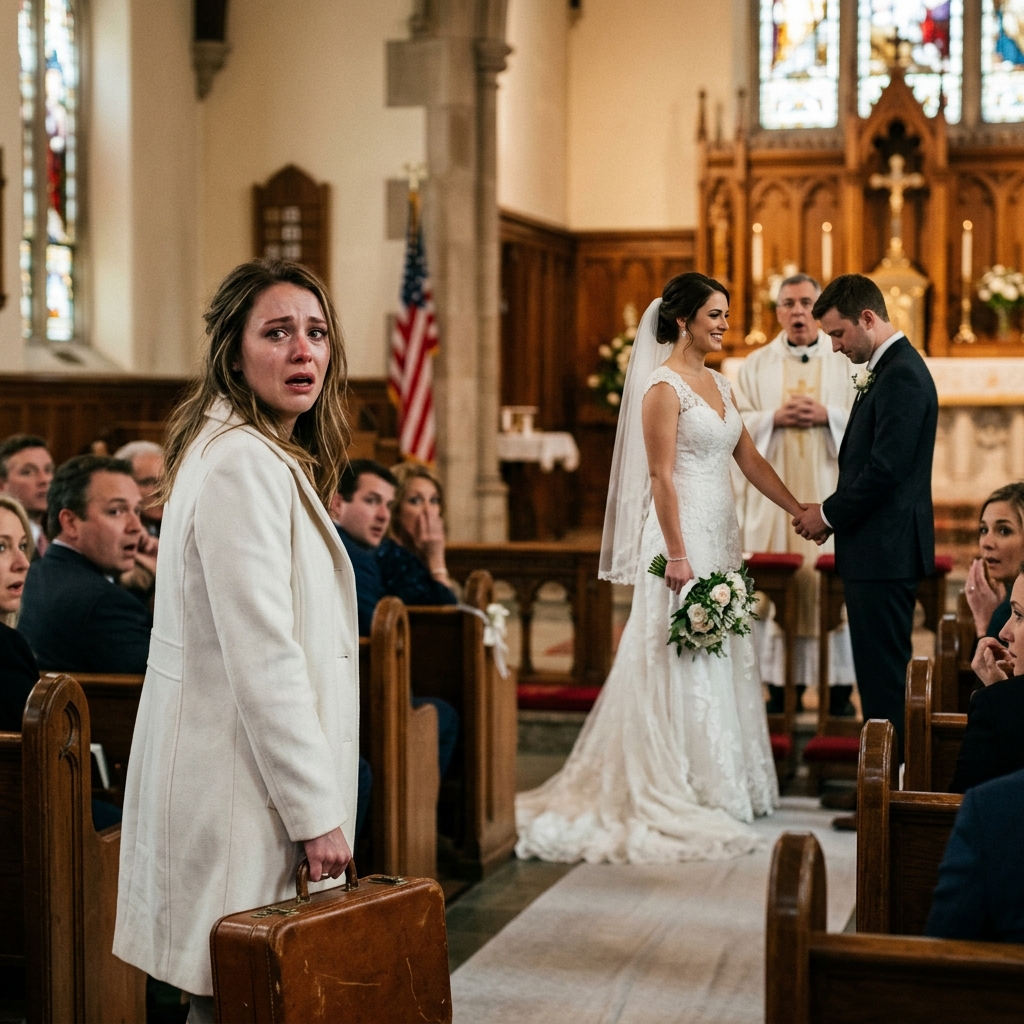
Kiara—my sister, the girl I had shared a room with for fifteen years, the one I defended, protected, trusted—was standing at the altar.
Wearing my dress.
Wearing my ring.
Holding my fiancé’s hand.
For a second, I genuinely thought I had walked into the wrong building. That maybe this was some cruel coincidence. But then she looked at me.
And she smiled.
Not nervous. Not guilty.
Satisfied.
Like she had finally won something I didn’t even know we were competing for.
“You made it,” she said softly as I walked closer, my heels echoing too loudly in the silence. “I was starting to think you wouldn’t come.”
My fiancé—no, not mine anymore—couldn’t even look at me. He kept his eyes fixed somewhere near the floor, like if he avoided eye contact long enough, I would disappear.
“What is this?” My voice didn’t crack. That surprised me more than anything else.
Kiara tilted her head slightly. “It’s a wedding,” she said. “You should know. You planned most of it.”
A few people shifted uncomfortably in their seats, but no one said a word.
I looked at him. “Julian?”
He finally exhaled, like saying my name would be too much effort. “It just… happened.”
“It just happened?” I repeated.
Kiara stepped closer, her fingers brushing the diamond that used to sit on my hand. “You couldn’t hold on to him,” she said quietly. “So I did.”
There it was.
No apology. No excuse.
Just truth.
I didn’t scream. I didn’t cry. I didn’t beg. I stood there for a moment, memorizing the way betrayal actually feels—not sharp, not explosive, but heavy, like something pressing down on your chest until breathing becomes optional.
Then I turned around, walked out of that church, and never looked back.
The sound that stayed with me wasn’t the wedding music starting again behind me. It was the soft click of my suitcase closing later that night.
That was the moment my life actually ended.
Three months later, I was still breathing. Barely.
I ended up in a small town off the I-10, the kind of place people only pass through when they’re trying to get somewhere better. I worked at a diner that smelled like burnt coffee and old grease. My hands were always red from dishwater, my shoes worn thin at the soles, my tips barely enough to cover rent in a room that felt more like a storage unit than a home.
People didn’t look at me anymore.
They looked through me.
Like I was part of the furniture.
I used to replay that day in my head sometimes—not the wedding, but the moment before it, when everything still felt normal. I tried to figure out where it broke. What I missed. What I did wrong.
Eventually, I stopped asking.
Because the answer didn’t matter.
They chose.
And I was the one they chose to leave behind.
It was raining the night everything changed.
Not soft rain—the kind that soaks through your clothes in seconds and turns the world gray. The bell over the diner door chimed, and he walked in.
You have to understand, men like him don’t walk into places like that.
He was dressed in a dark suit that didn’t have a single crease, his coat dry despite the storm, his presence quiet but heavy enough to shift the room. Conversations lowered without anyone realizing why. He sat in the corner booth and ordered black coffee.
That was it.
No small talk. No smile.
Just stillness.
When I brought his drink, he looked at me.
Not at my uniform. Not at the stains on my sleeves.
At me.
It was the first time in months someone had done that.
“Thank you,” he said.
His voice was calm, grounded. It made the noise in my head go quiet for a second.
He stayed for twenty minutes. Didn’t touch the menu again. Didn’t check his phone. Just sat there like he was waiting for something.
When he left, he didn’t leave a tip.
He left a ring.
I found it when I went to clear the table. It wasn’t delicate like the one Kiara had taken. This one was heavy, solid gold, carved with a crest that looked like it belonged to a different world.
I held it in my hand for a long time.
My rent was late. My bank account was almost empty. That ring could have changed everything overnight.
All I had to do was keep it.
But I didn’t.
Because I knew exactly what it felt like to have something taken from you.
There was a card under the napkin.
Han Lee.
An address.
I drove there the next day.
The gates alone were enough to make me turn around, but I didn’t. Something in me needed to finish this, needed to prove that I was still the kind of person who didn’t take what wasn’t hers.
When I finally stood in front of him again, in a house that felt too big and too quiet to belong to one person, I held the ring out.
“You left this,” I said.
He didn’t take it immediately. He studied me instead, like I was the question.
“You could have sold it,” he said.
“I know.”
“Why didn’t you?”
I shrugged slightly. “Because I know what it feels like to be stolen from.”
Something shifted in his expression.
Not surprise.
Recognition.
He took the ring, then gestured to the chair across from him. “Sit.”
I hesitated, then did.
“I need someone I can trust,” he said after a moment. “Someone who doesn’t belong to my world yet understands value. Loyalty. Discretion.”
I almost laughed. “You picked the wrong person. I’m a waitress.”
“No,” he said quietly. “You’re someone who had every reason to take something that didn’t belong to you… and didn’t.”
That was the moment everything changed.
He offered me a place in his world—not as decoration, not as charity, but as a partner in the spaces where power is tested silently. Events. Dinners. Rooms where people smile while looking for weaknesses.
“I’ll give you everything you need,” he said. “In return, you stand beside me.”
It sounded insane.
But so did everything else that had happened to me.
So I said yes.
The transformation wasn’t instant. It was built.
He taught me how to speak without explaining myself. How to stand without shrinking. How to look people in the eye long enough that they questioned their own assumptions.
“They only have power,” he told me once, “if you give it to them.”
For the first time in my life, I stopped giving it away.
Months passed. Then a year.
And then the past came back.
It always does.
Julian lost everything first. Fraud, bad investments, lies catching up with him. The life he chose over me collapsed piece by piece.
Kiara came after.
She called me one night, her voice shaking. “I have nowhere to go,” she said. “Please… you’re my sister.”
I didn’t say anything.
I just hung up.
A week later, I saw her again.
At the Bluebonnet Gala.
I stepped out of the car in a dress that felt like liquid gold, the lights catching every movement. Han’s hand rested lightly at my back as we entered, the room quieting just enough to notice.
And then I saw them.
Julian by the bar, thinner, worn down.
Kiara near the entrance, soaked from the rain, her dress clinging to her like a mistake she couldn’t wash off.
She looked at me like she was seeing a ghost.
“Bella?” Julian said, stepping closer. “Is that really you?”
I held his gaze, calm, steady. “Hello, Julian.”
He glanced at Han, confusion turning into something else. Greed, maybe. “We should talk,” he said quickly. “There’s been a misunderstanding—”
“There wasn’t,” I cut in.
Before he could respond, Kiara stumbled forward, pushing past security, her voice breaking. “Julian, please—”
He turned to the crowd instantly, forcing a laugh. “She’s not well,” he said. “I don’t even know her.”
Kiara froze.
And in that moment, she understood.
The same way I had.
She looked at him, then at me, and everything she had built her life on collapsed right there in front of everyone.
“Bella,” she whispered, her voice small now. “Tell them who I am.”
I looked at her.
Really looked.
And for the first time, I felt nothing.
“I don’t know who you are anymore,” I said.
Security moved in. The whispers started. The room shifted.
But I didn’t stay for it.
I turned, walked out beside Han, and left them standing in the wreckage they created.
A year ago, I thought they destroyed my life.
Standing there now, I finally understood the truth.
They didn’t destroy me.
They just removed everything that was holding me back.



![[FULL STORY] My Wife Said: "Stop Smothering Me, I Need Girl Time Every Weekend " I Replied: "Sure, Babe " The](https://social-media.rabedo.com/thumbnails/1776408499_5bb60e6f-4512-40e7-8148-47d3036df143.png)
![[FULL STORY] My Fiancée Demanded Her Ex Be Part Of Our Family Table, So I Handed Her The Bill For Our Canceled Wedding.](https://social-media.rabedo.com/thumbnails/1777307931_M9.png)