
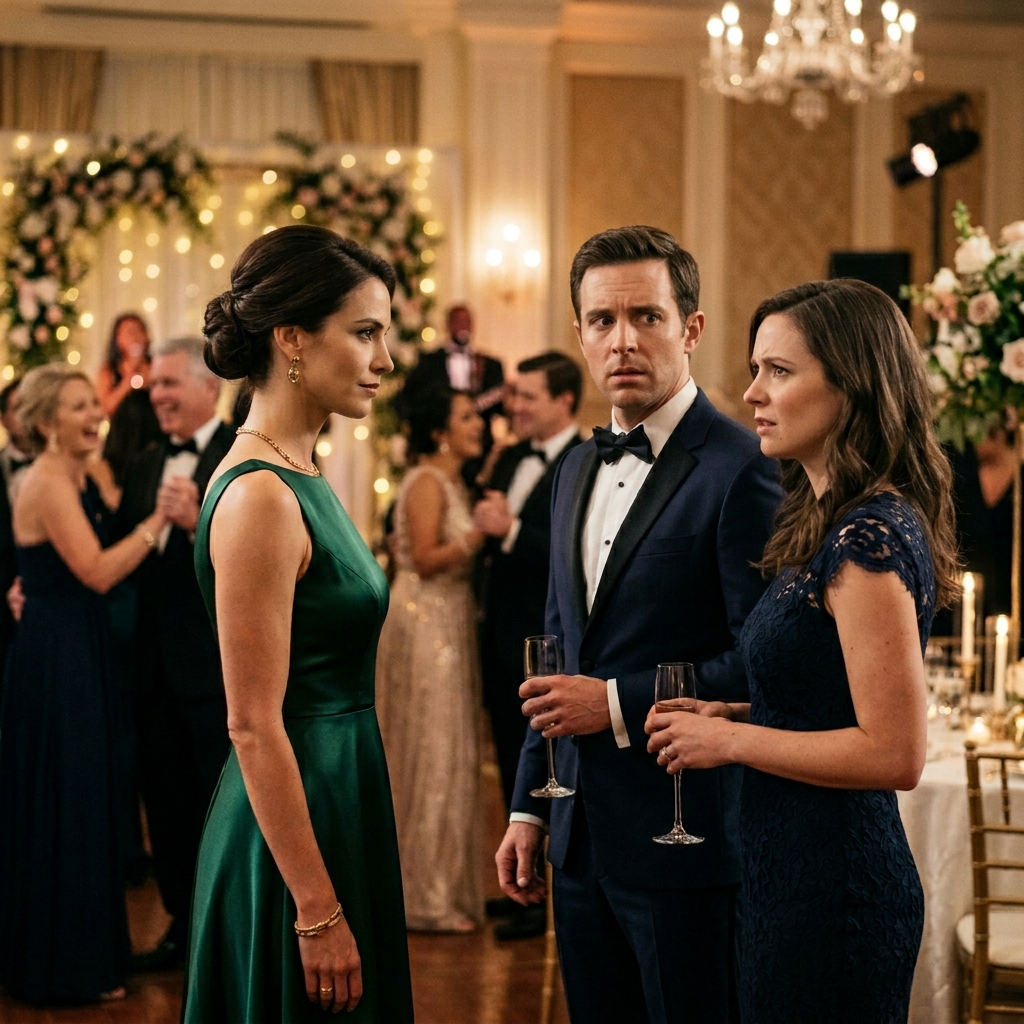
Clara Bennett didn’t realize she had been rewritten until she heard her own personality described by someone who had never really known her. It happened at a dinner she hadn’t even planned to attend, when a colleague of James casually said, “She was intense… like everything had to be perfect. Honestly, exhausting.” Clara had been standing close enough to hear every word, and what struck her wasn’t the judgment itself, but the familiarity of it. The phrasing, the tone, the subtle shift of truth into something unrecognizable. It was exactly how James used to talk when he wanted to win a narrative without technically lying.
She didn’t interrupt. She didn’t correct him. She simply stood there, let the words land, and for the first time understood something clearly: she had never been seen as she truly was, only as he needed her to be.
Three years earlier, Clara had been engaged to James Whitmore, and back then people used to call them perfect. They lived in a townhouse James had purchased shortly before they met, a place that wasn’t impressive at first glance but had potential Clara immediately recognized. She poured herself into that space the way she poured herself into everything she cared about. She didn’t demand attention for it. She didn’t ask for credit. She just noticed what needed to be done and did it. She fixed uneven cabinet doors, replaced lighting that dulled the rooms, reorganized the kitchen so it actually worked, paid for improvements when James said they could wait. It wasn’t about control. It was about care. But somewhere along the way, that care became something else in James’s eyes.
He started calling her exhausting, not in anger but in a quiet, dismissive tone that made it harder to argue against. He said she didn’t know how to relax, that she made everything feel like work, that nothing was ever good enough. What he never said outright was that her effort made him feel inadequate. Instead of rising to meet her, he reduced her. Instead of appreciating her presence, he reframed it as pressure. And slowly, without Clara realizing it, he began rewriting her in his mind.
The breakup itself was almost anticlimactic. There was no shouting, no dramatic betrayal revealed in a single moment. Just a quiet conversation where he told her he didn’t want to feel evaluated all the time, and she stood there, confused, because she had never evaluated him at all. She had simply been herself. She placed the ring on the table without argument, without pleading, without trying to change his mind. That silence became part of his story too. He told people she had been distant, cold, hard to connect with. It was easier than admitting he had chosen to walk away from someone who cared more than he knew how to handle.
What Clara didn’t know then was that Brianna had already entered his life before she left it. The timeline overlapped in ways he carefully hid, late nights explained as work, messages that arrived at odd hours, a gradual emotional withdrawal Clara noticed but didn’t confront because she believed in clarity over suspicion. After the breakup, James used that same skill to shape how others saw her. He described her as controlling, overly critical, someone who drained the joy out of simple things. And because he said it calmly, consistently, and to enough people, parts of it began to stick.
Clara felt the shift. Friends who became distant, invitations that stopped coming, conversations that felt slightly colder than before. She noticed all of it, and instead of fighting it, she stepped away. Not out of defeat, but because she understood something instinctively: you cannot correct a story people are comfortable believing. You can only outgrow it.
So she rebuilt her life quietly. She moved apartments, changed jobs, created routines that belonged entirely to her. She learned how to sit in her own space without needing to justify it to anyone. Over time, James became less of a presence and more of a memory that no longer held weight.
Until the invitation came.
It wasn’t from Lauren, the bride. It was from David, James’s longtime friend who had never cut Clara off after the breakup. His message was simple and direct. James would be there, but that didn’t change the fact that she was wanted. That mattered more than anything else.
Clara hesitated for exactly one evening before calling Rachel, who answered immediately and said she had already agreed to go. Rachel didn’t try to convince her with long explanations. She simply said Clara didn’t owe anyone a performance. She just had to show up as herself.
So Clara did.
On the morning of the wedding, she moved through her routine with quiet intention. The green dress, simple but elegant. Her hair styled in a way that felt natural to her. No extra effort to impress, no armor to protect herself. She wasn’t preparing for a confrontation. She was preparing to exist in a space that once would have felt complicated and now simply didn’t.
The venue was everything Lauren had described, warm and thoughtfully arranged. Clara noticed the details immediately. A flower arrangement slightly off balance, a glass placed just out of alignment, a ribbon slipping loose from a chair. She fixed them without thinking, the same way she always had. It wasn’t a performance. It was just who she was.
James arrived late, as expected, with Brianna at his side. He carried himself with the same confidence Clara remembered, the kind that relied on being seen and validated by the room. When his eyes met Clara’s, he paused for a fraction of a second, clearly expecting some kind of reaction. Shock, discomfort, acknowledgment of history. Instead, she looked at him calmly and then turned back to the ceremony. That moment, brief as it was, unsettled him more than any confrontation could have.
At the reception, he approached her with the same polished ease he had always used in social settings. He introduced Brianna, made small talk, asked what Clara had been doing as if the answer mattered less than the opportunity to measure her response. Clara answered simply, without offering more than necessary. When he tried to imply she had always needed someone waiting for her, she responded with a quiet sentence that shifted the entire dynamic. She said that if he wanted to talk about timelines, they could. She didn’t elaborate, didn’t accuse, didn’t raise her voice. But the meaning was clear enough.
Brianna heard it. More importantly, she understood it.
That was when things began to unravel.
Morris arrived shortly after, straight from the airport, slightly disheveled but entirely at ease. He didn’t scan the room or assess the situation the way James did. He went directly to Clara, greeted her with quiet familiarity, and settled into the evening as if he belonged there. The contrast between the two men was impossible to ignore. James’s confidence relied on perception. Morris’s came from something internal and steady.
Brianna started watching more closely after that. Not just Clara, but James as well. The small inconsistencies, the way his narrative didn’t fully align with what she was seeing in real time. When Lauren gave her speech and described Clara as someone who noticed, someone who quietly made things better without needing recognition, the room responded to that truth in a way that couldn’t be manufactured. It wasn’t dramatic. It was simply undeniable.
By the time dinner ended, Brianna had already begun to distance herself emotionally. The final shift happened on the dance floor, when she looked at Clara and Morris together, not performing, not trying to prove anything, just existing in a way that felt grounded and real. Something in her calculation changed. She understood, perhaps for the first time, that the story she had been told about Clara wasn’t just incomplete, it was intentionally distorted.
She left before dessert.
Not in tears, not dramatically, but with a quiet decisiveness that spoke louder than any confrontation could have.
James didn’t follow her.
He stayed, sitting alone at a table that had been meant for two, watching the room move on without him. For the first time, there was no narrative left to control. No one to impress. No version of events he could reshape in that moment.
Later that evening, he approached Clara again. This time, there was no performance in his voice. He admitted, in a limited way, that he shouldn’t have said the things he said about her. It wasn’t a full apology, not a complete acknowledgment of everything he had done, but it was more honesty than he had offered in years.
Clara listened, then responded simply that he shouldn’t have. She didn’t soften it, didn’t escalate it, didn’t offer him absolution or punishment. She just stated the truth and let it stand.
That was the moment everything settled.
Not because she had won something, but because she no longer needed to.
She hadn’t come to prove him wrong. She hadn’t engineered his downfall or waited for the perfect moment to expose him. She had simply shown up as herself, fully and without adjustment, and allowed reality to do the rest.
The room had adjusted around that.
James left that night with something he hadn’t expected to find: clarity. Not dramatic regret or immediate transformation, but the slow, undeniable realization that he had misjudged someone fundamentally. That he had let go of a person who was steady, thoughtful, and real, and had called those qualities boring because he didn’t understand their value.
Clara, on the other hand, left the venue with a quiet sense of completion. Not triumph, not vindication, just the understanding that the version of her James had created no longer had any power over her. She sat in the car beside Morris, looking out at the night, feeling something simple and rare.
Peace.



![[FULL STORY] “I’m not taking you to the concert. I’m taking him with me,” she said clearly.Even though I was](https://social-media.rabedo.com/thumbnails/1776928544_25.png)
![[FULL STORY] They Laughed at Me in Court—Then I Proved I Was Worth $1.3 Billion](https://social-media.rabedo.com/thumbnails/1776762418_D76.jpeg)
![[FULL STORY] My Stepdaughter Humiliated Me After Her Biological Father Reappeared And Turned Her Against Me...](https://social-media.rabedo.com/thumbnails/1777222379_C16.png)