Five days before my wedding, I stood in front of the mirror in a dress that cost more than most people’s yearly salary, staring at a life that didn’t feel like mine.
From the outside, everything was perfect. Ava Campbell, daughter of one of the most powerful corporate families in Washington DC, marrying Ethan Alford, the rising star everyone said would dominate the next decade of business and politics. Our engagement had been covered by media outlets, praised as a strategic alliance between two empires. Stock projections had shifted the day it was announced. Investors were confident. Our families were satisfied.
I felt like I was suffocating.
It wasn’t that Ethan was cruel. He was charming, composed, disciplined. The kind of man who knew exactly what to say in every room. The kind of man who never made mistakes in public.
But he never really saw me either.
I told myself it didn’t matter. This wasn’t about love. Not entirely. It was about legacy, about responsibility, about continuing what my family had built. That’s what my father told me the night he poured me a glass of wine and said, “This marriage will secure everything we’ve worked for.”
I nodded then. I always nodded.
Until two days before the wedding.
The house was full of people preparing for the rehearsal dinner. Caterers moving in and out, assistants coordinating schedules, my mother reviewing guest lists for the tenth time. I needed air. I slipped out onto the rooftop terrace of the hotel, the city glowing beneath me.
That’s when I heard them.
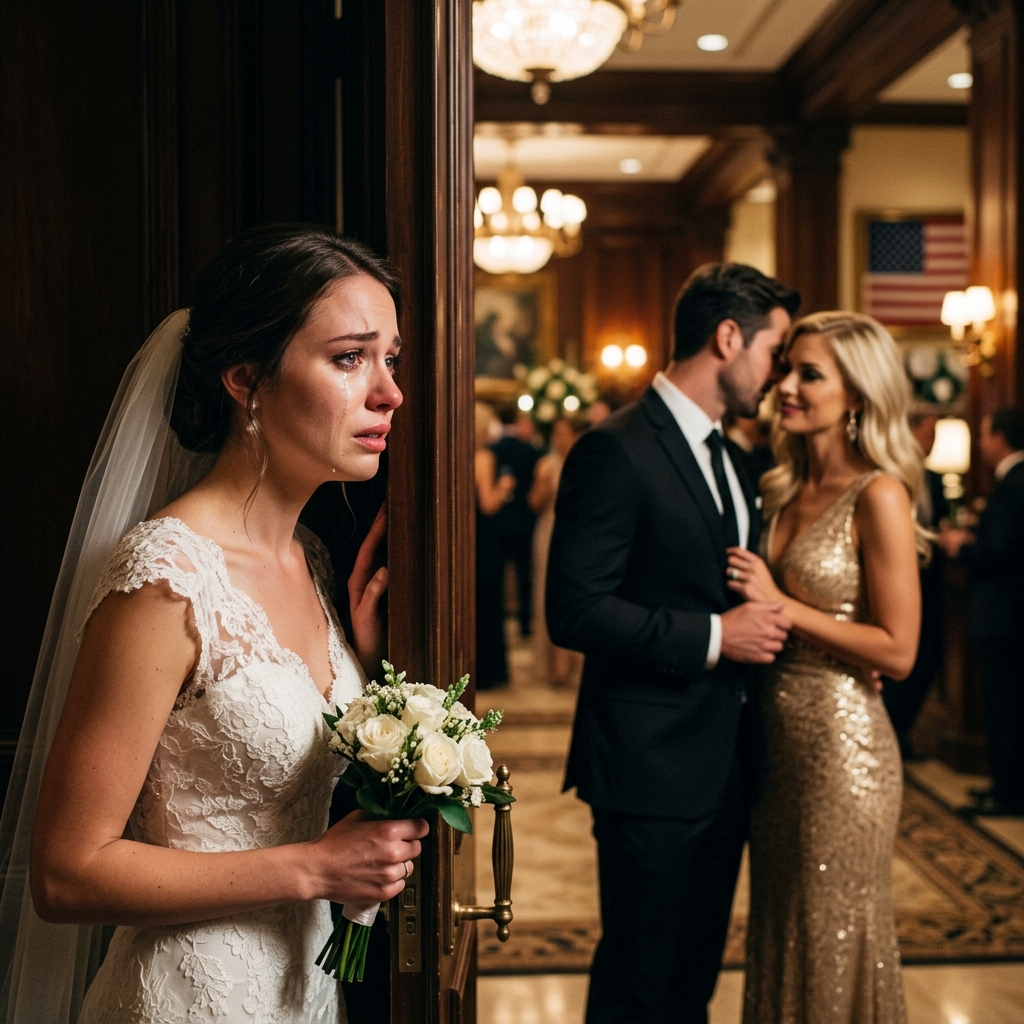
Ethan’s voice. Low, relaxed. Not the version he used with me.
“I need this marriage,” he said.
There was a pause. Then Emily’s voice. My cousin. My childhood shadow. “And me?”
“You know what this is,” he replied. “The merger depends on her name. Not her.”
My heart stopped.
“After the wedding,” he continued, “everything opens. Board access, contracts, influence. I’ll have what I need.”
“And we just continue like this?” Emily asked, almost amused.
“Nothing changes,” he said.
Nothing changes.
I didn’t remember walking back inside. I didn’t remember how long I stood in the hallway before anyone noticed me. I just remember the sound of my own breathing, too loud, too sharp, like my body was trying to escape something my mind hadn’t caught up with yet.
That night, I didn’t sleep.
The next morning, I went to my father.
He didn’t look surprised when I told him.
He didn’t look angry either.
He just listened, then said, “That doesn’t change anything.”
I stared at him. “He’s using me.”
“This is how power works,” my father replied calmly. “You knew that.”
“I didn’t agree to be humiliated.”
“You agreed to do your part.”
My chest tightened. “This isn’t a marriage.”
“It’s an alliance.”
That was the moment something inside me cracked cleanly in half.
Later that afternoon, my lawyer handed me the prenup.
I skimmed it once, then again, slower this time.
I had no claim to anything. No shared assets. No influence. No protection.
I wasn’t a partner.
I was leverage.
That night, I stood in my room, staring at the wedding dress again. It looked different now. Not beautiful. Not meaningful. Just expensive. Just part of the deal.
For the first time in my life, I didn’t nod.
The next morning, I canceled the wedding.
I didn’t give a speech. I didn’t explain. I just told my assistant to stop everything and walked out.
By the time I got into the car, my phone was already exploding.
News outlets picked it up within hours. “Campbell-Alford Wedding Called Off Days Before Ceremony.” Analysts speculated about the impact on the pending merger. Social media turned it into a spectacle. Some called me brave. Most called me reckless.
My father called it a mistake.
“You have no idea what you’ve just done,” he said.
I did.
For the first time, I had done something that belonged entirely to me.
It cost me everything.
Within days, I was out. Not formally disowned, but removed. Quietly cut off from decisions, from access, from the inner circle where everything important happened. My name still opened doors, but no one inside those rooms was looking at me the same way.
Ethan didn’t try to stop me at first. He moved forward. The merger shifted but didn’t collapse immediately. Emily stayed by his side. Of course she did.
I left DC.
I didn’t announce it. I didn’t post anything. I just disappeared.
I drove until the city thinned into coastline and stopped in a place that didn’t care who my last name belonged to. A small town where the ocean drowned out everything loud and artificial.
That’s where I met Daniel Fisher.
He didn’t recognize me. That was the first thing I noticed.
I was sitting at a small café, staring at my laptop, trying to remember what I liked doing before my life became a negotiation. He walked past, glanced at the screen, then stopped.
“You’re designing for real people,” he said.
I looked up. “What does that mean?”
“It means you’re not trying to impress anyone. You’re trying to make something that works.”
No one had said anything like that to me in years.
We talked. Not about power, not about influence, not about what my name could unlock. Just about work. About spaces. About how people actually live.
He was building something there. Small projects, community spaces, things that wouldn’t make headlines but mattered in ways I had almost forgotten how to measure.
I stayed.
At first, I told myself it was temporary. A break. Time to think.
But thinking turned into doing.
I started working again. Not for a board. Not for investors. Just because I wanted to. Because I remembered what it felt like to care about something without calculating its value.
Daniel never asked about my past. When I finally told him, weeks later, he didn’t react the way people in DC would have. No judgment. No curiosity about the scandal.
Just, “That must have been hard.”
That was it.
Something shifted in me then.
For the first time, I wasn’t being evaluated.
Months passed.
Then the world found me again.
A photo. A headline. “Runaway Bride Spotted with Reclusive Founder.”
My father called. My mother sent messages I didn’t answer. Investors started asking questions. The merger had stalled. Ethan needed stability.
He came himself this time.
I saw him standing outside the café one afternoon, looking out of place in a town that didn’t care about him.
“I need to talk to you,” he said.
I stepped outside.
“You made your point,” he continued. “Come back. We can fix this.”
I almost laughed.
“You think this was about making a point?”
“This is bigger than you,” he said. “It always was.”
“No,” I replied quietly. “It was bigger than me because you made it that way.”
He stepped closer. “This is how the world works, Ava. You don’t walk away from something like this.”
“I did.”
“You’re throwing away everything.”
“I’m keeping the only thing that matters.”
His jaw tightened. “You’re being emotional.”
That word.
That was always the word.
I looked at him, really looked this time, and saw exactly what I hadn’t seen before. Not power. Not control. Just someone who had built his entire identity on needing more and never knowing when to stop.
“I wasn’t your partner,” I said. “I was your transaction.”
He didn’t deny it.
That was the last confirmation I needed.
Weeks later, the final break came at a press conference.
The merger was being publicly restructured. Investors, media, analysts—all present. Ethan stood at the podium, polished as ever, trying to salvage what he could.
I walked in halfway through.
Every camera turned.
For a moment, no one spoke.
Then I did.
I didn’t scream. I didn’t accuse. I just told the truth. About the deal. About the arrangement. About what that marriage actually was.
The room shifted. You could feel it.
Ethan tried to interrupt. I didn’t let him.
When I finished, I left.
The deal collapsed within days.
I didn’t go back to DC.
I didn’t go back to my family.
For the first time in my life, I built something without asking for permission.
Daniel stayed. Not as a savior. Not as a solution. Just as someone who stood beside me without trying to shape me into anything else.
One night, months later, he asked, “What do you want now?”
No one had ever asked me that without expecting a strategic answer.
I thought about it.
“Something real,” I said.
He smiled. “Good. Me too.”
We didn’t rush anything.
When we finally decided to build a life together, it wasn’t because we needed each other to fix something broken. It was because we chose it.
There was no press. No announcement. Just a small ceremony by the water, with a handful of people who knew who we actually were.
No deal.
No leverage.
No transaction.
Just a choice.
Years later, someone asked me if I regretted walking away.
I didn’t hesitate.
“No.”
Because I finally understood something I should have known all along.
They thought I was part of the deal.
I was the one who walked away from it.
The first year after I walked away didn’t feel like freedom. It felt like learning how to exist without a script.
In DC, every decision I made had been framed for me. What to wear, where to go, who to speak to, what to say, what not to say. Even silence had been strategic. Out here, there was no one directing me. No expectations pressing against my shoulders. Just open space.
At first, that kind of freedom is terrifying.
I woke up every morning asking myself the same question: what do I actually want to do today? Not what would look good, not what would benefit someone else, not what would maintain an image. Just… what do I want?
Most days, I didn’t have an answer.
So I started small.
I worked with Daniel on local projects. Community centers, small housing renovations, shared spaces that didn’t need to impress anyone but had to function for real people. I relearned how to design without thinking about investor decks and presentation optics. I relearned how to care about things that didn’t translate into headlines.
It was slower than my old life. Quieter. Less impressive on paper.
But it felt real.
The first time I realized I had changed was during a meeting about a small housing project for low-income families. The budget was tight, the expectations were practical, and no one in the room cared about aesthetics in the way I had been trained to present them.
A younger architect looked at my plans and said, “This isn’t flashy.”
In DC, that would have been criticism.
Here, I just nodded. “It’s not supposed to be.”
And I meant it.
That was the moment I knew I wasn’t pretending anymore.
Months passed. Then a year.
I didn’t follow the news about my family or the company, but the news still found me. Articles about restructuring. Quiet mentions of failed negotiations. Ethan’s name appearing less frequently, then not at all. The narrative moved on, the way it always does.
The world forgets quickly.
I didn’t need it to remember.
Daniel never pushed me to go back or to completely cut off that part of my life. He just let me exist in the space between who I had been and who I was becoming.
One evening, we were sitting on the edge of the pier, watching the water turn dark as the sun dropped behind the horizon.
“You don’t miss it?” he asked.
“What?”
“The access. The influence. The scale of what you were part of.”
I thought about it honestly.
“I miss the illusion of control,” I said. “Not the reality.”
He nodded like he understood that without needing me to explain further.
“I used to think power meant being in those rooms,” I continued. “Now I think it means being able to walk out of them.”
Daniel smiled slightly. “That’s a better definition.”
For a while, that was enough.
But life doesn’t stay still.
About eighteen months after I left DC, I got a call I didn’t expect.
My mother.
I hadn’t heard her voice since the day I walked out.
“Ava,” she said, and for a moment, she sounded smaller than I remembered.
I didn’t answer right away. Not because I didn’t want to, but because I didn’t know which version of her I was about to hear. The woman who told me to go back and fix everything, or the one who had watched me leave without stopping me.
“How are you?” she asked.
“I’m okay.”
There was a pause.
“I’d like to see you.”
I closed my eyes for a second, feeling the weight of that request.
“Why now?”
Another pause, longer this time.
“Because I think I finally understand what you did.”
That was new.
I didn’t agree immediately. I told her I would think about it.
That night, I sat outside with Daniel, the phone still in my hand.
“You don’t have to go,” he said.
“I know.”
“But you want to?”
I looked out at the water, the same way I had the night he first asked me what I wanted.
“I think I need to,” I said.
Not for them.
For me.
A week later, I went back to Washington DC.
The city hadn’t changed. It never does. The same buildings, the same polished surfaces, the same quiet negotiations happening behind closed doors. But I had.
That made everything feel different.
When I walked into my family’s home, it didn’t feel like mine anymore. It felt like a place I had once lived.
My mother was waiting in the living room.
For the first time in my life, she didn’t look composed. Not perfectly styled, not carefully controlled. Just… tired.
We stood there for a moment before she stepped forward and hugged me.
She had never been the kind of person who hugged first.
“I’m sorry,” she said quietly.
That caught me off guard.
“For what?” I asked.
“For not seeing what they were doing to you,” she replied. “For letting it happen.”
I didn’t know what to say to that.
“I thought I was protecting you,” she continued. “I thought this was how things worked. I didn’t realize how much it was costing you.”
I had spent so long being angry that I hadn’t considered what it would feel like to hear this.
“I’m not that person anymore,” I said.
“I know,” she replied. “That’s why I asked you to come back. Not to return. Just to… talk.”
We talked for hours.
Not about the deal, not about Ethan, not about what could have been fixed. Just about us. About the years I had spent trying to meet expectations I didn’t choose. About the way she had done the same in her own life without ever questioning it.
Before I left, she said something that stayed with me.
“I don’t want you to come back into that world,” she said. “I just want to be part of the one you chose.”
That was the first real step toward something new between us.
I didn’t return to DC after that. Not fully.
But I stopped avoiding it.
Over the next few years, my work grew.
Not in the way it would have if I had stayed. Not faster, not louder, not bigger in the eyes of people who measure success by scale alone.
But it grew in the way that mattered.
We took on larger projects, but only the ones that aligned with what we believed in. Housing developments designed for people, not investors. Community spaces that didn’t feel temporary. Projects that had meaning beyond numbers.
Eventually, people started paying attention again.
But this time, it was different.
They weren’t interested in my last name.
They were interested in my work.
One day, a journalist came to interview me about a project that had gained national attention. At the end of the conversation, she asked, “Do you ever think about what your life would have looked like if you had gone through with that marriage?”
I didn’t need time to answer.
“I think I would have had everything I was supposed to want,” I said. “And none of what I actually needed.”
She paused, then asked, “Do you see what you have now as a loss or a gain?”
I smiled slightly.
“It’s not a trade,” I said. “It’s a correction.”
Years later, standing on the same shoreline where everything began again, Daniel asked me a question he had never asked before.
“Do you ever wonder if things could have turned out differently?”
“They did turn out differently,” I replied.
He shook his head. “I mean if he had been honest from the beginning. If the marriage had been real.”
I thought about it.
Then I shook my head.
“No,” I said. “Because even if it had been real at the start, I would have still become someone who needed more than that life allowed.”
He looked at me carefully. “More?”
“More freedom. More truth. More space to exist as myself.”
He nodded.
“That’s not something that life could have given you,” he said. “That’s something you had to take.”
I smiled.
“Exactly.”
That night, as we walked back from the water, I realized something that felt both simple and profound.
For a long time, I thought my story was about leaving him.
Then I thought it was about exposing the truth.
Then I thought it was about building something new.
But it wasn’t any one of those things.
It was about learning that I was never something to be negotiated in the first place.
Not a deal.
Not a strategy.
Not a transaction.
A person.
And once you understand that—really understand it—there’s nothing left for anyone else to take from you.