
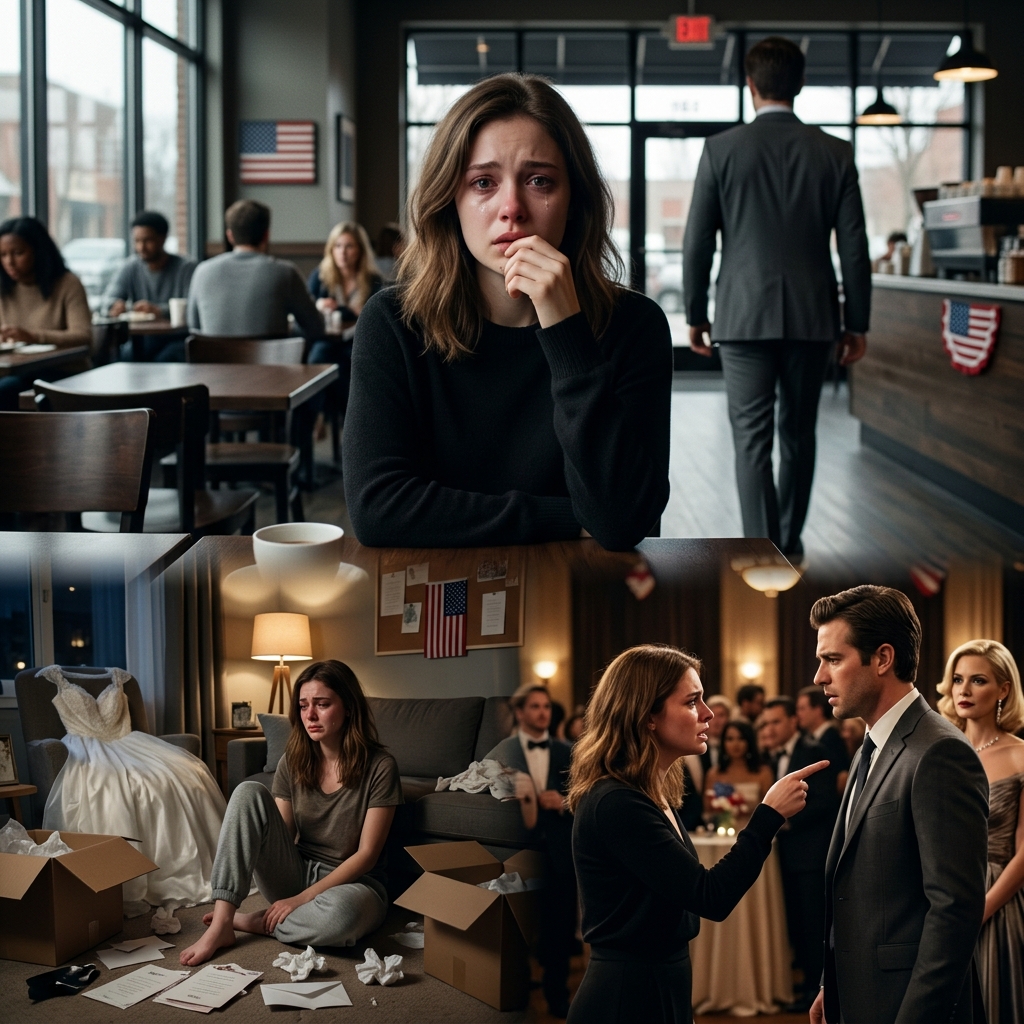
Five days before her wedding, a talented interior designer is brutally abandoned by her ambitious fiancé—only to discover he has stolen her work to impress a powerful heiress, forcing her to rebuild her life, reclaim her voice, and ultimately rise high enough to confront the man who once told her she was “not enough.
Celia Monroe used to believe she was one of the lucky ones.
At twenty-nine, she had a stable job at a mid-sized interior design firm in Boston, a small but warm apartment overlooking the Charles River, a mother who never stopped showing up for her, and a best friend who would burn the world down for her if needed. But more than anything, she had Adrian Hale—the man she was about to marry in five days.
On that quiet morning, Celia stood in front of her mirror, her fingers brushing lightly over the lace of her ivory wedding dress. Sunlight filtered through the curtains, making the fabric glow softly. She smiled at her reflection, her heart full, her future certain.
Then her phone rang.
Adrian.
She picked up immediately. “Good morning, almost husband.”
Silence.
Then his voice—flat, unfamiliar. “We need to talk. Meet me at Maple Corner in an hour.”
The call ended.
Celia stared at the screen, her smile slowly fading. A strange unease settled in her chest, but she pushed it down. Pre-wedding nerves. Everyone talked about them.
She got dressed, tied her hair back, and drove to the café, rehearsing gentle reassurances in her head.
But the moment she saw Adrian sitting at the corner table, she knew.
Something had already ended.
He looked perfect as always—tailored suit, immaculate posture—but his eyes were different. Cold. Detached. Like she was no longer part of his life, just someone he needed to deal with.
She sat across from him. “What’s wrong?”
“I’m not marrying you.”
The words hit like glass shattering inside her chest.
Celia blinked. “What?”
“I’ve been thinking about this for months,” Adrian continued, almost impatient. “You’re a good person, Celia. But you’re not enough for the life I want.”
Not enough.
Her throat tightened. “What does that even mean?”
“It means I need someone who matches my ambition. My world. My future.” He leaned back, studying her like a problem he had already solved. “I’ve met someone else.”
Celia felt the ground disappear beneath her.
“Her name is Vanessa Whitmore.”
The name alone was enough.
Vanessa Whitmore—the daughter of a billionaire real estate empire, a woman whose face appeared in financial magazines and high-society events. Powerful. Connected. Untouchable.
“You’re leaving me… five days before our wedding… for her?”
“The timing isn’t ideal,” Adrian said, as if discussing a minor inconvenience. “But I can’t keep pretending.”
“And I was what?” Celia’s voice broke. “A placeholder?”
He didn’t hesitate. “Something like that.”
It would have hurt less if he had slapped her.
“All those years—everything we built—”
“Comfort doesn’t build empires,” Adrian cut in. “And I’m not settling for comfort.”
He stood, adjusting his cufflinks. “I’ve already moved my things out. My lawyer will contact you.”
And just like that, he walked away.
No apology. No hesitation. No looking back.
Celia sat frozen long after he left, the world around her continuing as if nothing had happened.
But everything had.
—
The collapse came all at once.
The wedding dress still hung in her room. The invitations had already been sent. The venue was booked. Her future—mapped out down to the smallest detail—was gone in a single conversation.
Her mother arrived within the hour after Celia called, sobbing. They held each other on the floor of the living room, surrounded by unopened wedding decorations.
“How could he do this?” her mother whispered.
Celia had no answer.
The next day, the humiliation became public.
Photos of Adrian and Vanessa surfaced online—smiling, elegant, perfectly matched. Headlines labeled them Boston’s newest “power couple.”
The comments were worse.
“Didn’t he have a fiancée?”
“Guess he upgraded.”
“She was never in his league anyway.”
Celia read until her vision blurred.
By evening, her best friend, Nora Blake, stormed into her apartment with takeout and fury.
“He’s a coward,” Nora snapped. “And an opportunist. You didn’t lose anything. He did.”
“He said I wasn’t enough,” Celia whispered.
Nora grabbed her shoulders. “Listen to me. That man doesn’t understand value. He understands advantage.”
But the words didn’t land.
Because Adrian’s had.
Not enough.
Not enough.
Not enough.
—
The deeper wound revealed itself days later.
Celia returned to her laptop, trying to distract herself, scrolling through old design files she hadn’t touched in months. Projects she had abandoned while supporting Adrian’s ambitions.
Then she froze.
Several files had been accessed recently.
Her heart began to pound.
She opened them.
It was her work—her most personal project. A residential concept designed around emotional functionality rather than luxury display. A space meant to feel lived in, not showcased.
She had shown it to Adrian once.
Only once.
A week later, she saw it again.
This time in a business article.
A new Whitmore development project—“innovative, human-centered living for modern families.” The visuals weren’t identical, but the core idea… the structure… the philosophy…
It was hers.
Adrian had taken it.
Given it to Vanessa.
Used it to climb.
Celia didn’t cry this time.
Something inside her hardened instead.
—
For days, she hovered between rage and emptiness.
Then Nora forced a turning point.
One night, she shoved Celia’s laptop in front of her. “Look at this.”
“My work,” Celia said quietly.
“No. Your identity.” Nora leaned forward. “You’re letting him steal more than your idea. You’re letting him define your worth.”
Celia said nothing.
“Draw again,” Nora insisted. “If nothing else, just to prove you still can.”
That night, Celia opened a blank file.
And started.
—
The first few days were mechanical.
Then something shifted.
Design wasn’t just distraction—it was reclaiming something she had buried for years.
Her voice. Her instinct. Her perspective.
She began staying late at a quiet café after work, sketching, refining, building new ideas from the ruins of old ones.
And that’s where Elias Grant found her.
“I hope I’m not interrupting,” he said one evening, standing beside her table. “But I’ve been looking at your work for a few minutes now, and it would be a crime not to say something.”
Celia looked up.
He was in his mid-thirties, composed but approachable, with a calm confidence that didn’t need to announce itself.
“I’m Elias Grant.”
She recognized the name instantly.
Grant Urban Development—known for thoughtful, people-centered projects that stood in stark contrast to the glossy emptiness of companies like Whitmore.
“You have something rare,” Elias said, nodding at her screen. “You design for how people feel, not how things look.”
Celia blinked, caught off guard.
“I’ve been searching for someone with that mindset,” he continued. “Would you consider consulting on a project?”
It wasn’t pity.
It wasn’t curiosity.
It was recognition.
Three days later, she called him.
—
Working with Elias changed everything.
He didn’t try to “save” her.
He gave her space—and opportunity.
He listened. Challenged. Respected.
For the first time in years, Celia felt seen—not as someone’s partner, not as someone’s support system—but as herself.
Their project grew quickly.
And so did her confidence.
But the past wasn’t done with her yet.
—
Adrian came back.
At first, it was messages.
“I made a mistake.”
“Vanessa isn’t what I thought.”
“I miss you.”
Celia ignored them.
Then one evening, he was waiting outside her office.
“I need five minutes,” he said.
She should have walked away.
But she didn’t.
They sat on a bench nearby.
“I was wrong,” Adrian admitted. “Vanessa… she’s not who I thought. Nothing I do is ever enough for her.”
Celia felt a strange, hollow echo.
Not enough.
“I threw away something real,” he continued. “I want another chance.”
Celia looked at him.
Really looked.
This wasn’t love.
This was desperation.
“You don’t miss me,” she said calmly. “You miss how I made you feel.”
“That’s not true.”
“You came back because your upgrade failed.”
His jaw tightened.
“I love you, Celia.”
She stood.
“No,” she said. “You loved having someone who accepted you. Until someone more useful came along.”
“That’s not fair—”
“You told me I wasn’t enough.”
Her voice didn’t shake.
“You don’t get to rewrite that.”
He reached for her arm. “We can fix this.”
She pulled away.
“I already fixed it,” she said. “By realizing the problem was never me.”
And she walked away.
—
The final confrontation came weeks later.
At a major presentation for Grant Urban Development.
Celia stood at the front of a packed conference room, presenting the core concept of their new project.
Her project.
Her voice was steady. Confident.
She spoke about spaces that adapted to real life. About design that prioritized human experience over status.
And as the final slide appeared, she saw him.
Adrian.
Standing in the back.
Frozen.
Because he recognized it.
Every idea he had once taken and repackaged now stood fully realized—without him.
Better than he had ever imagined.
After the presentation, he cornered her.
“You planned this,” he accused.
Celia laughed softly.
“You mean presenting my own work?”
“That was my project—”
“No,” she said, cutting him off. “It was always mine.”
For a moment, he had no response.
Then he tried one last time.
“Come back to me,” he said quietly. “We can rebuild.”
Celia shook her head.
“I didn’t lose you,” she said. “I lost the version of myself that believed I needed you.”
And that was the end.
—
Six months later, Elias proposed.
Not with spectacle.
But with honesty.
“I can’t promise perfection,” he said. “But I can promise you’ll never have to shrink yourself to be loved.”
Celia said yes.
Without hesitation.
—
On her wedding day, she wore the same dress.
But this time, it meant something different.
Not a broken promise.
A reclaimed one.
As she walked down the aisle, she saw no doubt in Elias’s eyes. Only certainty.
Only love.
And when she said her vows, her voice was steady.
“I used to think love meant becoming what someone else needed,” she said. “Now I know it means being fully yourself—and being chosen anyway.”
They kissed.
And something inside her finally settled.
—
The next morning, her phone buzzed.
A message from an unknown number.
A photo of Adrian. Alone.
Text beneath it:
“You were right. I was the one who wasn’t enough.”
Celia looked at it for a moment.
Then deleted it.
No anger.
No satisfaction.
Nothing.
She set her phone down, turned to Elias, and smiled.
Because for the first time in her life—
She didn’t need anyone else to tell her who she was.
And she would never again believe she wasn’t enough.
Celia deleted the message, but the truth was, her story had not become simple just because she had learned how to stand upright again. Healing had never been a straight line. It had been a series of small, private battles no one applauded because no one saw them.
In the months between Adrian walking out of her life and Elias kneeling in front of her with a ring in his hand, there had been nights when Celia still woke with her heart racing, convinced for one disoriented second that she was late for a wedding that no longer existed. There had been mornings when she looked in the mirror and could still hear Adrian’s voice telling her she was not enough for the life he wanted. There had been moments, too many to count, when she had wondered if strength was just another costume women learned to wear after being humiliated in public.
But if pain had taught her anything, it was that rebuilding did not happen in one grand moment. It happened in ordinary ones. In showing up to work when she wanted to hide. In sending emails with steady hands when inside she was shaking. In reopening design files she had once associated with love, because she had worked on many of those projects while Adrian sat at her kitchen counter pretending to admire her talent while quietly measuring how he might use it.
That was the part that burned longest.
Not the betrayal itself. Not even the public humiliation.
It was the fact that Adrian had watched her create. He had watched her light up over floor plans and material palettes and sketches of family kitchens and reading nooks and courtyards built around morning sun. He had listened to her explain why homes mattered, why people deserved beauty that felt intimate rather than performative, why good design could make a tired mother breathe easier the second she walked through the door. He had looked directly at the most sincere part of her and seen not wonder, not brilliance, but leverage.
That realization changed her more than his abandonment ever had.
It stripped away something naive inside her. Not her softness, but her willingness to mistake admiration for respect.
The first time she admitted that out loud was to Elias.
They were in his office late one evening, surrounded by boards, samples, and half-empty coffee cups. Rain pressed softly against the windows. The rest of the building had long gone quiet. Celia had just finished reviewing revised elevations when Elias looked up and noticed she had been staring at the same sketch for almost a minute without moving.
“You disappeared somewhere,” he said gently.
Celia blinked. “Sorry.”
“You don’t have to apologize every time your mind wanders.”
She leaned back in the chair and rubbed at her temple. “I was just thinking.”
“About him?”
She gave a dry laugh. “I hate how obvious that is.”
“It’s not obvious,” Elias said. “I just know what it looks like when someone is fighting a memory they didn’t invite in.”
Something in the quiet steadiness of his voice made her put the pencil down. She stared at the table for a moment, then said, “The worst part isn’t even that he left me.”
Elias said nothing. He had that rare quality of making silence feel like permission rather than pressure.
“The worst part,” Celia continued, “is that I let him into the part of me that mattered most. I let him see the work before anyone else. I let him hear my ideas before they were fully formed. I thought that meant intimacy. I thought it meant he valued me. But he was inventorying me.” She swallowed hard. “I don’t know how to forgive myself for not seeing it.”
Elias folded his hands. “You’re asking yourself to have known what only a dishonest person could hide that well.”
Celia looked up.
He went on. “Trusting someone who claimed to love you isn’t stupidity. It’s not weakness. The shame belongs to the person who exploited trust, not the person who offered it.”
Her throat tightened unexpectedly. “You make everything sound so clear.”
“No,” Elias said with the faintest smile. “I just make it sound the way it always was.”
That conversation stayed with her long after she left his office. It did not erase the hurt. But it shifted the direction of her anger. Little by little, she stopped aiming it inward.
As Grant Urban Development expanded her role on the project, Celia began to feel not just useful, but powerful in a way that had nothing to do with appearances. She was no longer working around her own life; she was building one. The development they were creating was not glamorous in the shallow, magazine-cover sense that Whitmore projects chased. It was better than glamorous. It was meaningful.
The model units had adaptable layouts that could change as families grew. Shared outdoor spaces were designed not just to impress visitors but to be lived in by children with scraped knees and parents carrying grocery bags and elderly neighbors who wanted somewhere warm to sit in the late afternoon. Kitchens flowed toward living areas because Celia believed people should not be isolated from one another in the places where life actually happened. Natural light was treated not as a luxury feature but as emotional architecture.
At the first full design review, one of the investors, a man known for reducing every conversation to numbers, sat back after her presentation and said, “I expected a competent pitch. I didn’t expect to understand why this place should exist.”
Celia had smiled politely, but when she later got to the elevator alone, she leaned against the mirrored wall and let herself feel it fully. Not triumph over Adrian. Something better. Proof.
She was walking through the lobby that same afternoon when her phone lit up with a name she had deleted but still recognized instantly.
Adrian.
She stared at it until the call stopped. Then it rang again.
And again.
By the time Nora arrived at her apartment that night, Celia had twenty-three missed calls and a knot of old dread pulling tight beneath her ribs.
Nora took one look at her face, dropped her purse on the counter, and said, “How many?”
“Calls?”
“How many times has that parasite tried to crawl back in?”
Celia held up her phone.
Nora let out a low whistle. “He’s desperate.”
“I blocked one number. He used another. Then another.” Celia sat down at the kitchen table. “Why now?”
Nora opened a bottle of wine without asking. “Because men like Adrian never understand your value until they lose access to it. And because somewhere in that expensive little ego of his, he still thinks he owns part of your story.”
Celia laughed bitterly. “He doesn’t.”
“Then stop sounding like you’re afraid he does.”
The words landed harder than Nora intended, and the shift in Celia’s face made her soften immediately. She slid into the chair opposite her. “Hey. I’m not blaming you.”
“I know.” Celia stared at the phone. “I just hate that hearing his name still does something to me.”
“It’s supposed to,” Nora said. “He detonated your life. You don’t heal from that because a calendar moved forward.”
A few days later, Adrian stopped calling.
Instead, he appeared.
Celia was leaving a client meeting downtown when she saw him standing across the street near a black sedan, one hand in his coat pocket, the other wrapped around a paper coffee cup he clearly had not touched. Even from that distance, she could see the differences. Adrian was still handsome in the polished, expensive way he always had been, but there was strain in him now. His posture was too rigid. The skin under his eyes was shadowed. He looked like a man trying to maintain control over a life that was quietly slipping.
She could have turned around. She should have.
But there was a limit to avoidance, and she had reached it.
She crossed the street with deliberate steps.
“What do you want?” she asked.
He looked relieved just to hear her voice. “Thank you for stopping.”
“I didn’t stop for you. I stopped because I’m tired of being chased.”
He nodded like he deserved that. “Fair enough.”
For a moment, neither of them spoke. Traffic moved behind them. Someone laughed too loudly on the sidewalk nearby. The city went on being a city.
Finally Adrian said, “Can we talk somewhere private?”
“No.”
“Celia, please.”
She crossed her arms. “You have thirty seconds.”
His jaw tightened at the refusal, but he pressed on. “I know I don’t deserve your time. I know that. But I need you to hear this from me.”
“I’ve heard enough from you to last a lifetime.”
He flinched, and some colder, detached part of her noticed that with distant surprise. Adrian Hale had once moved through every room with the confidence of a man convinced no one whose opinion mattered would ever deny him. Now he looked uncertain.
“I ruined everything,” he said quietly.
“Yes.”
“I thought I knew what I was doing. I thought Vanessa was—” He stopped and gave a humorless laugh. “It doesn’t matter what I thought. I was wrong.”
Celia held his gaze. “You didn’t just choose someone else. You humiliated me. You gutted me.”
“I know.”
“No,” she said. “You know the words. You don’t know what it cost.”
A wind swept between the buildings, lifting the hem of her coat. Adrian looked like he wanted to reach for her and understood he could not.
“I was with Vanessa because I wanted access,” he admitted. “Power. Influence. The kind of life I’d spent years telling myself I deserved. She offered a shortcut to all of it. And I convinced myself that what I had with you was… too small.”
“Too small,” Celia repeated flatly.
He closed his eyes briefly. “I know how ugly that sounds.”
“It sounds accurate.”
His face hardened for a second at the edge in her voice, but then the performance cracked again. “She never respected me, Celia. Not really. I didn’t see it at first because I was too busy feeling chosen. But with her, everything was conditional. Every dinner, every introduction, every event—I had to keep earning my place. I was always one mistake away from being looked at like I didn’t belong.”
Celia felt no pity. Only clarity. He had gone where he believed he belonged and discovered, too late, that his hunger for status had chained him to people who valued him no more than he had valued her.
“And now,” she said, “you want to come back to the woman you called not enough because someone else made you feel the way you made me feel.”
Adrian’s mouth tightened. “I want to come back because I know what I lost.”
“No. You want to come back because the fantasy collapsed.”
“That’s not all this is.”
“It doesn’t matter if it is or isn’t,” Celia said. “Do you understand that? There is no version of this conversation where I become the place you return to when your ambition leaves you bleeding.”
He stepped closer, lowering his voice. “You and I were real.”
“We were real to me.”
The distinction hit him visibly.
Celia let it.
“You looked me in the eye,” she continued, her voice calm now, almost eerily so, “and told me I wasn’t enough for your future. Then you took my work and handed it to the woman you thought could buy you a better one. So don’t stand here and talk to me about what was real.”
He went pale. “I didn’t hand her your work.”
She almost laughed. “Adrian.”
He looked away.
That was answer enough.
Her pulse climbed, but her voice stayed steady. “I knew it.”
“I made a terrible decision,” he said quickly. “I was trying to prove myself. Vanessa wanted something fresh for the new development. I told her I knew someone brilliant, someone whose ideas were ahead of the market. I meant to bring your name into it eventually.”
Celia stared at him in disbelief. “You mean after you were done using it?”
“That’s not fair.”
“Fair?” Her composure fractured for the first time. “You think this is where you object to fairness?”
A couple passing nearby glanced over. Adrian lowered his head, suddenly aware they were no longer in some private universe where he could manage perception.
“I’m sorry,” he said.
There it was again. Sorry. A word too small for the wreckage it wanted to step around.
Celia drew a breath, forcing herself back into control. “Do not contact me again.”
“Celia—”
“No.” She took one step back. “You don’t get a redemption arc through me.”
Then she turned and walked away.
This time, she did not shake afterward. She did not go home and cry. She did not replay the conversation until dawn. She felt raw, yes, but underneath the rawness there was a solidity that had not existed the last time she walked away from him.
She called Elias that night and told him everything.
Not because she needed permission. Because she wanted there to be no shadows between them.
When she finished, Elias was silent for a moment.
Then he said, “Are you okay?”
The question alone made something soften in her chest. Not what did he say, not did you answer, not should I be worried. Are you okay.
“I think so,” she said. “More than I expected.”
“I’m glad.”
“And I need to say something before my courage disappears.” She sat on the edge of her bed, twisting the comforter between her fingers. “I told him no because I meant it. But I also told you because I care what this becomes between us, and I don’t want the past arriving unannounced.”
His voice, when it came, was low and steady. “Thank you for trusting me with that.”
A pause.
Then: “Can I ask you something?”
“Yes.”
“Would it be all right if I came over?”
He arrived half an hour later with Thai food, jasmine tea, and absolutely no attempt to turn the evening into something more than what she needed. They sat at her kitchen table in sock feet, eating noodles from white takeout boxes while Boston wind knocked softly at the windows. At one point Celia laughed—really laughed—at something ridiculous Nora had texted, and Elias looked at her with such quiet fondness that she had to look down at her tea.
It was not a lightning-bolt kind of love, the kind stories glamorize.
It was something steadier and far more dangerous.
Trust.
Months passed. Winter deepened and then began, slowly, to release its hold. Celia’s project at Grant moved from concept into public excitement. A local design journal ran a feature on her work, describing her approach as “emotionally intelligent architecture.” Her old firm, suddenly eager to have remained associated with her, invited her back to consult on a high-profile hospitality redesign. She declined politely and then laughed with Nora for ten full minutes afterward.
Helen noticed the difference before Celia did.
It happened on a Sunday afternoon while they were reorganizing kitchen cabinets in Helen’s townhouse, which was exactly the kind of unnecessary domestic project Helen tackled when she wanted to spend time with her daughter without forcing conversation.
Celia was standing on a chair, passing down mismatched mugs, when Helen said, almost casually, “You’re lighter.”
Celia looked down. “I’ve lost weight.”
“That’s not what I mean.” Helen took a mug from her and set it on the counter. “You’re lighter in the way you move. Like your body finally believes it’s safe again.”
For a second, Celia could not speak.
Helen reached up and touched her wrist. “He made you question your worth. But he also made you live clenched, sweetheart. Even before he left.”
Celia climbed down from the chair slowly. “You knew?”
“A mother always knows when her daughter is shrinking.” Helen’s eyes filled, though her voice stayed level. “I just didn’t know how bad it was until after.”
That night, Celia sat alone in her apartment for a long time thinking about that. Shrinking. It was such a simple word for something so devastating. She had spent three years shaving off pieces of herself in the name of being supportive, adaptable, understanding. She had called it partnership. In truth, she had been editing herself to fit a man who had already decided she would never be enough.
She never wanted to do that again.
A week later, Grant Urban Development hosted the full investor reveal for the residential project. The event was larger than the earlier internal presentation and drew press, city representatives, and several major financial groups. Celia had prepared for it obsessively. By the time she stepped onto the stage, she knew every line of her presentation so well she no longer needed the notes in her hand.
She spoke clearly, confidently, and without apology.
At one point she moved away from the podium entirely and addressed the room from memory, talking about how for too long urban housing had been built around aspiration rather than life. “People do not need homes that photograph well and fail them privately,” she said. “They need spaces that allow them to belong to themselves and to one another.”
The room listened.
When she finished, the applause was immediate and sustained.
Then came the questions.
Most were thoughtful, practical, encouraging. Then one reporter near the back raised his hand and asked, “There have been rumors of conceptual overlap between this project and an early-stage proposal once linked to Whitmore Holdings. Do you want to comment on that?”
The room shifted. Not loudly, but enough.
Elias looked toward her from the front row, not with alarm, but with complete faith that she could handle it however she chose.
Celia set down the remote and met the reporter’s eyes. “Yes,” she said. “I do.”
The silence sharpened.
“Several foundational ideas in the Whitmore proposal were derived from my original private design work without my consent. I chose not to engage publicly while my current team and I were building something stronger and fully documented. Every stage of this project, from concept development through design refinement, exists in a clear record under my authorship.”
A murmur moved through the audience.
She continued, still calm. “So if the question is whether there is overlap, the answer is simple. My work looks like my work, even when someone else tries to wear it.”
The room erupted—not chaotically, but in that electric, collective recognition that someone had just watched a story shift in real time. Cameras went up. Pens moved. A few people glanced toward the side of the room where, to Celia’s astonishment, Adrian was standing.
He had come.
She had not known he would.
But there he was, caught in the very space where he had hoped to move like a man of consequence, now forced to exist as the unspoken subject of what everyone had just understood.
His face drained of color.
Celia did not look at him again.
By morning, the clip was everywhere.
Design blogs praised her poise. Business pages covered the allegation more cautiously but noted that Whitmore had declined comment. Social media, which had once delighted in tearing apart the nameless fiancée Adrian had abandoned, now turned with brutal efficiency in the opposite direction. Sympathy for Celia mixed with admiration, outrage, and no small amount of satisfaction.
Nora sent her fourteen messages before nine a.m., most of them in all caps.
Helen called in tears.
Elias arrived at her apartment that evening with flowers—not roses, but wild, imperfect stems tied with twine because he had once heard her say she preferred arrangements that looked gathered rather than composed.
“You were extraordinary,” he told her.
Celia let out a long breath she felt she had been holding for months. “I was terrified.”
“People usually are when they tell the truth in public.”
She smiled faintly. “That makes it sound noble.”
“It was.”
A week later, Whitmore Holdings released a brief statement about “internal miscommunication during early conceptual sourcing” and announced Adrian Hale was no longer affiliated with any active development initiatives connected to the company.
Celia read the article once, set her phone down, and went back to work.
She did not celebrate his downfall. What would have been the point? Watching a man unravel because he had built himself out of hunger and vanity was not victory. Her victory was that his unraveling no longer controlled her weather.
The shift between her and Elias happened not in one dramatic moment, but in dozens of small ones that finally became impossible to mistake. In the way he looked for her in crowded rooms without needing to possess her. In the way he challenged her work seriously, never soothing her with false praise. In the way he once sat in silence with her for nearly an hour after she learned a former colleague had implied she was only succeeding now because her scandal had made her “interesting.”
“You don’t have to pretend that doesn’t hurt,” he had said.
“I know.”
“You also don’t have to build your life in reaction to people who need your story to be smaller than your talent.”
That was the night she kissed him first.
It happened on the rooftop terrace outside his office after a late meeting. The city glowed below them in winter gold and blue. Elias had just finished telling a story about the first awful apartment he ever rented as a broke graduate student, and Celia had laughed so hard she nearly spilled her wine. He reached to steady the glass, his hand brushing hers, and for one suspended second all the air between them changed.
She searched his face, saw no impatience, no strategy, no hunger to claim. Just openness.
So she leaned in.
The kiss was gentle at first, almost cautious, then deeper when neither of them pulled away. Celia had not expected to feel grief in that moment, but she did—a quick, sharp grief for how little tenderness had existed in the relationship she once thought was love. Then the grief passed, and all that remained was the startling sweetness of being met where she was instead of being measured.
They took things slowly after that. Deliberately. Not out of fear exactly, but respect for what both of them carried. Elias had loved deeply once before and lost his wife in a car accident three years earlier. Celia had survived a different kind of loss—one that left no obituary, only humiliation and distrust. Neither of them wanted to turn the other into a cure.
That was why, when Elias proposed six months later inside the nearly completed model unit of the project that had changed both their lives, Celia did not say yes because he rescued her.
She said yes because with him, rescue had never been the point.
The space around them still smelled faintly of fresh paint and new wood. Warm lamp light glowed across the kitchen island she had personally redesigned three times until the proportions felt right. Outside the windows, the first spring rain misted the city.
Elias stood in front of her, ring in hand, and said, “You do not owe me a yes because I love you. You don’t owe anyone love as repayment for being seen. I’m asking because every version of my life is better, truer, kinder with you in it. And if you want it too, I would spend the rest of my life building something honest with you.”
Celia cried before he even finished.
“Yes,” she whispered, then laughed through tears. “Yes.”
Planning the wedding with him felt nothing like the first time. There was no performance in it. No anxious balancing act between what she wanted and what would benefit someone else socially. If she preferred a smaller guest list, Elias agreed. If she wanted simple flowers and warm food and music that made people stay too late, he smiled and said, “Perfect.” If she had a hard day and the idea of choosing linen colors suddenly made her chest tighten with old memories, he did not tell her she was overreacting. He said, “Then we stop for today.”
Nora, naturally, considered herself in charge of emotional quality control.
At a dress fitting three weeks before the wedding, when Celia calmly announced she was wearing the same dress she had bought for Adrian, Nora nearly dropped an entire garment bag.
“Absolutely not.”
Celia laughed. “Hear me out.”
“I don’t need to hear a thing. That dress has bad history.”
“No,” Celia said softly. “That dress witnessed bad history. That’s different.”
Nora stared at her.
Celia ran a hand over the lace bodice. “I loved this dress before he destroyed what it meant. I’m not giving him ownership of every beautiful thing that existed around that time.”
For once, Nora had no comeback. She only shook her head and muttered, “God help anyone who ever underestimates you again.”
On the morning of the wedding, Helen helped Celia fasten the tiny buttons running down the back of the dress. Her hands trembled halfway through.
“Mom?”
Helen smiled through tears in the mirror. “I’m sorry. I just…” She inhaled shakily. “The last time you put this on, I wanted to break the whole world for you.”
Celia turned carefully and took her hands. “You kept me alive through that.”
Helen’s mouth quivered. “No, sweetheart. You did that. I just stood nearby and refused to let you forget who you were.”
Nora entered a minute later, saw both of them crying, and announced, “If either of you ruins your makeup before the ceremony, I will sue.”
It was exactly what they needed.
The ceremony itself was held in a restored historic garden conservatory just outside the city. Light filtered through glass and climbing ivy. The air smelled faintly of citrus trees and spring blossoms. Nothing about it was ostentatious. It was intimate, luminous, alive.
As Celia began the walk down the aisle, she saw Elias waiting for her.
He looked overwhelmed in the most beautiful way—eyes bright, smile unsteady, hand briefly pressed to his chest as if even now he could not believe she was real and walking toward him.
There was no doubt in his expression.
No calculation.
No secret weighing of what she could do for him.
Only love.
When it was time for vows, Celia took a breath and spoke the truth she had earned.
“I used to believe love meant proving I was enough,” she said. “Enough to be chosen, enough to be kept, enough to fit someone else’s vision of the future. I know better now. Love is not the prize we get for becoming smaller, quieter, more useful, or easier to leave. Real love makes room. Real love listens. Real love does not ask a person to disappear in order to stay.”
Her eyes filled, but her voice remained steady.
“You met me after I had been broken in public and blamed in private, after I had begun learning how to hold my own life again. You did not ask me to heal faster. You did not romanticize my pain. You simply stood beside me while I remembered my strength. I promise to do the same for you. To build with you. To tell the truth with you. To choose kindness, even when life is unkind.”
Elias’s own vows left almost everyone crying, including Nora, who later denied it with great aggression.
At the reception, there was laughter, dancing, too much champagne, and exactly the kind of fullness Celia had once thought only existed in movies. More than once she caught Helen watching her with an expression so full of relieved joy it nearly undid her.
Late in the evening, as the music softened and guests drifted between the dance floor and candlelit tables, Celia stepped outside for a breath of cool air.
That was when her phone buzzed.
Unknown number.
For a second she considered ignoring it. Then some instinct made her look.
It was a picture.
Adrian stood alone in front of a luxury apartment building, shoulders slightly hunched, his face thinner than she remembered. He looked like a man who had finally run out of mirrors willing to flatter him.
Beneath the photo was one line.
You were right. I was the one who wasn’t enough.
Celia read it once.
Then again.
She waited for some surge of vindication, some fierce satisfaction, some final cinematic release.
It never came.
What came instead was peace.
Not because he had suffered. Not because he had admitted it. But because his opinion—whether cruel or repentant—had lost the power to define the emotional temperature of her life.
She deleted the message.
When she turned back toward the glass doors, Elias was already there, searching for her. The instant he saw her, his face softened.
“You okay?” he asked.
Celia smiled.
More honestly than she ever had before, she said, “Yes.”
And she meant it.
The next morning, she woke in a sunlit room with wedding flowers still breathing their fragrance into the air and Elias asleep beside her, one hand resting loosely across the sheet between them. For a long moment she simply lay there, looking at the ceiling, listening to the silence.
Not the silence of emptiness.
The silence of arrival.
Her mind moved backward, not painfully now, but with perspective. To the mirror and the lace dress and the terrible phone call. To the café where a life had ended with a sentence. To the bathroom floor where she had held her mother and thought humiliation might kill her. To the nights spent rebuilding herself one sketch at a time. To the first time someone looked at her work and saw not ornament, not convenience, but truth. To the moment she learned that losing the wrong man could make space for the right life.
Elias stirred and opened his eyes. “What are you thinking about?”
Celia looked at him, then out at the morning light.
“Nothing that hurts anymore,” she said.
That was the real ending. Not the wedding. Not Adrian’s confession. Not the public vindication.
The real ending was this: she no longer needed the person who broke her to understand what he had destroyed. She no longer needed the people who had pitied her to revise their opinions. She no longer needed her success to function as revenge.
Because she had something better than revenge.
She had herself.
The self Adrian had tried to reduce to background support. The self she had once edited down in the hope of being enough. The self that had survived humiliation, reclaimed talent, spoken truth in public, and chosen love without abandoning dignity.
Some losses hollow you out.
Others carve away what was never meant to remain.
Adrian had taken a wedding, a future, and years of misplaced devotion. He had taken trust and turned it into theft. He had tried to make Celia feel small enough to justify his leaving.
What he had not known—what men like him never seemed to know—was that sometimes destroying a woman’s illusion is the very thing that frees her from the need to be chosen by someone unworthy.
And once she was free, she became impossible to own.
So when Celia and Elias left for their honeymoon later that afternoon, hands linked, sunlight sliding across the windshield, she did not look back in anger. She did not look back in triumph either.
She looked back only long enough to understand, with perfect clarity, that the worst day of her life had not been the end of her story.
It had been the day the wrong story died.
And everything that came after—every hard truth, every reclaimed idea, every tear, every risk, every inch of self-respect she rebuilt with her own hands—had led her here.
Not to a man.
Not to a marriage.
To herself, fully returned.
That was why this ending held.
Because this time, no one had chosen her into value.
She had remembered it on her own.
Years later, Celia would sometimes be asked how she knew Elias was different.
It happened in interviews after the Grant development won two national awards for community-centered residential design. It happened at alumni panels when young designers asked how she found the courage to return to her work after a public humiliation. It happened over long dinners with new friends who only knew the polished version of her life and could not imagine the woman she had once been—the one who confused endurance with love, silence with grace, and self-erasure with devotion.
She always gave them some version of the same answer.
It wasn’t that Elias was perfect.
It was that he never needed her to be less.
That truth became clearer in the quiet years that followed their wedding, not because life became easy, but because life became real. There were deadlines, disagreements, sick days, family worries, long stretches of work that blurred into evenings and weekends. There were losses too. Elias still had moments when grief for his late wife rose unexpectedly, not because he loved Celia less, but because human hearts do not erase to make room; they expand. And Celia, for all her healing, still had scars that would ache at strange times.
The first time it happened after they were married was at a formal charity event six months into their first year.
Grant Urban Development had become one of the city’s most talked-about firms after the success of the family housing project, and Elias had been invited to speak at a foundation dinner hosted in one of Boston’s grand old hotels. Celia wore a black silk gown and kept her makeup simple, but as she stood beside Elias near the ballroom entrance, hearing the hum of wealthy strangers and the tinkling of crystal glasses, she felt an old tension sliding beneath her skin.
This used to be Adrian’s world. Or at least, the world he had always tried to force himself into.
For one disorienting second, she could almost hear his voice again. Smile more. Don’t say anything too strong. Let me handle the important people. Wear something a little more refined next time.
Her spine locked. Her hand tightened around her clutch.
Elias noticed at once.
He leaned toward her without making it obvious. “Do you want to leave?”
The question itself nearly undid her.
Not Are you fine. Not It’s just one event. Not Don’t overthink it.
Do you want to leave?
Celia looked at him. “No. I want to stay.”
“Then we stay,” he said simply. “And if at any point you want out, we go.”
That was all.
No lecture. No pressure. No embarrassment.
Half an hour later, she was standing in a circle of architects, city planners, and donors, holding her own in a conversation about public housing reform with such quiet authority that two people asked for her card before dessert. On the drive home, she laughed softly and leaned her head against the window.
“What?” Elias asked, one hand on the wheel.
“I just realized something.”
“What’s that?”
“I spent so long thinking I was bad at those rooms.”
He glanced at her briefly. “You weren’t bad at them. You were just in them with the wrong person.”
Celia turned toward him, smiling in the dark. “That might be the truest thing anyone has ever said to me.”
Their marriage was built exactly that way—through hundreds of moments too small for headlines and too important for spectacle.
When Celia’s mother needed surgery the following winter, Elias rearranged his schedule without being asked and spent three nights sleeping in a hospital chair because Helen hated waking up alone. When Elias froze during the anniversary week of his wife’s death and went quieter than usual, Celia did not punish him for grief that belonged to an old wound. She sat beside him in the kitchen one evening, placed a cup of coffee near his hand, and said, “You don’t have to protect me from the fact that you loved someone before me.” He looked at her then with an expression so raw it made her chest ache, and for the first time he spoke about his wife without editing the pain into something tidier.
That was how trust deepened between them. Not by pretending old hurts were gone, but by refusing to weaponize them.
Two years into their marriage, Celia was offered the chance to lead a massive redevelopment project on the edge of the harbor—mixed-income housing, public green space, retail, community rooms, and an early childhood center integrated into the design. It was the largest project of her career.
It was also the kind of opportunity Adrian would once have told her to avoid unless she could guarantee perfection.
The old reflex returned immediately. What if she failed publicly? What if she was not ready? What if everyone who had praised her first success decided she had been overrated?
She sat with the contract in front of her for nearly an hour before Elias came home and found her untouched dinner still on the table.
He took one look at the papers. “Big offer?”
“Too big.”
He sat across from her. “Too big for what?”
“For me.”
He was quiet for a moment. “Do you believe that?”
Celia rubbed at her forehead. “I don’t know. Maybe. Maybe I’m just not built for this level.”
Elias leaned back in the chair and studied her with the same maddening calm he always had when she was spiraling toward an old lie. “Tell me something. If one of your junior designers came to you with this exact opportunity and this exact fear, what would you say?”
“That she’s capable.”
“Why?”
“Because no one grows by only accepting what already feels safe.”
He nodded once. “There you go.”
She sighed. “I hate when you do that.”
“You love when I do that.”
She laughed despite herself.
He reached across the table and touched the contract lightly with one finger. “Take the job because you want it, not because you need to prove anything. But do not turn it down just because some ghost taught you to confuse fear with truth.”
She took the job.
It changed her life again.
The harbor redevelopment took nearly four years from concept to groundbreaking. There were zoning battles, budget cuts, hostile public meetings, structural complications, an environmental review that nearly stalled phase two, and one spectacular disaster involving a supplier collapse that forced three months of redesign. Celia was tested in ways no classroom and no previous project had prepared her for.
And she rose anyway.
Not gracefully every time. Not without tears or anger or the occasional slammed office door after particularly infuriating meetings. But she rose.
By then she was no longer just a brilliant designer. She was a leader. The younger women in her team watched how she handled dismissive contractors, arrogant developers, and panels full of men who spoke over her until she calmly reclaimed the room without raising her voice. They watched how she credited others publicly, how she refused to let good ideas disappear simply because they came from quieter people, how she demanded humanity in projects everyone else wanted to reduce to square footage and return on investment.
One evening, after a brutal fourteen-hour day at the site, one of her junior designers, a shy twenty-four-year-old named Mara, caught up with her in the parking garage.
“Can I ask you something?” Mara said nervously.
“Of course.”
“How did you become like this?”
Celia frowned. “Like what?”
“So…” Mara searched for the word. “Unafraid.”
The question was so sincere it made Celia smile.
“I’m not unafraid,” she said.
Mara looked surprised.
“I’m just not willing to let fear make my decisions anymore.”
Mara absorbed that like it was something precious.
As Celia drove home that night, she thought about the woman she had once been—the one sitting in a wedding dress five days before disaster, believing a man’s love was the measure of her worth. If that younger version of herself could have seen her now, mud on her boots from the site walk, hair escaping its knot, exhausted and exhilarated and responsible for something enormous, would she even have recognized her?
Maybe not.
But she would have wanted to.
When the harbor project finally opened, it was celebrated not just as an architectural achievement but as a civic one. Families moved in. Children filled the courtyards. Elderly residents used the walking paths at dawn. The community rooms hosted reading circles, cooking classes, job fairs, and after-school tutoring. What had once been an underused, neglected stretch of the city became alive with the exact kind of belonging Celia had always believed design should protect.
At the ribbon-cutting ceremony, the mayor praised her vision. A state senator mentioned her by name. Journalists asked her how it felt to “reshape the future of urban living.”
Celia answered professionally, graciously, but what mattered most to her happened after the cameras left.
An older woman approached her near the playground with her granddaughter. She wore a plain coat and held the little girl’s hand tightly.
“Are you the designer?” the woman asked.
“One of them,” Celia said.
The woman’s eyes drifted toward the building behind them. “My daughter and granddaughter moved in last week. We never thought we’d get someplace this nice. My granddaughter has asthma, and this place has air filtration and light and space. She slept through the night for the first time in months.”
The little girl looked up shyly, then back at the swings.
The woman turned back to Celia, eyes bright. “I just wanted you to know it matters.”
For a second, Celia could not speak.
All those years ago, Adrian had asked what her designs were worth in terms of status, access, ambition.
Here was the answer.
They were worth this.
Years passed. Not in a blur, but in layers.
Helen moved into a sunny townhouse ten minutes away from Celia and Elias after declaring she was tired of pretending she enjoyed yard work. Nora eventually married a documentary filmmaker she met while arguing with him at a zoning hearing, which everyone agreed was exactly on brand. She never lost her talent for chaos, but she did gain a daughter with fierce eyes and an alarming capacity for negotiation by age four.
Celia and Elias talked for a long time about whether they wanted children. They did not rush the decision. They understood too well what it meant to build a life out of fear, expectation, or inherited script. When they finally decided to try, it took longer than they hoped. There were doctor appointments, disappointments, carefully protected optimism, and one devastating early loss that left Celia unable to enter the nursery aisle of any store for nearly a year.
That grief was different from what Adrian had done to her. Cleaner, in a way, because it came without betrayal. But it was still grief. Still a hole.
One night after the loss, Celia sat on the bathroom floor in the dark, too numb to cry anymore. Elias found her there and lowered himself onto the tile beside her without a word. For a long time they sat shoulder to shoulder.
Finally Celia whispered, “I’m so tired of losing things I thought were becoming my future.”
Elias closed his eyes. “I know.”
“I don’t want you to tell me everything happens for a reason.”
“I would never.”
She let out a broken laugh.
He turned toward her. “I can tell you this, though. Whatever happens next, we do not turn pain into proof that we were foolish to hope.”
That sentence carried her for months.
Two years later, their daughter was born.
They named her June.
She arrived in the middle of a thunderstorm after nineteen exhausting hours of labor, furious at the world and beautiful beyond comprehension. Celia had prepared herself for love, but not for the sheer terror of how much there would be. Holding June for the first time felt like being handed both a miracle and a permanent vulnerability.
Helen cried so hard in the hospital room that the nurse brought her tissues twice.
Nora arrived with balloons, contraband sandwiches, and a stuffed rabbit the size of a toddler.
Elias, when everyone finally left and the room quieted, stood by the window holding June against his chest with a look Celia would never forget. It was not triumph. It was reverence.
“Hey,” Celia whispered from the bed, exhausted and smiling.
He looked up. “Hey.”
“What are you thinking?”
He glanced down at their daughter. “That I have never loved anything this much and I’m already afraid of every sharp edge in the world.”
Celia laughed softly. “Good. Means you’re a real parent now.”
June changed the shape of their life in all the expected ways and several unexpected ones. Sleep vanished. Time warped. Conversations became fragmented and precious. Work was renegotiated. Boundaries were redrawn. Celia fought the familiar urge to disappear into support mode, to become the person who managed everyone else’s life while quietly abandoning the edges of her own.
But this time she caught it.
This time when she felt herself slipping toward self-erasure, she stopped.
There was one particular night, six months after June’s birth, when the baby had been crying for nearly an hour, Helen had the flu, a project deadline had exploded, and Elias was stuck in New York because of weather delays. Celia stood in the kitchen at midnight holding a screaming child and watching formula powder spill across the counter, and suddenly she was crying too—hard, messy, furious tears she could not control.
When Elias finally got home at three in the morning, he found her asleep in the rocking chair with June on her chest, the kitchen still a disaster. He cleaned everything quietly, showered, then came back and woke her gently.
Celia started apologizing before she was fully awake.
He stopped her immediately. “No.”
She blinked at him. “I’m sorry, I just—”
“No,” he repeated, softer. “You do not apologize for being overwhelmed by a hard day.”
The sentence landed deep because it contradicted so many old reflexes. Under Adrian, exhaustion had always felt like failure. Need had felt like weakness. Here, it was simply part of being human.
As June grew, Celia became fiercely intentional about what her daughter would and would not learn from the world.
She would not learn that love required shrinking.
She would not learn that ambition made women difficult.
She would not learn to confuse desirability with worth.
She would not learn to hand someone else the authority to name her enough or not enough.
Those convictions sharpened unexpectedly when June was seven and came home from school one afternoon unusually quiet.
Celia found her sitting on the living room rug, pulling apart a string bracelet with tiny, deliberate fingers.
“What happened?” Celia asked.
June did not look up right away. “Nothing.”
That, of course, meant something.
Celia sat beside her. “Do you want to tell me the nothing?”
June frowned at the bracelet. “Evelyn said girls who talk too much don’t get picked first for things.”
Celia went still.
“Picked first for what?”
“For group projects. And games. And maybe when you’re older… other stuff.” June’s cheeks flushed. “She said boys don’t like bossy girls.”
Celia took a slow breath.
There it was. The seed. The tiny poisonous thing the world always seemed eager to hand girls early: be smaller, softer, less.
She touched June’s shoulder. “Do you know what people sometimes call girls when they don’t know what to do with their confidence?”
June shrugged.
“They call them bossy because it’s easier than admitting they are strong.”
June looked up at her. “So talking too much is okay?”
Celia smiled. “Sometimes listening matters. But using your voice? That’s more than okay. And anyone who wants you quiet just so they feel bigger is not someone you need to become smaller for.”
June considered this seriously, then nodded once as if receiving an important rule of physics.
That night, after bedtime, Celia stood in the doorway of her daughter’s room watching her sleep and felt a wave of emotion so strong it nearly staggered her. Not sadness, exactly. A kind of reckoning.
So much of motherhood, she was learning, meant going back through your own life with a lantern and deciding what must never be passed down.
When June was ten, Celia was invited to deliver the keynote address at a national conference for women in design and urban planning. The organizers wanted her to speak not just about projects, but about leadership, resilience, and authorship. She almost declined. Public recognition still carried traces of old danger. Visibility had once come packaged with humiliation.
Then Mara—now a senior designer on her team—looked at her in disbelief when she mentioned turning it down.
“You have to do it,” Mara said.
“I don’t have to do anything.”
“Fine. But you should. Do you know how many women in this field only know they can be taken seriously because they’ve seen you do it without becoming cruel?”
Celia snorted. “That sounds suspiciously like emotional blackmail.”
“It is,” Mara said. “Use it wisely.”
So she accepted.
The ballroom where the conference was held was far grander than anything Celia would have chosen for herself. Hundreds of attendees filled the room. Screens glowed. Spotlights warmed the stage. As she stepped to the podium, she felt an old flicker of nerves.
Then she saw Elias in the third row, Helen beside him, Nora grinning like a menace, June between them swinging her feet and looking impossibly proud.
Celia smiled.
And then she spoke.
She spoke about design, yes, but also about authorship. About how often women’s ideas were treated as collaborative only after someone else repeated them louder. About how easily brilliance was dismissed when it arrived in a voice not already stamped with authority. She spoke about ambition without apology, about humane spaces, about the danger of building cities around prestige rather than people.
And then, near the end, she said something she had never said publicly in full.
“There was a time in my life when someone I loved told me I was not enough for the future he wanted. At the time, I believed him enough to let it wound the center of me. But here is what I know now. Whenever someone tells a woman she is not enough, look carefully. More often than not, what they mean is she is not willing to disappear in the exact shape that serves them.”
The room went so quiet she could hear the hum of the lights.
Celia let the silence hold.
“Enoughness is not awarded by romance, status, or public approval,” she continued. “It is not handed down by people with power. It is not revoked when you are left, underestimated, copied, interrupted, or dismissed. If there is one thing I want every person in this room to remember, it is this: your worth does not become real only when someone else finally recognizes it.”
When she finished, the applause rose so fast and full that it seemed to hit her physically.
Afterward, women lined up to speak to her. Students. Executives. Architects. Interns. One woman in her sixties held her hand and said, tears in her eyes, “I wish someone had told me that forty years ago.”
Celia squeezed her fingers. “Then take it now.”
That evening, back at the hotel, June climbed into bed beside her while Elias showered and said very seriously, “Mom?”
“Yes?”
“I think when I grow up, I want to be the kind of bossy they’re scared of.”
Celia laughed so hard she had to wipe tears from her face.
“You already are,” she said.
By the time June was fifteen, Adrian Hale had become little more than a footnote in Celia’s memory—a man whose cruelty had once rearranged her life, but no longer occupied its center. She occasionally heard fragments about him through the long, messy grapevine of professional circles. He had moved to Chicago for a while. Then back east. He had joined two firms, left both, tried consulting, disappeared from public view, resurfaced briefly attached to a luxury development that never got off the ground. Vanessa Whitmore had long since married someone else and relocated overseas.
Celia never asked for updates. They arrived on their own and passed through her without leaving much.
Then, one autumn afternoon, the past stepped out from behind glass.
Celia had just finished touring a university project in Cambridge where her firm had been hired to redesign student housing. She stopped at a café on her way back to the office, more out of habit than hunger, and was standing near the counter waiting for tea when a voice said her name.
Not in memory.
In the room.
She turned.
Adrian.
Older now, of course. The edges of his face sharper, the confidence stripped of its shine, his suit expensive but worn with the subdued care of someone trying to look like the version of himself people once took for granted. He seemed startled that she had actually turned.
For one suspended second, everything she had survived flashed through her body like light through old glass.
Then it passed.
“Adrian,” she said.
He gave a small, uncertain nod. “Hi.”
It was astonishing how ordinary he looked.
Not monstrous. Not magnetic. Just a man.
Celia felt, with almost clinical clarity, that whatever power he had once held over her had been built largely from timing, vulnerability, and her own misplaced faith.
“How are you?” he asked.
It was such a strange question that she almost smiled.
“I’m well.”
“I can see that.”
A barista called an order number. Someone laughed by the window. Life continued, unimpressed.
Adrian glanced down, then back at her. “I’ve thought about reaching out a hundred times.”
“I’m sure.”
“I never knew whether I had the right.”
“You didn’t.”
He nodded, accepting it.
For a moment she thought that would be all. But then he said, “I’m sorry.”
Not dramatic. Not pleading. Just tired.
Celia looked at him carefully. There were no sparks of revenge left in her. No ache either. Only distance and a kind of solemn understanding that some apologies arrive years too late and still matter—not because they heal, but because they confirm the wound was real.
“I know,” she said.
He swallowed. “I was cruel.”
“Yes.”
“And cowardly.”
“Yes.”
He let out a breath. “You didn’t deserve any of it.”
“No,” Celia said. “I didn’t.”
The simplicity of that seemed to land harder on him than anger would have.
He looked as if he wanted to say more, perhaps about regret, perhaps about failure, perhaps about the version of himself he had ruined in the process of ruining her. But Celia no longer needed that confession.
Her tea was placed on the counter.
She picked it up. “Take care of yourself, Adrian.”
That was it.
No dramatic exit. No speech. No victory line.
Just the truth, standing fully grown where a wound used to live.
When she got home that evening, Elias was in the kitchen helping June with geometry homework while Helen sat nearby pretending not to interfere and absolutely interfering. The house smelled like garlic and roasted tomatoes. A radio played low in the background.
June looked up first. “Mom, Nana says triangles are a scam.”
Helen lifted a hand. “I said unnecessary, not a scam.”
Elias turned and smiled. “How was your site visit?”
Celia stood there for one second longer than usual, taking in the scene.
This. This was what Adrian had never been able to imagine because people like him always mistook power for spectacle. He had chased rooms full of strategic smiles and conditional access. He had called comfort too small to build an empire.
But this was not comfort in the shallow sense.
This was substance.
This was a life built from truth, work, grief, humor, loyalty, second chances, chosen family, earned respect, and the slow daily miracle of being loved without being diminished.
“It was good,” Celia said finally, setting down her bag.
Elias studied her face for a beat. “Everything okay?”
She crossed the kitchen and kissed him lightly before answering. “Yes.”
He searched her expression, then smiled as if he understood there was more and trusted it would come when she wanted. “Good.”
Later that night, after June was asleep and Helen had gone home, Celia told him about the café.
Elias listened without interrupting.
“And how do you feel?” he asked when she finished.
Celia thought about it honestly.
“Like I finally met him at the correct size.”
Elias leaned back against the headboard, smiling faintly. “That sounds like you.”
She laughed, then grew quiet. “He said he was sorry.”
“Was it enough?”
“No,” Celia said. “But I didn’t need it to be.”
Elias reached for her hand. “That’s freedom.”
It was.
And perhaps that was the final truth of her story—not that pain disappeared, or that justice arrived neatly, or that love erased every scar. It was that she had outlived the need for the past to conclude itself perfectly.
She had become larger than the injury.
In time, June left for college. Mara became a partner at the firm. Nora’s daughter started a nonprofit at seventeen and terrified seasoned politicians by nineteen. Helen developed an intense and inexplicable passion for watercolor painting. Elias began teaching one seminar each spring because, as he claimed, “someone has to explain to young developers that human beings are not a branding strategy.”
Celia kept working, kept building, kept speaking, kept noticing the small emotional mechanics of space the way other people noticed weather. She designed schools, housing, women’s health clinics, community arts centers, a library expansion, and eventually a refuge for women rebuilding their lives after domestic and financial abuse.
That last project mattered to her in a way she struggled to articulate.
During the planning phase, one of the counselors on the advisory team said, “We need rooms that don’t feel temporary. These women have spent years being made to feel removable.”
Removable.
Celia went home and wrote the word down.
For weeks it stayed pinned above her desk while she worked.
The refuge, when completed, was full of light. Private without feeling isolated. Safe without feeling institutional. Beautiful without apology. The bedrooms had deep window seats. The communal kitchen opened into a warm dining area instead of a fluorescent cafeteria. There were quiet rooms for panic attacks, legal consultations, and grief. There was a children’s garden enclosed by tall hedges. There were doors that locked properly and walls painted in colors chosen for dignity, not trend.
At the opening, a woman on staff walked through the building with tears in her eyes and said, “This doesn’t feel like a place where people come after being broken. It feels like a place where they remember they still exist.”
Celia stepped outside afterward and stood alone in the sun for a moment.
Once, years ago, Adrian had looked at her and seen a placeholder.
Now the world was full of places shaped by her mind, her resilience, her refusal to let herself be reduced.
What greater answer could there be than that?
On the evening of her sixtieth birthday, surrounded by family and old friends in the backyard she and Elias had finally landscaped after fifteen years of postponing it, Nora raised a glass and said, “To Celia, who turned one idiot’s bad decision into approximately forty-seven breathtaking buildings, one terrifyingly competent daughter, and the most emotionally stable marriage I have ever had the misfortune of witnessing.”
Everyone laughed.
Celia shook her head. “That speech got away from you.”
“It started strong,” Nora insisted.
June, now grown and sharp and radiant in her own fully claimed life, clinked her glass lightly against her mother’s. “I’m glad he left you.”
The table went still for half a second.
Then June added, “Not because you deserved it. Because if he hadn’t, maybe you wouldn’t have become exactly who you are. And I can’t imagine being raised by anyone else.”
Celia looked at her daughter, then at Elias, then at Helen, whose eyes were already wet, and felt gratitude move through her so fully it almost hurt.
Some stories begin with love and end with betrayal.
Some begin with betrayal and end with self-possession.
Hers had done both.
And if there was any lesson worth carrying from the wreckage of that first life into the fullness of the second, it was this:
The people who underestimate you are not prophets.
They are merely witnesses with limited vision.
Adrian had once mistaken Celia’s gentleness for smallness, her loyalty for lack of ambition, her warmth for ordinariness, her trust for dependence. He had believed power lived in access, in appearances, in choosing the higher ladder.
He was wrong.
Power lived here.
In a woman who survived being discarded and did not turn hard in the wrong places.
In talent reclaimed.
In work that made other lives more livable.
In love that did not require surrender.
In the quiet certainty, earned over years, that no one else had the authority to measure her enoughness ever again.
Later that night, after the guests had gone and the garden lights glowed softly over the empty glasses and folded chairs, Celia sat beside Elias on the back steps. The air was warm. Somewhere inside, the dishwasher hummed.
“Do you ever think about how close we came to never meeting?” Elias asked.
She smiled. “Sometimes.”
“What do you think then?”
Celia rested her head lightly against his shoulder. “That life is strange.”
“Profound.”
“No,” she said, laughing softly. “Unhelpfully strange.”
He kissed the top of her head.
After a moment, she added, “I also think that if we hadn’t met, I still would have been okay eventually.”
Elias turned to look at her, not offended, only curious. “Would you?”
“Yes.” She reached for his hand. “Because you are part of the life that made me happy. But you are not the reason I became worthy of happiness.”
His eyes softened with something deeper than romance. Respect, maybe. Recognition.
“Good,” he said quietly. “That’s exactly why I love you.”
They sat in silence after that, watching the lights tremble in the leaves.
The story had long since stopped being about the man who left.
It had become about the woman who remained, rebuilt, and refused to disappear.
And that, finally, was enough.
Celia Monroe used to believe she was one of the lucky ones.
At twenty-nine, she had a stable job at a mid-sized interior design firm in Boston, a small but warm apartment overlooking the Charles River, a mother who never stopped showing up for her, and a best friend who would burn the world down for her if needed. But more than anything, she had Adrian Hale—the man she was about to marry in five days.
On that quiet morning, Celia stood in front of her mirror, her fingers brushing lightly over the lace of her ivory wedding dress. Sunlight filtered through the curtains, making the fabric glow softly. She smiled at her reflection, her heart full, her future certain.
Then her phone rang.
Adrian.
She picked up immediately. “Good morning, almost husband.”
Silence.
Then his voice—flat, unfamiliar. “We need to talk. Meet me at Maple Corner in an hour.”
The call ended.
Celia stared at the screen, her smile slowly fading. A strange unease settled in her chest, but she pushed it down. Pre-wedding nerves. Everyone talked about them.
She got dressed, tied her hair back, and drove to the café, rehearsing gentle reassurances in her head.
But the moment she saw Adrian sitting at the corner table, she knew.
Something had already ended.
He looked perfect as always—tailored suit, immaculate posture—but his eyes were different. Cold. Detached. Like she was no longer part of his life, just someone he needed to deal with.
She sat across from him. “What’s wrong?”
“I’m not marrying you.”
The words hit like glass shattering inside her chest.
Celia blinked. “What?”
“I’ve been thinking about this for months,” Adrian continued, almost impatient. “You’re a good person, Celia. But you’re not enough for the life I want.”
Not enough.
Her throat tightened. “What does that even mean?”
“It means I need someone who matches my ambition. My world. My future.” He leaned back, studying her like a problem he had already solved. “I’ve met someone else.”
Celia felt the ground disappear beneath her.
“Her name is Vanessa Whitmore.”
The name alone was enough.
Vanessa Whitmore—the daughter of a billionaire real estate empire, a woman whose face appeared in financial magazines and high-society events. Powerful. Connected. Untouchable.
“You’re leaving me… five days before our wedding… for her?”
“The timing isn’t ideal,” Adrian said, as if discussing a minor inconvenience. “But I can’t keep pretending.”
“And I was what?” Celia’s voice broke. “A placeholder?”
He didn’t hesitate. “Something like that.”
It would have hurt less if he had slapped her.
“All those years—everything we built—”
“Comfort doesn’t build empires,” Adrian cut in. “And I’m not settling for comfort.”
He stood, adjusting his cufflinks. “I’ve already moved my things out. My lawyer will contact you.”
And just like that, he walked away.
No apology. No hesitation. No looking back.
Celia sat frozen long after he left, the world around her continuing as if nothing had happened.
But everything had.
—
The collapse came all at once.
The wedding dress still hung in her room. The invitations had already been sent. The venue was booked. Her future—mapped out down to the smallest detail—was gone in a single conversation.
Her mother arrived within the hour after Celia called, sobbing. They held each other on the floor of the living room, surrounded by unopened wedding decorations.
“How could he do this?” her mother whispered.
Celia had no answer.
The next day, the humiliation became public.
Photos of Adrian and Vanessa surfaced online—smiling, elegant, perfectly matched. Headlines labeled them Boston’s newest “power couple.”
The comments were worse.
“Didn’t he have a fiancée?”
“Guess he upgraded.”
“She was never in his league anyway.”
Celia read until her vision blurred.
By evening, her best friend, Nora Blake, stormed into her apartment with takeout and fury.
“He’s a coward,” Nora snapped. “And an opportunist. You didn’t lose anything. He did.”
“He said I wasn’t enough,” Celia whispered.
Nora grabbed her shoulders. “Listen to me. That man doesn’t understand value. He understands advantage.”
But the words didn’t land.
Because Adrian’s had.
Not enough.
Not enough.
Not enough.
—
The deeper wound revealed itself days later.
Celia returned to her laptop, trying to distract herself, scrolling through old design files she hadn’t touched in months. Projects she had abandoned while supporting Adrian’s ambitions.
Then she froze.
Several files had been accessed recently.
Her heart began to pound.
She opened them.
It was her work—her most personal project. A residential concept designed around emotional functionality rather than luxury display. A space meant to feel lived in, not showcased.
She had shown it to Adrian once.
Only once.
A week later, she saw it again.
This time in a business article.
A new Whitmore development project—“innovative, human-centered living for modern families.” The visuals weren’t identical, but the core idea… the structure… the philosophy…
It was hers.
Adrian had taken it.
Given it to Vanessa.
Used it to climb.
Celia didn’t cry this time.
Something inside her hardened instead.
—
For days, she hovered between rage and emptiness.
Then Nora forced a turning point.
One night, she shoved Celia’s laptop in front of her. “Look at this.”
“My work,” Celia said quietly.
“No. Your identity.” Nora leaned forward. “You’re letting him steal more than your idea. You’re letting him define your worth.”
Celia said nothing.
“Draw again,” Nora insisted. “If nothing else, just to prove you still can.”
That night, Celia opened a blank file.
And started.
—
The first few days were mechanical.
Then something shifted.
Design wasn’t just distraction—it was reclaiming something she had buried for years.
Her voice. Her instinct. Her perspective.
She began staying late at a quiet café after work, sketching, refining, building new ideas from the ruins of old ones.
And that’s where Elias Grant found her.
“I hope I’m not interrupting,” he said one evening, standing beside her table. “But I’ve been looking at your work for a few minutes now, and it would be a crime not to say something.”
Celia looked up.
He was in his mid-thirties, composed but approachable, with a calm confidence that didn’t need to announce itself.
“I’m Elias Grant.”
She recognized the name instantly.
Grant Urban Development—known for thoughtful, people-centered projects that stood in stark contrast to the glossy emptiness of companies like Whitmore.
“You have something rare,” Elias said, nodding at her screen. “You design for how people feel, not how things look.”
Celia blinked, caught off guard.
“I’ve been searching for someone with that mindset,” he continued. “Would you consider consulting on a project?”
It wasn’t pity.
It wasn’t curiosity.
It was recognition.
Three days later, she called him.
—
Working with Elias changed everything.
He didn’t try to “save” her.
He gave her space—and opportunity.
He listened. Challenged. Respected.
For the first time in years, Celia felt seen—not as someone’s partner, not as someone’s support system—but as herself.
Their project grew quickly.
And so did her confidence.
But the past wasn’t done with her yet.
—
Adrian came back.
At first, it was messages.
“I made a mistake.”
“Vanessa isn’t what I thought.”
“I miss you.”
Celia ignored them.
Then one evening, he was waiting outside her office.
“I need five minutes,” he said.
She should have walked away.
But she didn’t.
They sat on a bench nearby.
“I was wrong,” Adrian admitted. “Vanessa… she’s not who I thought. Nothing I do is ever enough for her.”
Celia felt a strange, hollow echo.
Not enough.
“I threw away something real,” he continued. “I want another chance.”
Celia looked at him.
Really looked.
This wasn’t love.
This was desperation.
“You don’t miss me,” she said calmly. “You miss how I made you feel.”
“That’s not true.”
“You came back because your upgrade failed.”
His jaw tightened.
“I love you, Celia.”
She stood.
“No,” she said. “You loved having someone who accepted you. Until someone more useful came along.”
“That’s not fair—”
“You told me I wasn’t enough.”
Her voice didn’t shake.
“You don’t get to rewrite that.”
He reached for her arm. “We can fix this.”
She pulled away.
“I already fixed it,” she said. “By realizing the problem was never me.”
And she walked away.
—
The final confrontation came weeks later.
At a major presentation for Grant Urban Development.
Celia stood at the front of a packed conference room, presenting the core concept of their new project.
Her project.
Her voice was steady. Confident.
She spoke about spaces that adapted to real life. About design that prioritized human experience over status.
And as the final slide appeared, she saw him.
Adrian.
Standing in the back.
Frozen.
Because he recognized it.
Every idea he had once taken and repackaged now stood fully realized—without him.
Better than he had ever imagined.
After the presentation, he cornered her.
“You planned this,” he accused.
Celia laughed softly.
“You mean presenting my own work?”
“That was my project—”
“No,” she said, cutting him off. “It was always mine.”
For a moment, he had no response.
Then he tried one last time.
“Come back to me,” he said quietly. “We can rebuild.”
Celia shook her head.
“I didn’t lose you,” she said. “I lost the version of myself that believed I needed you.”
And that was the end.
—
Six months later, Elias proposed.
Not with spectacle.
But with honesty.
“I can’t promise perfection,” he said. “But I can promise you’ll never have to shrink yourself to be loved.”
Celia said yes.
Without hesitation.
—
On her wedding day, she wore the same dress.
But this time, it meant something different.
Not a broken promise.
A reclaimed one.
As she walked down the aisle, she saw no doubt in Elias’s eyes. Only certainty.
Only love.
And when she said her vows, her voice was steady.
“I used to think love meant becoming what someone else needed,” she said. “Now I know it means being fully yourself—and being chosen anyway.”
They kissed.
And something inside her finally settled.
—
The next morning, her phone buzzed.
A message from an unknown number.
A photo of Adrian. Alone.
Text beneath it:
“You were right. I was the one who wasn’t enough.”
Celia looked at it for a moment.
Then deleted it.
No anger.
No satisfaction.
Nothing.
She set her phone down, turned to Elias, and smiled.
Because for the first time in her life—
She didn’t need anyone else to tell her who she was.
And she would never again believe she wasn’t enough.
Celia deleted the message, but the truth was, her story had not become simple just because she had learned how to stand upright again. Healing had never been a straight line. It had been a series of small, private battles no one applauded because no one saw them.
In the months between Adrian walking out of her life and Elias kneeling in front of her with a ring in his hand, there had been nights when Celia still woke with her heart racing, convinced for one disoriented second that she was late for a wedding that no longer existed. There had been mornings when she looked in the mirror and could still hear Adrian’s voice telling her she was not enough for the life he wanted. There had been moments, too many to count, when she had wondered if strength was just another costume women learned to wear after being humiliated in public.
But if pain had taught her anything, it was that rebuilding did not happen in one grand moment. It happened in ordinary ones. In showing up to work when she wanted to hide. In sending emails with steady hands when inside she was shaking. In reopening design files she had once associated with love, because she had worked on many of those projects while Adrian sat at her kitchen counter pretending to admire her talent while quietly measuring how he might use it.
That was the part that burned longest.
Not the betrayal itself. Not even the public humiliation.
It was the fact that Adrian had watched her create. He had watched her light up over floor plans and material palettes and sketches of family kitchens and reading nooks and courtyards built around morning sun. He had listened to her explain why homes mattered, why people deserved beauty that felt intimate rather than performative, why good design could make a tired mother breathe easier the second she walked through the door. He had looked directly at the most sincere part of her and seen not wonder, not brilliance, but leverage.
That realization changed her more than his abandonment ever had.
It stripped away something naive inside her. Not her softness, but her willingness to mistake admiration for respect.
The first time she admitted that out loud was to Elias.
They were in his office late one evening, surrounded by boards, samples, and half-empty coffee cups. Rain pressed softly against the windows. The rest of the building had long gone quiet. Celia had just finished reviewing revised elevations when Elias looked up and noticed she had been staring at the same sketch for almost a minute without moving.
“You disappeared somewhere,” he said gently.
Celia blinked. “Sorry.”
“You don’t have to apologize every time your mind wanders.”
She leaned back in the chair and rubbed at her temple. “I was just thinking.”
“About him?”
She gave a dry laugh. “I hate how obvious that is.”
“It’s not obvious,” Elias said. “I just know what it looks like when someone is fighting a memory they didn’t invite in.”
Something in the quiet steadiness of his voice made her put the pencil down. She stared at the table for a moment, then said, “The worst part isn’t even that he left me.”
Elias said nothing. He had that rare quality of making silence feel like permission rather than pressure.
“The worst part,” Celia continued, “is that I let him into the part of me that mattered most. I let him see the work before anyone else. I let him hear my ideas before they were fully formed. I thought that meant intimacy. I thought it meant he valued me. But he was inventorying me.” She swallowed hard. “I don’t know how to forgive myself for not seeing it.”
Elias folded his hands. “You’re asking yourself to have known what only a dishonest person could hide that well.”
Celia looked up.
He went on. “Trusting someone who claimed to love you isn’t stupidity. It’s not weakness. The shame belongs to the person who exploited trust, not the person who offered it.”
Her throat tightened unexpectedly. “You make everything sound so clear.”
“No,” Elias said with the faintest smile. “I just make it sound the way it always was.”
That conversation stayed with her long after she left his office. It did not erase the hurt. But it shifted the direction of her anger. Little by little, she stopped aiming it inward.
As Grant Urban Development expanded her role on the project, Celia began to feel not just useful, but powerful in a way that had nothing to do with appearances. She was no longer working around her own life; she was building one. The development they were creating was not glamorous in the shallow, magazine-cover sense that Whitmore projects chased. It was better than glamorous. It was meaningful.
The model units had adaptable layouts that could change as families grew. Shared outdoor spaces were designed not just to impress visitors but to be lived in by children with scraped knees and parents carrying grocery bags and elderly neighbors who wanted somewhere warm to sit in the late afternoon. Kitchens flowed toward living areas because Celia believed people should not be isolated from one another in the places where life actually happened. Natural light was treated not as a luxury feature but as emotional architecture.
At the first full design review, one of the investors, a man known for reducing every conversation to numbers, sat back after her presentation and said, “I expected a competent pitch. I didn’t expect to understand why this place should exist.”
Celia had smiled politely, but when she later got to the elevator alone, she leaned against the mirrored wall and let herself feel it fully. Not triumph over Adrian. Something better. Proof.
She was walking through the lobby that same afternoon when her phone lit up with a name she had deleted but still recognized instantly.
Adrian.
She stared at it until the call stopped. Then it rang again.
And again.
By the time Nora arrived at her apartment that night, Celia had twenty-three missed calls and a knot of old dread pulling tight beneath her ribs.
Nora took one look at her face, dropped her purse on the counter, and said, “How many?”
“Calls?”
“How many times has that parasite tried to crawl back in?”
Celia held up her phone.
Nora let out a low whistle. “He’s desperate.”
“I blocked one number. He used another. Then another.” Celia sat down at the kitchen table. “Why now?”
Nora opened a bottle of wine without asking. “Because men like Adrian never understand your value until they lose access to it. And because somewhere in that expensive little ego of his, he still thinks he owns part of your story.”
Celia laughed bitterly. “He doesn’t.”
“Then stop sounding like you’re afraid he does.”
The words landed harder than Nora intended, and the shift in Celia’s face made her soften immediately. She slid into the chair opposite her. “Hey. I’m not blaming you.”
“I know.” Celia stared at the phone. “I just hate that hearing his name still does something to me.”
“It’s supposed to,” Nora said. “He detonated your life. You don’t heal from that because a calendar moved forward.”
A few days later, Adrian stopped calling.
Instead, he appeared.
Celia was leaving a client meeting downtown when she saw him standing across the street near a black sedan, one hand in his coat pocket, the other wrapped around a paper coffee cup he clearly had not touched. Even from that distance, she could see the differences. Adrian was still handsome in the polished, expensive way he always had been, but there was strain in him now. His posture was too rigid. The skin under his eyes was shadowed. He looked like a man trying to maintain control over a life that was quietly slipping.
She could have turned around. She should have.
But there was a limit to avoidance, and she had reached it.
She crossed the street with deliberate steps.
“What do you want?” she asked.
He looked relieved just to hear her voice. “Thank you for stopping.”
“I didn’t stop for you. I stopped because I’m tired of being chased.”
He nodded like he deserved that. “Fair enough.”
For a moment, neither of them spoke. Traffic moved behind them. Someone laughed too loudly on the sidewalk nearby. The city went on being a city.
Finally Adrian said, “Can we talk somewhere private?”
“No.”
“Celia, please.”
She crossed her arms. “You have thirty seconds.”
His jaw tightened at the refusal, but he pressed on. “I know I don’t deserve your time. I know that. But I need you to hear this from me.”
“I’ve heard enough from you to last a lifetime.”
He flinched, and some colder, detached part of her noticed that with distant surprise. Adrian Hale had once moved through every room with the confidence of a man convinced no one whose opinion mattered would ever deny him. Now he looked uncertain.
“I ruined everything,” he said quietly.
“Yes.”
“I thought I knew what I was doing. I thought Vanessa was—” He stopped and gave a humorless laugh. “It doesn’t matter what I thought. I was wrong.”
Celia held his gaze. “You didn’t just choose someone else. You humiliated me. You gutted me.”
“I know.”
“No,” she said. “You know the words. You don’t know what it cost.”
A wind swept between the buildings, lifting the hem of her coat. Adrian looked like he wanted to reach for her and understood he could not.
“I was with Vanessa because I wanted access,” he admitted. “Power. Influence. The kind of life I’d spent years telling myself I deserved. She offered a shortcut to all of it. And I convinced myself that what I had with you was… too small.”
“Too small,” Celia repeated flatly.
He closed his eyes briefly. “I know how ugly that sounds.”
“It sounds accurate.”
His face hardened for a second at the edge in her voice, but then the performance cracked again. “She never respected me, Celia. Not really. I didn’t see it at first because I was too busy feeling chosen. But with her, everything was conditional. Every dinner, every introduction, every event—I had to keep earning my place. I was always one mistake away from being looked at like I didn’t belong.”
Celia felt no pity. Only clarity. He had gone where he believed he belonged and discovered, too late, that his hunger for status had chained him to people who valued him no more than he had valued her.
“And now,” she said, “you want to come back to the woman you called not enough because someone else made you feel the way you made me feel.”
Adrian’s mouth tightened. “I want to come back because I know what I lost.”
“No. You want to come back because the fantasy collapsed.”
“That’s not all this is.”
“It doesn’t matter if it is or isn’t,” Celia said. “Do you understand that? There is no version of this conversation where I become the place you return to when your ambition leaves you bleeding.”
He stepped closer, lowering his voice. “You and I were real.”
“We were real to me.”
The distinction hit him visibly.
Celia let it.
“You looked me in the eye,” she continued, her voice calm now, almost eerily so, “and told me I wasn’t enough for your future. Then you took my work and handed it to the woman you thought could buy you a better one. So don’t stand here and talk to me about what was real.”
He went pale. “I didn’t hand her your work.”
She almost laughed. “Adrian.”
He looked away.
That was answer enough.
Her pulse climbed, but her voice stayed steady. “I knew it.”
“I made a terrible decision,” he said quickly. “I was trying to prove myself. Vanessa wanted something fresh for the new development. I told her I knew someone brilliant, someone whose ideas were ahead of the market. I meant to bring your name into it eventually.”
Celia stared at him in disbelief. “You mean after you were done using it?”
“That’s not fair.”
“Fair?” Her composure fractured for the first time. “You think this is where you object to fairness?”
A couple passing nearby glanced over. Adrian lowered his head, suddenly aware they were no longer in some private universe where he could manage perception.
“I’m sorry,” he said.
There it was again. Sorry. A word too small for the wreckage it wanted to step around.
Celia drew a breath, forcing herself back into control. “Do not contact me again.”
“Celia—”
“No.” She took one step back. “You don’t get a redemption arc through me.”
Then she turned and walked away.
This time, she did not shake afterward. She did not go home and cry. She did not replay the conversation until dawn. She felt raw, yes, but underneath the rawness there was a solidity that had not existed the last time she walked away from him.
She called Elias that night and told him everything.
Not because she needed permission. Because she wanted there to be no shadows between them.
When she finished, Elias was silent for a moment.
Then he said, “Are you okay?”
The question alone made something soften in her chest. Not what did he say, not did you answer, not should I be worried. Are you okay.
“I think so,” she said. “More than I expected.”
“I’m glad.”
“And I need to say something before my courage disappears.” She sat on the edge of her bed, twisting the comforter between her fingers. “I told him no because I meant it. But I also told you because I care what this becomes between us, and I don’t want the past arriving unannounced.”
His voice, when it came, was low and steady. “Thank you for trusting me with that.”
A pause.
Then: “Can I ask you something?”
“Yes.”
“Would it be all right if I came over?”
He arrived half an hour later with Thai food, jasmine tea, and absolutely no attempt to turn the evening into something more than what she needed. They sat at her kitchen table in sock feet, eating noodles from white takeout boxes while Boston wind knocked softly at the windows. At one point Celia laughed—really laughed—at something ridiculous Nora had texted, and Elias looked at her with such quiet fondness that she had to look down at her tea.
It was not a lightning-bolt kind of love, the kind stories glamorize.
It was something steadier and far more dangerous.
Trust.
Months passed. Winter deepened and then began, slowly, to release its hold. Celia’s project at Grant moved from concept into public excitement. A local design journal ran a feature on her work, describing her approach as “emotionally intelligent architecture.” Her old firm, suddenly eager to have remained associated with her, invited her back to consult on a high-profile hospitality redesign. She declined politely and then laughed with Nora for ten full minutes afterward.
Helen noticed the difference before Celia did.
It happened on a Sunday afternoon while they were reorganizing kitchen cabinets in Helen’s townhouse, which was exactly the kind of unnecessary domestic project Helen tackled when she wanted to spend time with her daughter without forcing conversation.
Celia was standing on a chair, passing down mismatched mugs, when Helen said, almost casually, “You’re lighter.”
Celia looked down. “I’ve lost weight.”
“That’s not what I mean.” Helen took a mug from her and set it on the counter. “You’re lighter in the way you move. Like your body finally believes it’s safe again.”
For a second, Celia could not speak.
Helen reached up and touched her wrist. “He made you question your worth. But he also made you live clenched, sweetheart. Even before he left.”
Celia climbed down from the chair slowly. “You knew?”
“A mother always knows when her daughter is shrinking.” Helen’s eyes filled, though her voice stayed level. “I just didn’t know how bad it was until after.”
That night, Celia sat alone in her apartment for a long time thinking about that. Shrinking. It was such a simple word for something so devastating. She had spent three years shaving off pieces of herself in the name of being supportive, adaptable, understanding. She had called it partnership. In truth, she had been editing herself to fit a man who had already decided she would never be enough.
She never wanted to do that again.
A week later, Grant Urban Development hosted the full investor reveal for the residential project. The event was larger than the earlier internal presentation and drew press, city representatives, and several major financial groups. Celia had prepared for it obsessively. By the time she stepped onto the stage, she knew every line of her presentation so well she no longer needed the notes in her hand.
She spoke clearly, confidently, and without apology.
At one point she moved away from the podium entirely and addressed the room from memory, talking about how for too long urban housing had been built around aspiration rather than life. “People do not need homes that photograph well and fail them privately,” she said. “They need spaces that allow them to belong to themselves and to one another.”
The room listened.
When she finished, the applause was immediate and sustained.
Then came the questions.
Most were thoughtful, practical, encouraging. Then one reporter near the back raised his hand and asked, “There have been rumors of conceptual overlap between this project and an early-stage proposal once linked to Whitmore Holdings. Do you want to comment on that?”
The room shifted. Not loudly, but enough.
Elias looked toward her from the front row, not with alarm, but with complete faith that she could handle it however she chose.
Celia set down the remote and met the reporter’s eyes. “Yes,” she said. “I do.”
The silence sharpened.
“Several foundational ideas in the Whitmore proposal were derived from my original private design work without my consent. I chose not to engage publicly while my current team and I were building something stronger and fully documented. Every stage of this project, from concept development through design refinement, exists in a clear record under my authorship.”
A murmur moved through the audience.
She continued, still calm. “So if the question is whether there is overlap, the answer is simple. My work looks like my work, even when someone else tries to wear it.”
The room erupted—not chaotically, but in that electric, collective recognition that someone had just watched a story shift in real time. Cameras went up. Pens moved. A few people glanced toward the side of the room where, to Celia’s astonishment, Adrian was standing.
He had come.
She had not known he would.
But there he was, caught in the very space where he had hoped to move like a man of consequence, now forced to exist as the unspoken subject of what everyone had just understood.
His face drained of color.
Celia did not look at him again.
By morning, the clip was everywhere.
Design blogs praised her poise. Business pages covered the allegation more cautiously but noted that Whitmore had declined comment. Social media, which had once delighted in tearing apart the nameless fiancée Adrian had abandoned, now turned with brutal efficiency in the opposite direction. Sympathy for Celia mixed with admiration, outrage, and no small amount of satisfaction.
Nora sent her fourteen messages before nine a.m., most of them in all caps.
Helen called in tears.
Elias arrived at her apartment that evening with flowers—not roses, but wild, imperfect stems tied with twine because he had once heard her say she preferred arrangements that looked gathered rather than composed.
“You were extraordinary,” he told her.
Celia let out a long breath she felt she had been holding for months. “I was terrified.”
“People usually are when they tell the truth in public.”
She smiled faintly. “That makes it sound noble.”
“It was.”
A week later, Whitmore Holdings released a brief statement about “internal miscommunication during early conceptual sourcing” and announced Adrian Hale was no longer affiliated with any active development initiatives connected to the company.
Celia read the article once, set her phone down, and went back to work.
She did not celebrate his downfall. What would have been the point? Watching a man unravel because he had built himself out of hunger and vanity was not victory. Her victory was that his unraveling no longer controlled her weather.
The shift between her and Elias happened not in one dramatic moment, but in dozens of small ones that finally became impossible to mistake. In the way he looked for her in crowded rooms without needing to possess her. In the way he challenged her work seriously, never soothing her with false praise. In the way he once sat in silence with her for nearly an hour after she learned a former colleague had implied she was only succeeding now because her scandal had made her “interesting.”
“You don’t have to pretend that doesn’t hurt,” he had said.
“I know.”
“You also don’t have to build your life in reaction to people who need your story to be smaller than your talent.”
That was the night she kissed him first.
It happened on the rooftop terrace outside his office after a late meeting. The city glowed below them in winter gold and blue. Elias had just finished telling a story about the first awful apartment he ever rented as a broke graduate student, and Celia had laughed so hard she nearly spilled her wine. He reached to steady the glass, his hand brushing hers, and for one suspended second all the air between them changed.
She searched his face, saw no impatience, no strategy, no hunger to claim. Just openness.
So she leaned in.
The kiss was gentle at first, almost cautious, then deeper when neither of them pulled away. Celia had not expected to feel grief in that moment, but she did—a quick, sharp grief for how little tenderness had existed in the relationship she once thought was love. Then the grief passed, and all that remained was the startling sweetness of being met where she was instead of being measured.
They took things slowly after that. Deliberately. Not out of fear exactly, but respect for what both of them carried. Elias had loved deeply once before and lost his wife in a car accident three years earlier. Celia had survived a different kind of loss—one that left no obituary, only humiliation and distrust. Neither of them wanted to turn the other into a cure.
That was why, when Elias proposed six months later inside the nearly completed model unit of the project that had changed both their lives, Celia did not say yes because he rescued her.
She said yes because with him, rescue had never been the point.
The space around them still smelled faintly of fresh paint and new wood. Warm lamp light glowed across the kitchen island she had personally redesigned three times until the proportions felt right. Outside the windows, the first spring rain misted the city.
Elias stood in front of her, ring in hand, and said, “You do not owe me a yes because I love you. You don’t owe anyone love as repayment for being seen. I’m asking because every version of my life is better, truer, kinder with you in it. And if you want it too, I would spend the rest of my life building something honest with you.”
Celia cried before he even finished.
“Yes,” she whispered, then laughed through tears. “Yes.”
Planning the wedding with him felt nothing like the first time. There was no performance in it. No anxious balancing act between what she wanted and what would benefit someone else socially. If she preferred a smaller guest list, Elias agreed. If she wanted simple flowers and warm food and music that made people stay too late, he smiled and said, “Perfect.” If she had a hard day and the idea of choosing linen colors suddenly made her chest tighten with old memories, he did not tell her she was overreacting. He said, “Then we stop for today.”
Nora, naturally, considered herself in charge of emotional quality control.
At a dress fitting three weeks before the wedding, when Celia calmly announced she was wearing the same dress she had bought for Adrian, Nora nearly dropped an entire garment bag.
“Absolutely not.”
Celia laughed. “Hear me out.”
“I don’t need to hear a thing. That dress has bad history.”
“No,” Celia said softly. “That dress witnessed bad history. That’s different.”
Nora stared at her.
Celia ran a hand over the lace bodice. “I loved this dress before he destroyed what it meant. I’m not giving him ownership of every beautiful thing that existed around that time.”
For once, Nora had no comeback. She only shook her head and muttered, “God help anyone who ever underestimates you again.”
On the morning of the wedding, Helen helped Celia fasten the tiny buttons running down the back of the dress. Her hands trembled halfway through.
“Mom?”
Helen smiled through tears in the mirror. “I’m sorry. I just…” She inhaled shakily. “The last time you put this on, I wanted to break the whole world for you.”
Celia turned carefully and took her hands. “You kept me alive through that.”
Helen’s mouth quivered. “No, sweetheart. You did that. I just stood nearby and refused to let you forget who you were.”
Nora entered a minute later, saw both of them crying, and announced, “If either of you ruins your makeup before the ceremony, I will sue.”
It was exactly what they needed.
The ceremony itself was held in a restored historic garden conservatory just outside the city. Light filtered through glass and climbing ivy. The air smelled faintly of citrus trees and spring blossoms. Nothing about it was ostentatious. It was intimate, luminous, alive.
As Celia began the walk down the aisle, she saw Elias waiting for her.
He looked overwhelmed in the most beautiful way—eyes bright, smile unsteady, hand briefly pressed to his chest as if even now he could not believe she was real and walking toward him.
There was no doubt in his expression.
No calculation.
No secret weighing of what she could do for him.
Only love.
When it was time for vows, Celia took a breath and spoke the truth she had earned.
“I used to believe love meant proving I was enough,” she said. “Enough to be chosen, enough to be kept, enough to fit someone else’s vision of the future. I know better now. Love is not the prize we get for becoming smaller, quieter, more useful, or easier to leave. Real love makes room. Real love listens. Real love does not ask a person to disappear in order to stay.”
Her eyes filled, but her voice remained steady.
“You met me after I had been broken in public and blamed in private, after I had begun learning how to hold my own life again. You did not ask me to heal faster. You did not romanticize my pain. You simply stood beside me while I remembered my strength. I promise to do the same for you. To build with you. To tell the truth with you. To choose kindness, even when life is unkind.”
Elias’s own vows left almost everyone crying, including Nora, who later denied it with great aggression.
At the reception, there was laughter, dancing, too much champagne, and exactly the kind of fullness Celia had once thought only existed in movies. More than once she caught Helen watching her with an expression so full of relieved joy it nearly undid her.
Late in the evening, as the music softened and guests drifted between the dance floor and candlelit tables, Celia stepped outside for a breath of cool air.
That was when her phone buzzed.
Unknown number.
For a second she considered ignoring it. Then some instinct made her look.
It was a picture.
Adrian stood alone in front of a luxury apartment building, shoulders slightly hunched, his face thinner than she remembered. He looked like a man who had finally run out of mirrors willing to flatter him.
Beneath the photo was one line.
You were right. I was the one who wasn’t enough.
Celia read it once.
Then again.
She waited for some surge of vindication, some fierce satisfaction, some final cinematic release.
It never came.
What came instead was peace.
Not because he had suffered. Not because he had admitted it. But because his opinion—whether cruel or repentant—had lost the power to define the emotional temperature of her life.
She deleted the message.
When she turned back toward the glass doors, Elias was already there, searching for her. The instant he saw her, his face softened.
“You okay?” he asked.
Celia smiled.
More honestly than she ever had before, she said, “Yes.”
And she meant it.
The next morning, she woke in a sunlit room with wedding flowers still breathing their fragrance into the air and Elias asleep beside her, one hand resting loosely across the sheet between them. For a long moment she simply lay there, looking at the ceiling, listening to the silence.
Not the silence of emptiness.
The silence of arrival.
Her mind moved backward, not painfully now, but with perspective. To the mirror and the lace dress and the terrible phone call. To the café where a life had ended with a sentence. To the bathroom floor where she had held her mother and thought humiliation might kill her. To the nights spent rebuilding herself one sketch at a time. To the first time someone looked at her work and saw not ornament, not convenience, but truth. To the moment she learned that losing the wrong man could make space for the right life.
Elias stirred and opened his eyes. “What are you thinking about?”
Celia looked at him, then out at the morning light.
“Nothing that hurts anymore,” she said.
That was the real ending. Not the wedding. Not Adrian’s confession. Not the public vindication.
The real ending was this: she no longer needed the person who broke her to understand what he had destroyed. She no longer needed the people who had pitied her to revise their opinions. She no longer needed her success to function as revenge.
Because she had something better than revenge.
She had herself.
The self Adrian had tried to reduce to background support. The self she had once edited down in the hope of being enough. The self that had survived humiliation, reclaimed talent, spoken truth in public, and chosen love without abandoning dignity.
Some losses hollow you out.
Others carve away what was never meant to remain.
Adrian had taken a wedding, a future, and years of misplaced devotion. He had taken trust and turned it into theft. He had tried to make Celia feel small enough to justify his leaving.
What he had not known—what men like him never seemed to know—was that sometimes destroying a woman’s illusion is the very thing that frees her from the need to be chosen by someone unworthy.
And once she was free, she became impossible to own.
So when Celia and Elias left for their honeymoon later that afternoon, hands linked, sunlight sliding across the windshield, she did not look back in anger. She did not look back in triumph either.
She looked back only long enough to understand, with perfect clarity, that the worst day of her life had not been the end of her story.
It had been the day the wrong story died.
And everything that came after—every hard truth, every reclaimed idea, every tear, every risk, every inch of self-respect she rebuilt with her own hands—had led her here.
Not to a man.
Not to a marriage.
To herself, fully returned.
That was why this ending held.
Because this time, no one had chosen her into value.
She had remembered it on her own.
Years later, Celia would sometimes be asked how she knew Elias was different.
It happened in interviews after the Grant development won two national awards for community-centered residential design. It happened at alumni panels when young designers asked how she found the courage to return to her work after a public humiliation. It happened over long dinners with new friends who only knew the polished version of her life and could not imagine the woman she had once been—the one who confused endurance with love, silence with grace, and self-erasure with devotion.
She always gave them some version of the same answer.
It wasn’t that Elias was perfect.
It was that he never needed her to be less.
That truth became clearer in the quiet years that followed their wedding, not because life became easy, but because life became real. There were deadlines, disagreements, sick days, family worries, long stretches of work that blurred into evenings and weekends. There were losses too. Elias still had moments when grief for his late wife rose unexpectedly, not because he loved Celia less, but because human hearts do not erase to make room; they expand. And Celia, for all her healing, still had scars that would ache at strange times.
The first time it happened after they were married was at a formal charity event six months into their first year.
Grant Urban Development had become one of the city’s most talked-about firms after the success of the family housing project, and Elias had been invited to speak at a foundation dinner hosted in one of Boston’s grand old hotels. Celia wore a black silk gown and kept her makeup simple, but as she stood beside Elias near the ballroom entrance, hearing the hum of wealthy strangers and the tinkling of crystal glasses, she felt an old tension sliding beneath her skin.
This used to be Adrian’s world. Or at least, the world he had always tried to force himself into.
For one disorienting second, she could almost hear his voice again. Smile more. Don’t say anything too strong. Let me handle the important people. Wear something a little more refined next time.
Her spine locked. Her hand tightened around her clutch.
Elias noticed at once.
He leaned toward her without making it obvious. “Do you want to leave?”
The question itself nearly undid her.
Not Are you fine. Not It’s just one event. Not Don’t overthink it.
Do you want to leave?
Celia looked at him. “No. I want to stay.”
“Then we stay,” he said simply. “And if at any point you want out, we go.”
That was all.
No lecture. No pressure. No embarrassment.
Half an hour later, she was standing in a circle of architects, city planners, and donors, holding her own in a conversation about public housing reform with such quiet authority that two people asked for her card before dessert. On the drive home, she laughed softly and leaned her head against the window.
“What?” Elias asked, one hand on the wheel.
“I just realized something.”
“What’s that?”
“I spent so long thinking I was bad at those rooms.”
He glanced at her briefly. “You weren’t bad at them. You were just in them with the wrong person.”
Celia turned toward him, smiling in the dark. “That might be the truest thing anyone has ever said to me.”
Their marriage was built exactly that way—through hundreds of moments too small for headlines and too important for spectacle.
When Celia’s mother needed surgery the following winter, Elias rearranged his schedule without being asked and spent three nights sleeping in a hospital chair because Helen hated waking up alone. When Elias froze during the anniversary week of his wife’s death and went quieter than usual, Celia did not punish him for grief that belonged to an old wound. She sat beside him in the kitchen one evening, placed a cup of coffee near his hand, and said, “You don’t have to protect me from the fact that you loved someone before me.” He looked at her then with an expression so raw it made her chest ache, and for the first time he spoke about his wife without editing the pain into something tidier.
That was how trust deepened between them. Not by pretending old hurts were gone, but by refusing to weaponize them.
Two years into their marriage, Celia was offered the chance to lead a massive redevelopment project on the edge of the harbor—mixed-income housing, public green space, retail, community rooms, and an early childhood center integrated into the design. It was the largest project of her career.
It was also the kind of opportunity Adrian would once have told her to avoid unless she could guarantee perfection.
The old reflex returned immediately. What if she failed publicly? What if she was not ready? What if everyone who had praised her first success decided she had been overrated?
She sat with the contract in front of her for nearly an hour before Elias came home and found her untouched dinner still on the table.
He took one look at the papers. “Big offer?”
“Too big.”
He sat across from her. “Too big for what?”
“For me.”
He was quiet for a moment. “Do you believe that?”
Celia rubbed at her forehead. “I don’t know. Maybe. Maybe I’m just not built for this level.”
Elias leaned back in the chair and studied her with the same maddening calm he always had when she was spiraling toward an old lie. “Tell me something. If one of your junior designers came to you with this exact opportunity and this exact fear, what would you say?”
“That she’s capable.”
“Why?”
“Because no one grows by only accepting what already feels safe.”
He nodded once. “There you go.”
She sighed. “I hate when you do that.”
“You love when I do that.”
She laughed despite herself.
He reached across the table and touched the contract lightly with one finger. “Take the job because you want it, not because you need to prove anything. But do not turn it down just because some ghost taught you to confuse fear with truth.”
She took the job.
It changed her life again.
The harbor redevelopment took nearly four years from concept to groundbreaking. There were zoning battles, budget cuts, hostile public meetings, structural complications, an environmental review that nearly stalled phase two, and one spectacular disaster involving a supplier collapse that forced three months of redesign. Celia was tested in ways no classroom and no previous project had prepared her for.
And she rose anyway.
Not gracefully every time. Not without tears or anger or the occasional slammed office door after particularly infuriating meetings. But she rose.
By then she was no longer just a brilliant designer. She was a leader. The younger women in her team watched how she handled dismissive contractors, arrogant developers, and panels full of men who spoke over her until she calmly reclaimed the room without raising her voice. They watched how she credited others publicly, how she refused to let good ideas disappear simply because they came from quieter people, how she demanded humanity in projects everyone else wanted to reduce to square footage and return on investment.
One evening, after a brutal fourteen-hour day at the site, one of her junior designers, a shy twenty-four-year-old named Mara, caught up with her in the parking garage.
“Can I ask you something?” Mara said nervously.
“Of course.”
“How did you become like this?”
Celia frowned. “Like what?”
“So…” Mara searched for the word. “Unafraid.”
The question was so sincere it made Celia smile.
“I’m not unafraid,” she said.
Mara looked surprised.
“I’m just not willing to let fear make my decisions anymore.”
Mara absorbed that like it was something precious.
As Celia drove home that night, she thought about the woman she had once been—the one sitting in a wedding dress five days before disaster, believing a man’s love was the measure of her worth. If that younger version of herself could have seen her now, mud on her boots from the site walk, hair escaping its knot, exhausted and exhilarated and responsible for something enormous, would she even have recognized her?
Maybe not.
But she would have wanted to.
When the harbor project finally opened, it was celebrated not just as an architectural achievement but as a civic one. Families moved in. Children filled the courtyards. Elderly residents used the walking paths at dawn. The community rooms hosted reading circles, cooking classes, job fairs, and after-school tutoring. What had once been an underused, neglected stretch of the city became alive with the exact kind of belonging Celia had always believed design should protect.
At the ribbon-cutting ceremony, the mayor praised her vision. A state senator mentioned her by name. Journalists asked her how it felt to “reshape the future of urban living.”
Celia answered professionally, graciously, but what mattered most to her happened after the cameras left.
An older woman approached her near the playground with her granddaughter. She wore a plain coat and held the little girl’s hand tightly.
“Are you the designer?” the woman asked.
“One of them,” Celia said.
The woman’s eyes drifted toward the building behind them. “My daughter and granddaughter moved in last week. We never thought we’d get someplace this nice. My granddaughter has asthma, and this place has air filtration and light and space. She slept through the night for the first time in months.”
The little girl looked up shyly, then back at the swings.
The woman turned back to Celia, eyes bright. “I just wanted you to know it matters.”
For a second, Celia could not speak.
All those years ago, Adrian had asked what her designs were worth in terms of status, access, ambition.
Here was the answer.
They were worth this.
Years passed. Not in a blur, but in layers.
Helen moved into a sunny townhouse ten minutes away from Celia and Elias after declaring she was tired of pretending she enjoyed yard work. Nora eventually married a documentary filmmaker she met while arguing with him at a zoning hearing, which everyone agreed was exactly on brand. She never lost her talent for chaos, but she did gain a daughter with fierce eyes and an alarming capacity for negotiation by age four.
Celia and Elias talked for a long time about whether they wanted children. They did not rush the decision. They understood too well what it meant to build a life out of fear, expectation, or inherited script. When they finally decided to try, it took longer than they hoped. There were doctor appointments, disappointments, carefully protected optimism, and one devastating early loss that left Celia unable to enter the nursery aisle of any store for nearly a year.
That grief was different from what Adrian had done to her. Cleaner, in a way, because it came without betrayal. But it was still grief. Still a hole.
One night after the loss, Celia sat on the bathroom floor in the dark, too numb to cry anymore. Elias found her there and lowered himself onto the tile beside her without a word. For a long time they sat shoulder to shoulder.
Finally Celia whispered, “I’m so tired of losing things I thought were becoming my future.”
Elias closed his eyes. “I know.”
“I don’t want you to tell me everything happens for a reason.”
“I would never.”
She let out a broken laugh.
He turned toward her. “I can tell you this, though. Whatever happens next, we do not turn pain into proof that we were foolish to hope.”
That sentence carried her for months.
Two years later, their daughter was born.
They named her June.
She arrived in the middle of a thunderstorm after nineteen exhausting hours of labor, furious at the world and beautiful beyond comprehension. Celia had prepared herself for love, but not for the sheer terror of how much there would be. Holding June for the first time felt like being handed both a miracle and a permanent vulnerability.
Helen cried so hard in the hospital room that the nurse brought her tissues twice.
Nora arrived with balloons, contraband sandwiches, and a stuffed rabbit the size of a toddler.
Elias, when everyone finally left and the room quieted, stood by the window holding June against his chest with a look Celia would never forget. It was not triumph. It was reverence.
“Hey,” Celia whispered from the bed, exhausted and smiling.
He looked up. “Hey.”
“What are you thinking?”
He glanced down at their daughter. “That I have never loved anything this much and I’m already afraid of every sharp edge in the world.”
Celia laughed softly. “Good. Means you’re a real parent now.”
June changed the shape of their life in all the expected ways and several unexpected ones. Sleep vanished. Time warped. Conversations became fragmented and precious. Work was renegotiated. Boundaries were redrawn. Celia fought the familiar urge to disappear into support mode, to become the person who managed everyone else’s life while quietly abandoning the edges of her own.
But this time she caught it.
This time when she felt herself slipping toward self-erasure, she stopped.
There was one particular night, six months after June’s birth, when the baby had been crying for nearly an hour, Helen had the flu, a project deadline had exploded, and Elias was stuck in New York because of weather delays. Celia stood in the kitchen at midnight holding a screaming child and watching formula powder spill across the counter, and suddenly she was crying too—hard, messy, furious tears she could not control.
When Elias finally got home at three in the morning, he found her asleep in the rocking chair with June on her chest, the kitchen still a disaster. He cleaned everything quietly, showered, then came back and woke her gently.
Celia started apologizing before she was fully awake.
He stopped her immediately. “No.”
She blinked at him. “I’m sorry, I just—”
“No,” he repeated, softer. “You do not apologize for being overwhelmed by a hard day.”
The sentence landed deep because it contradicted so many old reflexes. Under Adrian, exhaustion had always felt like failure. Need had felt like weakness. Here, it was simply part of being human.
As June grew, Celia became fiercely intentional about what her daughter would and would not learn from the world.
She would not learn that love required shrinking.
She would not learn that ambition made women difficult.
She would not learn to confuse desirability with worth.
She would not learn to hand someone else the authority to name her enough or not enough.
Those convictions sharpened unexpectedly when June was seven and came home from school one afternoon unusually quiet.
Celia found her sitting on the living room rug, pulling apart a string bracelet with tiny, deliberate fingers.
“What happened?” Celia asked.
June did not look up right away. “Nothing.”
That, of course, meant something.
Celia sat beside her. “Do you want to tell me the nothing?”
June frowned at the bracelet. “Evelyn said girls who talk too much don’t get picked first for things.”
Celia went still.
“Picked first for what?”
“For group projects. And games. And maybe when you’re older… other stuff.” June’s cheeks flushed. “She said boys don’t like bossy girls.”
Celia took a slow breath.
There it was. The seed. The tiny poisonous thing the world always seemed eager to hand girls early: be smaller, softer, less.
She touched June’s shoulder. “Do you know what people sometimes call girls when they don’t know what to do with their confidence?”
June shrugged.
“They call them bossy because it’s easier than admitting they are strong.”
June looked up at her. “So talking too much is okay?”
Celia smiled. “Sometimes listening matters. But using your voice? That’s more than okay. And anyone who wants you quiet just so they feel bigger is not someone you need to become smaller for.”
June considered this seriously, then nodded once as if receiving an important rule of physics.
That night, after bedtime, Celia stood in the doorway of her daughter’s room watching her sleep and felt a wave of emotion so strong it nearly staggered her. Not sadness, exactly. A kind of reckoning.
So much of motherhood, she was learning, meant going back through your own life with a lantern and deciding what must never be passed down.
When June was ten, Celia was invited to deliver the keynote address at a national conference for women in design and urban planning. The organizers wanted her to speak not just about projects, but about leadership, resilience, and authorship. She almost declined. Public recognition still carried traces of old danger. Visibility had once come packaged with humiliation.
Then Mara—now a senior designer on her team—looked at her in disbelief when she mentioned turning it down.
“You have to do it,” Mara said.
“I don’t have to do anything.”
“Fine. But you should. Do you know how many women in this field only know they can be taken seriously because they’ve seen you do it without becoming cruel?”
Celia snorted. “That sounds suspiciously like emotional blackmail.”
“It is,” Mara said. “Use it wisely.”
So she accepted.
The ballroom where the conference was held was far grander than anything Celia would have chosen for herself. Hundreds of attendees filled the room. Screens glowed. Spotlights warmed the stage. As she stepped to the podium, she felt an old flicker of nerves.
Then she saw Elias in the third row, Helen beside him, Nora grinning like a menace, June between them swinging her feet and looking impossibly proud.
Celia smiled.
And then she spoke.
She spoke about design, yes, but also about authorship. About how often women’s ideas were treated as collaborative only after someone else repeated them louder. About how easily brilliance was dismissed when it arrived in a voice not already stamped with authority. She spoke about ambition without apology, about humane spaces, about the danger of building cities around prestige rather than people.
And then, near the end, she said something she had never said publicly in full.
“There was a time in my life when someone I loved told me I was not enough for the future he wanted. At the time, I believed him enough to let it wound the center of me. But here is what I know now. Whenever someone tells a woman she is not enough, look carefully. More often than not, what they mean is she is not willing to disappear in the exact shape that serves them.”
The room went so quiet she could hear the hum of the lights.
Celia let the silence hold.
“Enoughness is not awarded by romance, status, or public approval,” she continued. “It is not handed down by people with power. It is not revoked when you are left, underestimated, copied, interrupted, or dismissed. If there is one thing I want every person in this room to remember, it is this: your worth does not become real only when someone else finally recognizes it.”
When she finished, the applause rose so fast and full that it seemed to hit her physically.
Afterward, women lined up to speak to her. Students. Executives. Architects. Interns. One woman in her sixties held her hand and said, tears in her eyes, “I wish someone had told me that forty years ago.”
Celia squeezed her fingers. “Then take it now.”
That evening, back at the hotel, June climbed into bed beside her while Elias showered and said very seriously, “Mom?”
“Yes?”
“I think when I grow up, I want to be the kind of bossy they’re scared of.”
Celia laughed so hard she had to wipe tears from her face.
“You already are,” she said.
By the time June was fifteen, Adrian Hale had become little more than a footnote in Celia’s memory—a man whose cruelty had once rearranged her life, but no longer occupied its center. She occasionally heard fragments about him through the long, messy grapevine of professional circles. He had moved to Chicago for a while. Then back east. He had joined two firms, left both, tried consulting, disappeared from public view, resurfaced briefly attached to a luxury development that never got off the ground. Vanessa Whitmore had long since married someone else and relocated overseas.
Celia never asked for updates. They arrived on their own and passed through her without leaving much.
Then, one autumn afternoon, the past stepped out from behind glass.
Celia had just finished touring a university project in Cambridge where her firm had been hired to redesign student housing. She stopped at a café on her way back to the office, more out of habit than hunger, and was standing near the counter waiting for tea when a voice said her name.
Not in memory.
In the room.
She turned.
Adrian.
Older now, of course. The edges of his face sharper, the confidence stripped of its shine, his suit expensive but worn with the subdued care of someone trying to look like the version of himself people once took for granted. He seemed startled that she had actually turned.
For one suspended second, everything she had survived flashed through her body like light through old glass.
Then it passed.
“Adrian,” she said.
He gave a small, uncertain nod. “Hi.”
It was astonishing how ordinary he looked.
Not monstrous. Not magnetic. Just a man.
Celia felt, with almost clinical clarity, that whatever power he had once held over her had been built largely from timing, vulnerability, and her own misplaced faith.
“How are you?” he asked.
It was such a strange question that she almost smiled.
“I’m well.”
“I can see that.”
A barista called an order number. Someone laughed by the window. Life continued, unimpressed.
Adrian glanced down, then back at her. “I’ve thought about reaching out a hundred times.”
“I’m sure.”
“I never knew whether I had the right.”
“You didn’t.”
He nodded, accepting it.
For a moment she thought that would be all. But then he said, “I’m sorry.”
Not dramatic. Not pleading. Just tired.
Celia looked at him carefully. There were no sparks of revenge left in her. No ache either. Only distance and a kind of solemn understanding that some apologies arrive years too late and still matter—not because they heal, but because they confirm the wound was real.
“I know,” she said.
He swallowed. “I was cruel.”
“Yes.”
“And cowardly.”
“Yes.”
He let out a breath. “You didn’t deserve any of it.”
“No,” Celia said. “I didn’t.”
The simplicity of that seemed to land harder on him than anger would have.
He looked as if he wanted to say more, perhaps about regret, perhaps about failure, perhaps about the version of himself he had ruined in the process of ruining her. But Celia no longer needed that confession.
Her tea was placed on the counter.
She picked it up. “Take care of yourself, Adrian.”
That was it.
No dramatic exit. No speech. No victory line.
Just the truth, standing fully grown where a wound used to live.
When she got home that evening, Elias was in the kitchen helping June with geometry homework while Helen sat nearby pretending not to interfere and absolutely interfering. The house smelled like garlic and roasted tomatoes. A radio played low in the background.
June looked up first. “Mom, Nana says triangles are a scam.”
Helen lifted a hand. “I said unnecessary, not a scam.”
Elias turned and smiled. “How was your site visit?”
Celia stood there for one second longer than usual, taking in the scene.
This. This was what Adrian had never been able to imagine because people like him always mistook power for spectacle. He had chased rooms full of strategic smiles and conditional access. He had called comfort too small to build an empire.
But this was not comfort in the shallow sense.
This was substance.
This was a life built from truth, work, grief, humor, loyalty, second chances, chosen family, earned respect, and the slow daily miracle of being loved without being diminished.
“It was good,” Celia said finally, setting down her bag.
Elias studied her face for a beat. “Everything okay?”
She crossed the kitchen and kissed him lightly before answering. “Yes.”
He searched her expression, then smiled as if he understood there was more and trusted it would come when she wanted. “Good.”
Later that night, after June was asleep and Helen had gone home, Celia told him about the café.
Elias listened without interrupting.
“And how do you feel?” he asked when she finished.
Celia thought about it honestly.
“Like I finally met him at the correct size.”
Elias leaned back against the headboard, smiling faintly. “That sounds like you.”
She laughed, then grew quiet. “He said he was sorry.”
“Was it enough?”
“No,” Celia said. “But I didn’t need it to be.”
Elias reached for her hand. “That’s freedom.”
It was.
And perhaps that was the final truth of her story—not that pain disappeared, or that justice arrived neatly, or that love erased every scar. It was that she had outlived the need for the past to conclude itself perfectly.
She had become larger than the injury.
In time, June left for college. Mara became a partner at the firm. Nora’s daughter started a nonprofit at seventeen and terrified seasoned politicians by nineteen. Helen developed an intense and inexplicable passion for watercolor painting. Elias began teaching one seminar each spring because, as he claimed, “someone has to explain to young developers that human beings are not a branding strategy.”
Celia kept working, kept building, kept speaking, kept noticing the small emotional mechanics of space the way other people noticed weather. She designed schools, housing, women’s health clinics, community arts centers, a library expansion, and eventually a refuge for women rebuilding their lives after domestic and financial abuse.
That last project mattered to her in a way she struggled to articulate.
During the planning phase, one of the counselors on the advisory team said, “We need rooms that don’t feel temporary. These women have spent years being made to feel removable.”
Removable.
Celia went home and wrote the word down.
For weeks it stayed pinned above her desk while she worked.
The refuge, when completed, was full of light. Private without feeling isolated. Safe without feeling institutional. Beautiful without apology. The bedrooms had deep window seats. The communal kitchen opened into a warm dining area instead of a fluorescent cafeteria. There were quiet rooms for panic attacks, legal consultations, and grief. There was a children’s garden enclosed by tall hedges. There were doors that locked properly and walls painted in colors chosen for dignity, not trend.
At the opening, a woman on staff walked through the building with tears in her eyes and said, “This doesn’t feel like a place where people come after being broken. It feels like a place where they remember they still exist.”
Celia stepped outside afterward and stood alone in the sun for a moment.
Once, years ago, Adrian had looked at her and seen a placeholder.
Now the world was full of places shaped by her mind, her resilience, her refusal to let herself be reduced.
What greater answer could there be than that?
On the evening of her sixtieth birthday, surrounded by family and old friends in the backyard she and Elias had finally landscaped after fifteen years of postponing it, Nora raised a glass and said, “To Celia, who turned one idiot’s bad decision into approximately forty-seven breathtaking buildings, one terrifyingly competent daughter, and the most emotionally stable marriage I have ever had the misfortune of witnessing.”
Everyone laughed.
Celia shook her head. “That speech got away from you.”
“It started strong,” Nora insisted.
June, now grown and sharp and radiant in her own fully claimed life, clinked her glass lightly against her mother’s. “I’m glad he left you.”
The table went still for half a second.
Then June added, “Not because you deserved it. Because if he hadn’t, maybe you wouldn’t have become exactly who you are. And I can’t imagine being raised by anyone else.”
Celia looked at her daughter, then at Elias, then at Helen, whose eyes were already wet, and felt gratitude move through her so fully it almost hurt.
Some stories begin with love and end with betrayal.
Some begin with betrayal and end with self-possession.
Hers had done both.
And if there was any lesson worth carrying from the wreckage of that first life into the fullness of the second, it was this:
The people who underestimate you are not prophets.
They are merely witnesses with limited vision.
Adrian had once mistaken Celia’s gentleness for smallness, her loyalty for lack of ambition, her warmth for ordinariness, her trust for dependence. He had believed power lived in access, in appearances, in choosing the higher ladder.
He was wrong.
Power lived here.
In a woman who survived being discarded and did not turn hard in the wrong places.
In talent reclaimed.
In work that made other lives more livable.
In love that did not require surrender.
In the quiet certainty, earned over years, that no one else had the authority to measure her enoughness ever again.
Later that night, after the guests had gone and the garden lights glowed softly over the empty glasses and folded chairs, Celia sat beside Elias on the back steps. The air was warm. Somewhere inside, the dishwasher hummed.
“Do you ever think about how close we came to never meeting?” Elias asked.
She smiled. “Sometimes.”
“What do you think then?”
Celia rested her head lightly against his shoulder. “That life is strange.”
“Profound.”
“No,” she said, laughing softly. “Unhelpfully strange.”
He kissed the top of her head.
After a moment, she added, “I also think that if we hadn’t met, I still would have been okay eventually.”
Elias turned to look at her, not offended, only curious. “Would you?”
“Yes.” She reached for his hand. “Because you are part of the life that made me happy. But you are not the reason I became worthy of happiness.”
His eyes softened with something deeper than romance. Respect, maybe. Recognition.
“Good,” he said quietly. “That’s exactly why I love you.”
They sat in silence after that, watching the lights tremble in the leaves.
The story had long since stopped being about the man who left.
It had become about the woman who remained, rebuilt, and refused to disappear.
And that, finally, was enough.
![[FULL STORY] My Partner Of 5 Years Dumped Me For A "Dominant" Boss, Only To Realize I Was The One Signing His Paychecks All Along.](https://social-media.rabedo.com/thumbnails/1777359867_B30.png)
![[FULL STORY] My Fiancée Rejected a Prenup — Then I Discovered Her Secret Divorce Plan](https://social-media.rabedo.com/thumbnails/1776413886_669637715_978717028013833_1609483322963371948_n.jpg)